

Borrowing Resolution
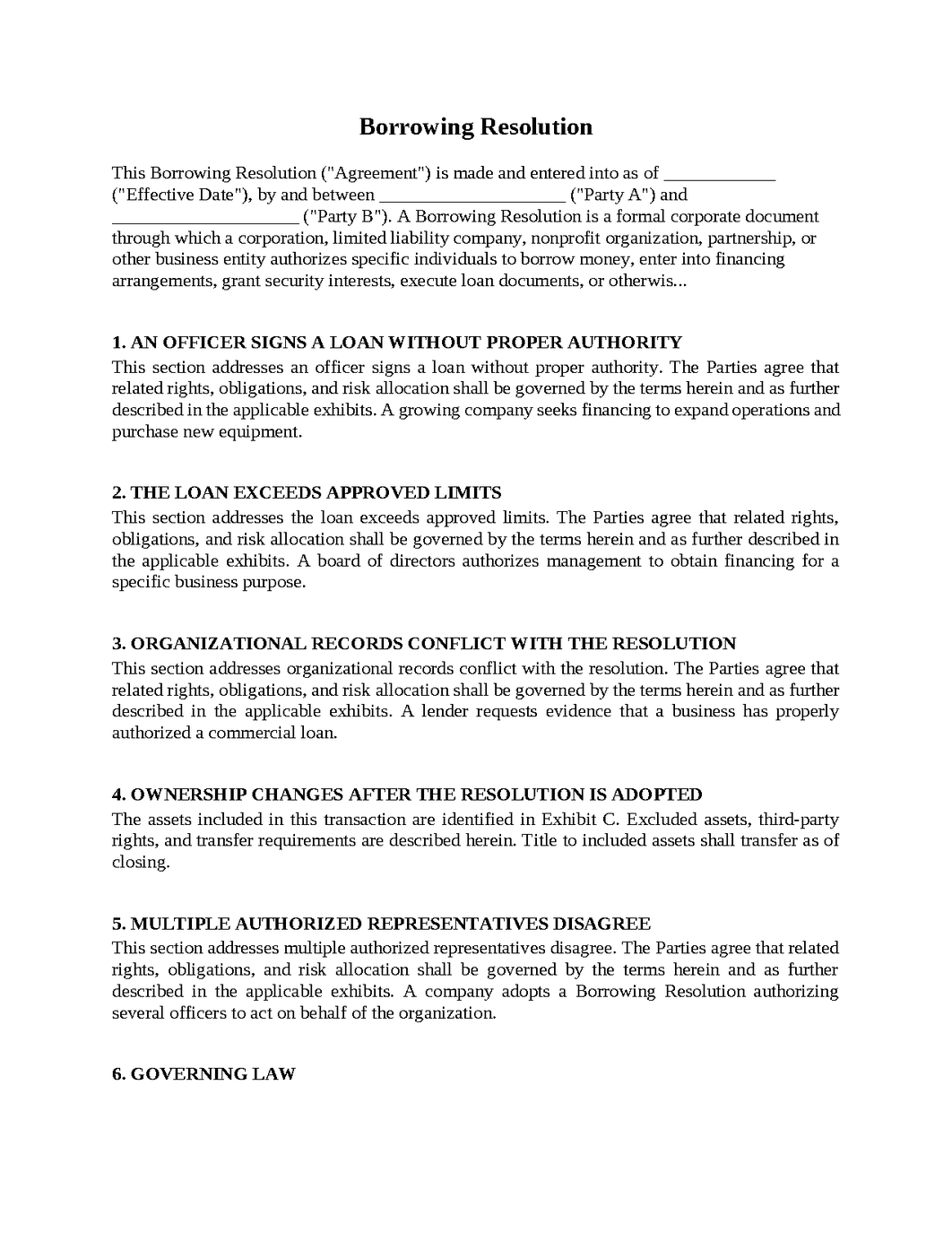
A Borrowing Resolution is a formal corporate document through which a corporation, limited liability company, nonprofit organization, partnership, or other business entity authorizes specific individuals to borrow money, enter into financing arrangements, grant security interests, execute loan documents, or otherwise incur debt on behalf of the organization. Borrowing Resolutions are commonly required by banks, credit unions, commercial lenders, equipment finance companies, government lending programs, and other financing sources before a loan transaction can proceed. Because lenders rely upon these resolutions to verify authority and because borrowing decisions can significantly affect an organization's financial condition, disputes can arise when questions emerge regarding authorization, scope of authority, or compliance with organizational governance requirements. A carefully drafted Borrowing Resolution helps establish certainty regarding who has authority to bind the organization and under what circumstances.
An Officer Signs a Loan Without Proper Authority
A growing company seeks financing to expand operations and purchase new equipment.
One executive negotiates loan terms directly with a lender and signs the financing documents believing the transaction will benefit the business. The lender relies upon the executive's apparent authority and funds the loan.
Months later, other members of management discover the financing arrangement and object to the transaction. They argue that the executive never obtained the approvals required under the company's governing documents.
The lender believes the executive had authority to act on behalf of the company. The company argues that internal approval procedures were ignored and that the borrowing was never properly authorized.
The disagreement centers on whether the loan is binding upon the organization.
To help avoid this problem, a Borrowing Resolution should clearly identify authorized representatives and establish the scope of authority granted for borrowing activities.
The Loan Exceeds Approved Limits
A board of directors authorizes management to obtain financing for a specific business purpose.
The Borrowing Resolution permits borrowing up to a stated amount and identifies the intended use of the funds. Both the lender and the company believe the authorization is sufficient.
As negotiations progress, the financing amount increases beyond the original expectations. Management executes loan documents reflecting the higher amount without obtaining an updated resolution.
After the funds are disbursed, questions arise regarding whether management exceeded the authority granted by the board. The lender believes the company accepted the financing and benefited from the proceeds.
The company argues that the authorization was limited and that additional approvals should have been obtained before the transaction closed.
The disagreement focuses on the scope of the authority originally granted.
To help prevent these issues, a Borrowing Resolution should clearly establish borrowing limits and identify any conditions requiring additional approval.
Organizational Records Conflict With the Resolution
A lender requests evidence that a business has properly authorized a commercial loan.
The company provides a Borrowing Resolution signed by individuals who appear to possess appropriate authority. Initially, the lender is satisfied and proceeds with underwriting.
Later, inconsistencies emerge between the Borrowing Resolution and the organization's governing documents, meeting minutes, or ownership records. Questions arise regarding whether the resolution was approved properly.
The lender becomes concerned about the enforceability of the transaction. The company insists that the financing was authorized appropriately despite the inconsistencies.
The disagreement shifts away from the loan itself and toward the validity of the authorization process.
To help avoid these problems, a Borrowing Resolution should be consistent with governing documents and supported by accurate organizational records.
Ownership Changes After the Resolution Is Adopted
A company adopts a Borrowing Resolution authorizing certain officers to obtain financing on behalf of the organization.
Several months later, ownership changes occur through investment transactions, stock transfers, or management restructuring. New stakeholders assume leadership positions and begin reviewing company obligations.
During the review, questions arise regarding whether the existing Borrowing Resolution remains valid following the ownership changes. The lender believes the authorization remains effective until revoked formally.
The new owners believe additional approvals should have been required before new borrowing activity occurred. Each side interprets the continuing effect of the resolution differently.
The disagreement creates uncertainty regarding future financing transactions.
To help prevent these issues, a Borrowing Resolution should clearly address duration, revocation procedures, and the effect of ownership or management changes.
Multiple Authorized Representatives Disagree
A company adopts a Borrowing Resolution authorizing several officers to act on behalf of the organization.
The resolution is intended to provide operational flexibility and allow financing opportunities to be pursued efficiently. Initially, the arrangement functions without difficulty.
Over time, disagreements emerge among the authorized representatives regarding borrowing decisions. One executive supports a proposed financing transaction while another opposes it.
The lender receives conflicting instructions from individuals who appear equally authorized under the resolution. Uncertainty develops regarding whose direction should be followed.
The dispute delays the transaction and creates confusion for all parties involved.
To help avoid these problems, a Borrowing Resolution should clearly identify decision-making procedures and specify whether authorized representatives may act independently or must act jointly.
Borrowing Resolutions are essential governance documents that provide lenders with assurance that financing transactions have been authorized properly. However, issues involving unauthorized borrowing, exceeded limits, inconsistent records, ownership changes, and competing authority claims can become significant sources of conflict when authorization procedures are not documented clearly. A carefully drafted Borrowing Resolution provides a structured framework for defining borrowing authority and protecting both lenders and organizations. When prepared thoughtfully, it can reduce uncertainty, support efficient financing transactions, strengthen corporate governance, and provide confidence for all parties involved.

Get started with Upsign today!
Easily send, sign and track your documents