

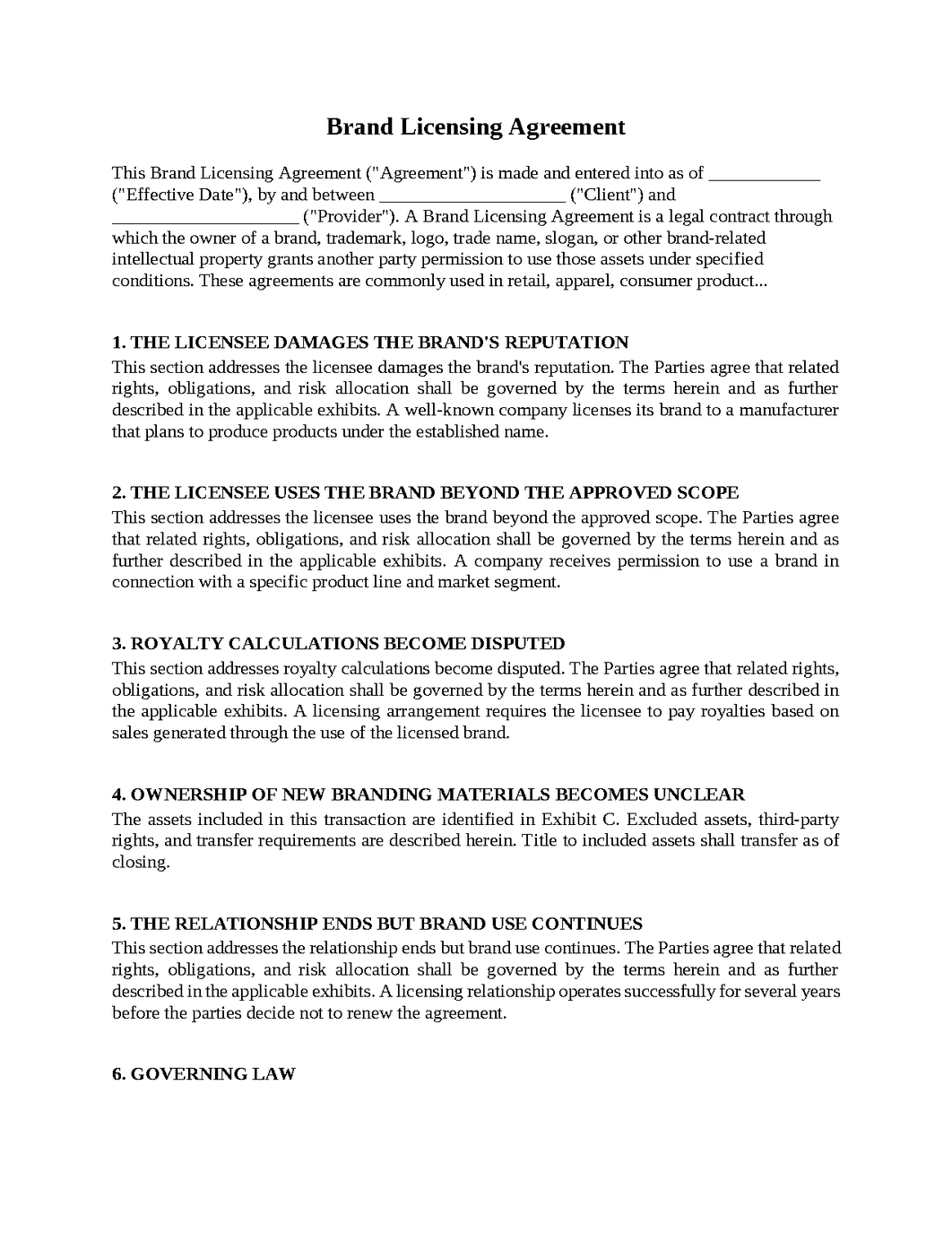
Brand Licensing Agreement
A Brand Licensing Agreement is a legal contract through which the owner of a brand, trademark, logo, trade name, slogan, or other brand-related intellectual property grants another party permission to use those assets under specified conditions. These agreements are commonly used in retail, apparel, consumer products, franchising, entertainment, sports merchandising, food and beverage industries, technology partnerships, and marketing collaborations. The purpose of a Brand Licensing Agreement is to allow the licensee to benefit from the recognition and goodwill associated with an established brand while allowing the brand owner to expand market reach and generate revenue. Because a brand's reputation is often one of its most valuable assets, disputes can arise when expectations regarding quality, usage rights, and brand protection are not documented clearly. A carefully drafted Brand Licensing Agreement helps protect both the value of the brand and the interests of the parties involved.
The Licensee Damages the Brand's Reputation
A well-known company licenses its brand to a manufacturer that plans to produce products under the established name.
Both parties expect the relationship to be beneficial. The manufacturer gains access to a recognized brand, and the brand owner gains additional revenue and market exposure.
After the products enter the market, customer complaints begin increasing. Consumers report quality concerns, poor customer service, and performance issues associated with the licensed products.
The public begins associating the problems with the brand itself rather than the manufacturer. The brand owner becomes concerned that years of goodwill are being damaged by products outside its direct control.
The manufacturer believes the products satisfy contractual requirements and argues that customer dissatisfaction is an ordinary business risk.
To help avoid this problem, a Brand Licensing Agreement should clearly establish quality standards, inspection rights, and remedies available when licensed products fail to meet brand expectations.
The Licensee Uses the Brand Beyond the Approved Scope
A company receives permission to use a brand in connection with a specific product line and market segment.
The licensing arrangement proceeds successfully, and sales exceed expectations. Encouraged by the results, the licensee begins expanding the use of the brand into additional products and promotional materials.
The brand owner eventually discovers that the brand is being used in markets and product categories that were never approved. Customers begin assuming that all of the new offerings are officially endorsed by the brand owner.
The licensee believes the expanded use is a natural extension of the original relationship. The brand owner believes the additional uses exceed the authority granted under the agreement.
The disagreement centers on where the boundaries of the license actually exist.
To help prevent these issues, a Brand Licensing Agreement should clearly define the permitted uses of the brand, including product categories, geographic markets, and approved marketing activities.
Royalty Calculations Become Disputed
A licensing arrangement requires the licensee to pay royalties based on sales generated through the use of the licensed brand.
Initially, both parties expect the royalty calculation process to be straightforward. As sales volumes increase, however, questions emerge regarding returns, discounts, bundled products, promotional pricing, and other adjustments.
The brand owner believes royalties should be calculated using a broader definition of revenue. The licensee believes certain deductions should be permitted before royalty payments are determined.
The financial impact grows as sales increase, and the parties find themselves interpreting the agreement differently.
What began as a successful licensing arrangement becomes a dispute regarding compensation.
To help avoid these problems, a Brand Licensing Agreement should clearly define royalty calculations, reporting obligations, audit rights, and acceptable deductions.
Ownership of New Branding Materials Becomes Unclear
A licensee invests substantial resources developing advertising campaigns, packaging designs, promotional materials, and product branding associated with a licensed trademark.
The marketing efforts generate strong results and significantly increase product visibility. Over time, the newly created materials become valuable assets in their own right.
Questions later arise regarding ownership of the creative materials developed during the licensing relationship. The licensee believes the investment in developing the content should create ownership rights.
The brand owner believes materials incorporating the licensed brand should remain under its control. Neither party anticipated the value these assets would eventually create.
The disagreement focuses on ownership and control of intellectual property created during the relationship.
To help prevent these issues, a Brand Licensing Agreement should clearly address ownership of derivative materials, marketing assets, and intellectual property developed during the term of the agreement.
The Relationship Ends but Brand Use Continues
A licensing relationship operates successfully for several years before the parties decide not to renew the agreement.
The brand owner expects all use of the brand to stop immediately once the agreement expires. The licensee begins winding down operations but still possesses inventory, marketing materials, packaging, and customer-facing content bearing the brand.
As time passes, the brand owner discovers that branded materials remain in circulation and that some products continue being sold. The licensee argues that a reasonable transition period is necessary to dispose of existing inventory.
The brand owner believes ongoing use undermines control over the brand. The licensee believes practical business realities require additional flexibility.
The disagreement centers on the obligations that survive termination of the licensing relationship.
To help avoid these problems, a Brand Licensing Agreement should clearly address termination procedures, inventory sell-off rights, and post-termination obligations relating to brand usage.
Brand Licensing Agreements are valuable tools for expanding market reach while leveraging the recognition and goodwill associated with established brands. However, issues involving product quality, unauthorized usage, royalty calculations, ownership of marketing materials, and post-termination brand use can become significant sources of conflict when expectations are not documented clearly. A carefully drafted Brand Licensing Agreement provides a structured framework for protecting brand value while creating commercial opportunities for both parties. When prepared thoughtfully, it can reduce uncertainty, support profitable partnerships, preserve intellectual property rights, and strengthen long-term business relationships.

Get started with Upsign today!
Easily send, sign and track your documents