

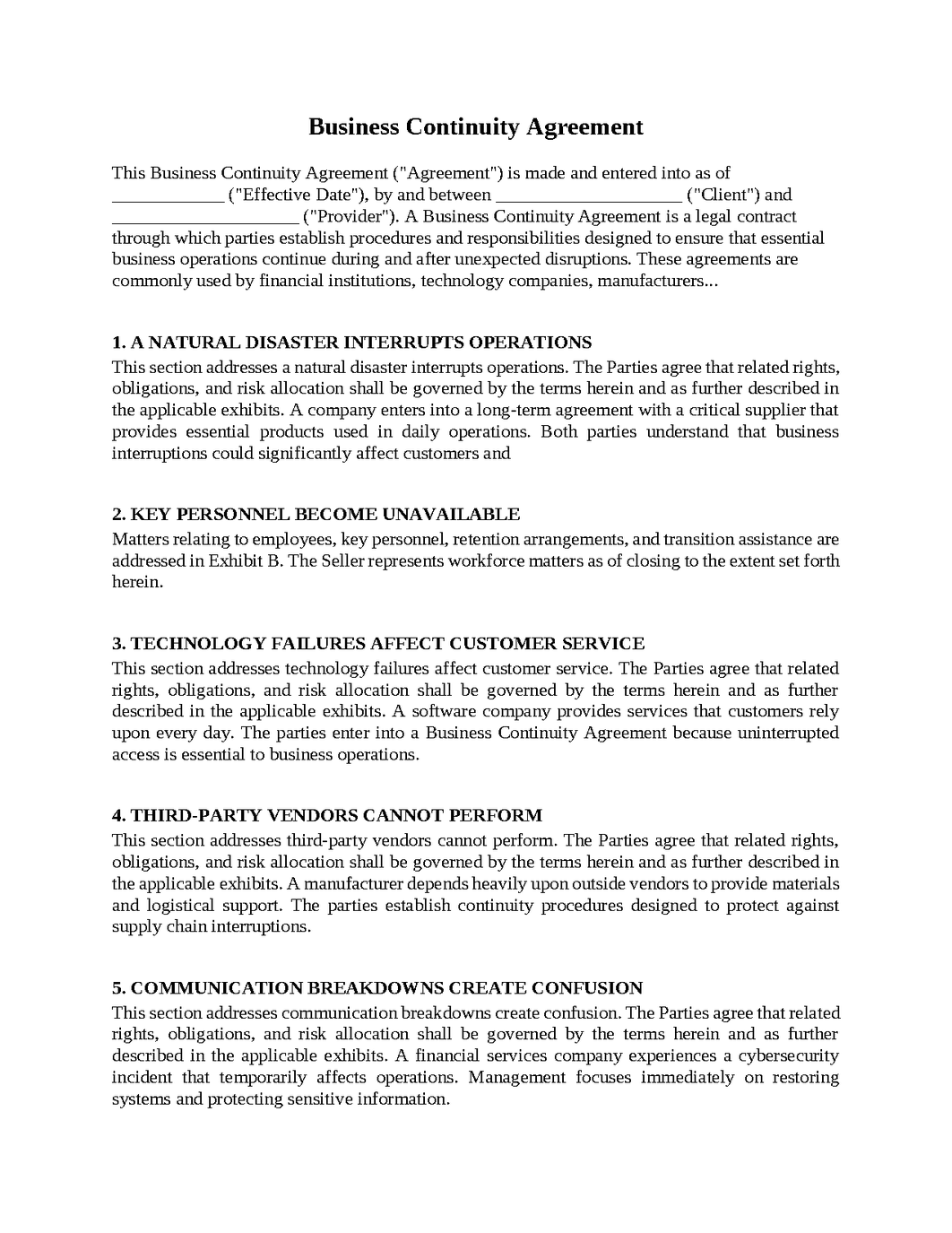
Business Continuity Agreement
A Business Continuity Agreement is a legal contract through which parties establish procedures and responsibilities designed to ensure that essential business operations continue during and after unexpected disruptions. These agreements are commonly used by financial institutions, technology companies, manufacturers, healthcare organizations, professional service firms, government contractors, and businesses that depend upon uninterrupted operations. A Business Continuity Agreement typically addresses disaster recovery procedures, backup facilities, communication protocols, data preservation, key personnel responsibilities, vendor relationships, and contingency plans for maintaining critical services. Because unexpected events can threaten operations, customers, and financial stability, disputes can arise when expectations regarding continuity obligations are not documented clearly. A carefully drafted Business Continuity Agreement helps reduce uncertainty and protect the interests of all parties involved.
A Natural Disaster Interrupts Operations
A company enters into a long-term agreement with a critical supplier that provides essential products used in daily operations. Both parties understand that business interruptions could significantly affect customers and financial performance.
For several years, operations proceed smoothly and contingency plans receive little attention. Then a severe weather event damages facilities and prevents the supplier from operating normally.
The customer expects emergency procedures to be implemented immediately and believes the supplier should continue providing products through alternate channels. The supplier argues that the disaster created circumstances beyond its control and that restoring operations will require additional time.
The disagreement centers on whether the continuity measures were adequate and whether reasonable efforts were made to minimize disruptions.
To help avoid this problem, a Business Continuity Agreement should clearly establish disaster recovery procedures and define the responsibilities of each party when unexpected events interrupt operations.
Key Personnel Become Unavailable
A growing business relies heavily on a small group of executives and technical specialists who possess unique knowledge essential to operations. Everyone assumes these individuals will remain available when needed.
Unexpected illnesses and retirements create staffing challenges that affect critical systems and customer relationships. Projects begin falling behind and operational problems become increasingly difficult to manage.
The company's clients believe adequate succession planning should have been implemented. Management argues that certain losses of personnel were impossible to anticipate and that replacement efforts are already underway.
The disagreement develops because customers expected continuity while the company struggles to maintain expertise and leadership.
To help prevent these issues, a Business Continuity Agreement should address succession planning, knowledge transfer, and procedures for replacing key personnel.
Technology Failures Affect Customer Service
A software company provides services that customers rely upon every day. The parties enter into a Business Continuity Agreement because uninterrupted access is essential to business operations.
Initially, the technology performs reliably and backup systems receive little attention. Eventually, a major system failure causes outages that prevent customers from accessing critical information.
Customers believe the company should have maintained stronger backup capabilities and faster recovery procedures. The company argues that extraordinary technical failures occasionally occur despite reasonable safeguards.
The disagreement focuses on how quickly services should be restored and whether the provider met its continuity obligations.
To help avoid these problems, a Business Continuity Agreement should clearly establish recovery objectives, backup requirements, and communication procedures following technology disruptions.
Third-Party Vendors Cannot Perform
A manufacturer depends heavily upon outside vendors to provide materials and logistical support. The parties establish continuity procedures designed to protect against supply chain interruptions.
When one of the vendors experiences financial difficulties, deliveries begin slowing and production schedules are disrupted. Customers become concerned because orders are delayed and inventory shortages begin affecting operations.
The manufacturer believes alternative suppliers should have been identified before problems developed. The vendor argues that market conditions created challenges that no one could reasonably predict.
The disagreement centers on whether sufficient contingency planning existed to address disruptions involving third-party relationships.
To help prevent these problems, a Business Continuity Agreement should clearly address vendor dependencies and establish alternative sourcing procedures for critical services and materials.
Communication Breakdowns Create Confusion
A financial services company experiences a cybersecurity incident that temporarily affects operations. Management focuses immediately on restoring systems and protecting sensitive information.
Customers and business partners expect timely updates regarding the nature of the disruption and the anticipated timeline for recovery. However, inconsistent communications begin creating confusion and uncertainty.
Some customers believe important information was withheld and that communication procedures were inadequate. The company believes restoring operations deserved priority and that updates were provided as circumstances evolved.
The disagreement shifts from the underlying disruption to the effectiveness of communication during the crisis.
To help avoid these problems, a Business Continuity Agreement should clearly establish notification procedures and identify how information will be communicated during emergencies.
Business Continuity Agreements are important tools for helping organizations prepare for unexpected disruptions and preserve essential operations. However, issues involving natural disasters, key personnel, technology failures, vendor interruptions, and communication breakdowns can become significant sources of conflict when expectations are not documented clearly. A carefully drafted Business Continuity Agreement provides a structured framework for defining responsibilities and protecting critical relationships during times of uncertainty. When prepared thoughtfully, it can reduce operational risks, support customer confidence, preserve business stability, and provide the resilience necessary for organizations to continue operating successfully in the face of unexpected challenges.

Get started with Upsign today!
Easily send, sign and track your documents