

Business Venture Agreement
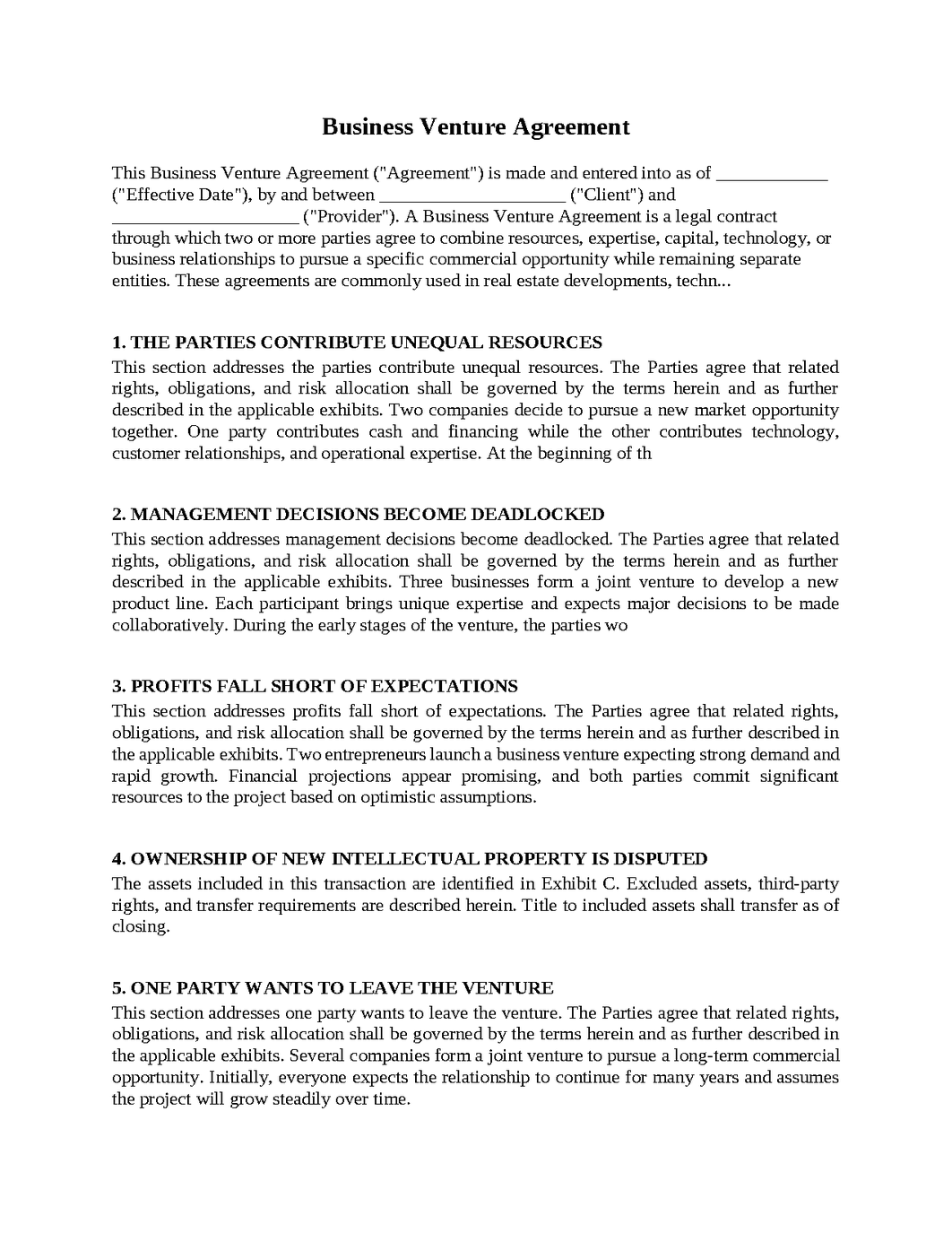
A Business Venture Agreement is a legal contract through which two or more parties agree to combine resources, expertise, capital, technology, or business relationships to pursue a specific commercial opportunity while remaining separate entities. These agreements are commonly used in real estate developments, technology projects, manufacturing partnerships, international expansions, product launches, research initiatives, and strategic collaborations. A Business Venture Agreement typically addresses ownership interests, capital contributions, management responsibilities, profit-sharing arrangements, decision-making authority, intellectual property rights, and procedures for ending the venture. Because joint ventures often involve significant investments and different expectations among the participants, disputes can arise when the parties fail to define their responsibilities and objectives clearly. A carefully drafted Business Venture Agreement helps allocate risk and establish a framework for cooperation throughout the life of the project.
The Parties Contribute Unequal Resources
Two companies decide to pursue a new market opportunity together. One party contributes cash and financing while the other contributes technology, customer relationships, and operational expertise. At the beginning of the relationship, both parties believe their respective contributions provide a fair balance and expect the venture to benefit everyone involved.
As the project develops, one company begins devoting significantly more personnel, time, and financial resources than originally anticipated. Unexpected challenges require additional investments, and the parties start reevaluating whether the original arrangement still reflects the realities of the venture.
The company contributing additional resources believes it should receive a greater share of profits or decision-making authority. The other party argues that the original bargain should remain in place because both sides accepted risks at the outset. Tensions increase as each side develops different views regarding fairness and value, making future decisions increasingly difficult.
To help avoid this problem, a Business Venture Agreement should clearly define contributions, ownership interests, and procedures for addressing circumstances in which one party contributes substantially more resources than originally anticipated.
Management Decisions Become Deadlocked
Three businesses form a joint venture to develop a new product line. Each participant brings unique expertise and expects major decisions to be made collaboratively. During the early stages of the venture, the parties work together effectively and enjoy a productive relationship.
As the business grows, disagreements emerge regarding expansion plans, hiring decisions, pricing strategies, and additional capital investments. Each participant believes its approach will maximize the success of the venture.
One group favors rapid growth while another prefers a more conservative strategy. Because no clear mechanism exists for breaking ties, important decisions are delayed and operational opportunities begin slipping away. Frustration grows among the parties, and the inability to reach consensus begins affecting employee morale and customer relationships.
To help prevent these issues, a Business Venture Agreement should clearly establish voting procedures and provide mechanisms for resolving deadlocks involving major business decisions.
Profits Fall Short of Expectations
Two entrepreneurs launch a business venture expecting strong demand and rapid growth. Financial projections appear promising, and both parties commit significant resources to the project based on optimistic assumptions.
After operations begin, sales grow more slowly than anticipated and expenses exceed original budgets. Revenue falls short of expectations, and the venture struggles to achieve profitability.
One party believes additional investments are necessary to preserve the opportunity, while the other becomes reluctant to commit more resources to a project that is underperforming. Disagreements arise regarding whether losses should be shared equally and whether the venture should continue operating. The relationship becomes strained as financial pressures increase and confidence in the project begins declining.
To help avoid this problem, a Business Venture Agreement should clearly address loss allocations, capital calls, and procedures for handling situations in which the venture performs below expectations.
Ownership of New Intellectual Property Is Disputed
A software company and a marketing firm enter into a business venture to develop a new digital platform. Both organizations contribute valuable resources and expect the project to create long-term opportunities for everyone involved.
As the venture succeeds, new software, branding materials, and proprietary processes are created. The value of these assets exceeds anyone's expectations and becomes one of the venture's most important resources.
The software company believes ownership should follow technological contributions, while the marketing firm argues that its branding efforts and customer relationships played an equally important role in creating the platform's value. Disagreements begin emerging regarding licensing rights, future development, and ownership of the intellectual property after the venture ends. The growing success of the project makes resolving these questions increasingly important.
To help prevent these problems, a Business Venture Agreement should clearly define ownership rights and establish procedures governing intellectual property created during the relationship.
One Party Wants to Leave the Venture
Several companies form a joint venture to pursue a long-term commercial opportunity. Initially, everyone expects the relationship to continue for many years and assumes the project will grow steadily over time.
After a few years, one participant decides to focus on other priorities and no longer wishes to remain involved. The remaining parties want the venture to continue but are uncertain about how the departing party's interest should be valued and transferred.
The departing participant expects to receive fair compensation for its ownership interest, while the remaining members are concerned about preserving the financial stability of the venture. Different opinions emerge regarding valuation, payment schedules, and whether outside investors should be permitted to acquire the interest. As negotiations become more complicated, the future of the venture itself becomes uncertain.
To help avoid this problem, a Business Venture Agreement should clearly establish withdrawal rights, valuation procedures, and mechanisms for transferring ownership interests when a participant decides to leave.
Business Venture Agreements are important tools for allowing businesses to pursue opportunities that might be difficult or impossible to achieve independently. However, issues involving unequal contributions, management disputes, financial performance, intellectual property ownership, and partner departures can become significant sources of conflict when expectations are not documented clearly. A carefully drafted Business Venture Agreement provides a structured framework for allocating responsibilities and preserving cooperation among the participants. When prepared thoughtfully, it can reduce uncertainty, strengthen strategic relationships, encourage innovation, and provide the stability necessary for a successful and profitable venture.

Get started with Upsign today!
Easily send, sign and track your documents