

Deferred Payment Agreement
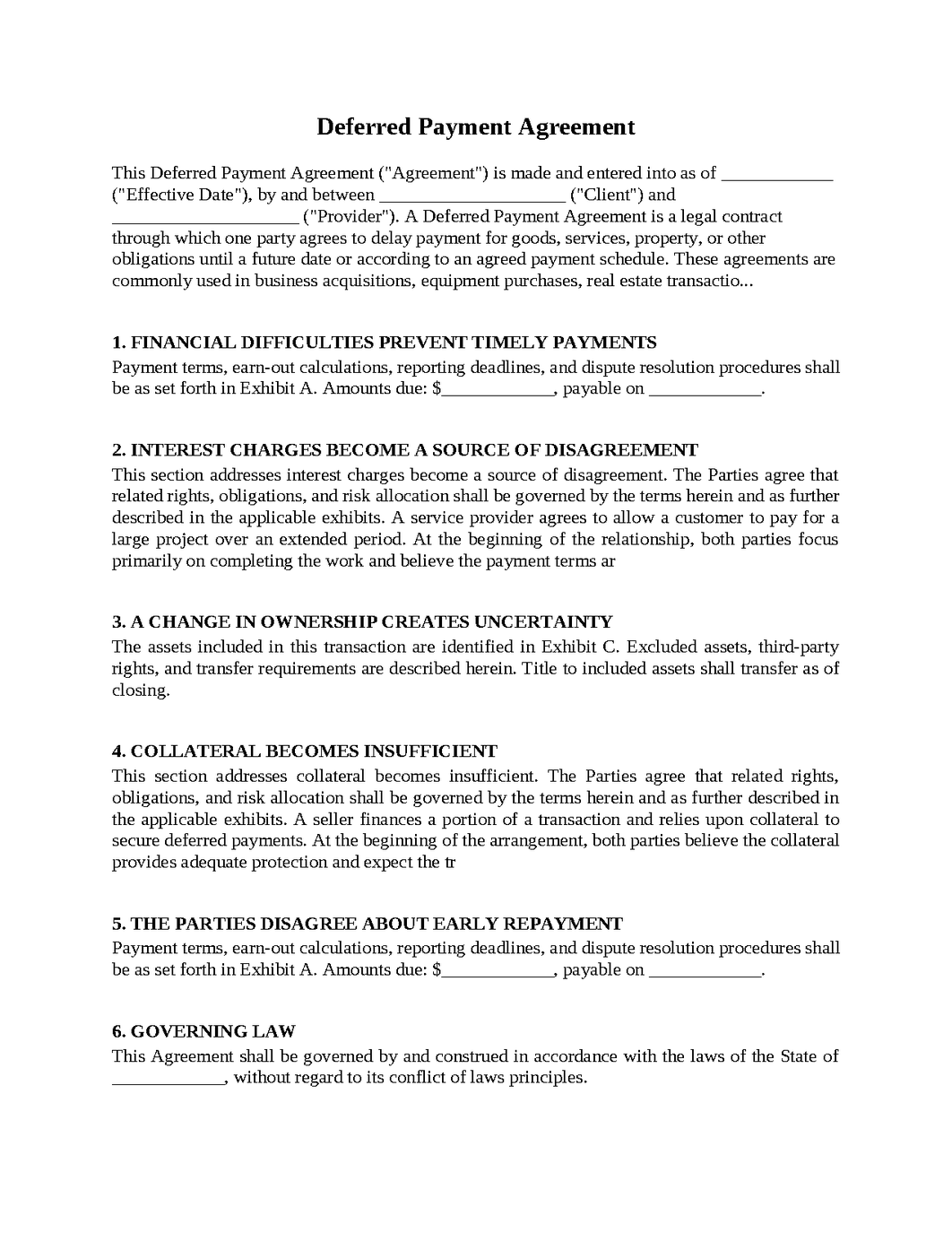
A Deferred Payment Agreement is a legal contract through which one party agrees to delay payment for goods, services, property, or other obligations until a future date or according to an agreed payment schedule. These agreements are commonly used in business acquisitions, equipment purchases, real estate transactions, consulting arrangements, construction projects, vendor relationships, and commercial financing transactions. A Deferred Payment Agreement typically addresses the amount owed, payment deadlines, interest provisions, default remedies, collateral requirements, and the consequences that apply if payments are not made as agreed. Because deferred payment arrangements often involve long periods of performance and changing financial circumstances, disputes can arise when expectations regarding repayment obligations are not documented clearly. A carefully drafted Deferred Payment Agreement helps establish certainty and protect the interests of both parties while facilitating transactions that might not otherwise occur.
Financial Difficulties Prevent Timely Payments
A company purchases specialized equipment from a supplier and negotiates a Deferred Payment Agreement to preserve cash flow during a period of expansion. Both parties believe the arrangement will allow the buyer to grow operations while providing the seller with a predictable stream of payments.
During the first several months, payments are made on time and the relationship remains positive. Unexpected market conditions eventually reduce revenue, causing cash flow problems that make it difficult for the buyer to satisfy future obligations according to the original schedule.
The seller believes the payment deadlines should be enforced because the equipment has already been delivered and the risks associated with delayed payment were accepted at the outset. The buyer believes temporary financial setbacks should justify additional flexibility and argues that preserving the business benefits both sides. As tensions increase, both parties begin disagreeing about the appropriate remedies and whether the payment schedule should be modified.
To help avoid this problem, a Deferred Payment Agreement should clearly establish payment obligations and define the remedies available if financial difficulties prevent timely performance.
Interest Charges Become a Source of Disagreement
A service provider agrees to allow a customer to pay for a large project over an extended period. At the beginning of the relationship, both parties focus primarily on completing the work and believe the payment terms are straightforward.
As payments continue over time, questions emerge regarding accrued interest, late charges, and the method used to calculate outstanding balances. The customer becomes concerned that the total amount being paid exceeds what was originally expected.
The service provider believes the charges are consistent with the agreement and necessary to compensate for the risks associated with delayed payment. The customer believes certain fees and calculations are excessive and argues that important details were never fully explained. As the remaining balance grows, frustrations increase and both parties begin interpreting the agreement differently.
To help prevent these issues, a Deferred Payment Agreement should clearly explain interest calculations, late fees, and the methodology used to determine the amount owed over time.
A Change in Ownership Creates Uncertainty
A business sells a portion of its operations and agrees to accept deferred payments from the buyer over several years. Both parties expect the arrangement to provide flexibility and believe the relationship will continue according to the agreed schedule.
Several years later, the buyer sells the business to a third party. Questions quickly arise regarding who remains responsible for the unpaid balance and whether the original obligations continue after the ownership transition.
The seller believes the original buyer should remain liable unless a formal release is granted. The buyer believes the obligations transferred with the business and expects the new owner to assume responsibility. As ownership changes and new parties become involved, uncertainty grows regarding who is legally responsible for future payments.
To help avoid these problems, a Deferred Payment Agreement should clearly address assignment rights and establish whether obligations may be transferred without the consent of the other party.
Collateral Becomes Insufficient
A seller finances a portion of a transaction and relies upon collateral to secure deferred payments. At the beginning of the arrangement, both parties believe the collateral provides adequate protection and expect the transaction to proceed without difficulty.
Over time, market conditions change and the value of the collateral declines significantly. The seller becomes concerned that the remaining security may not be sufficient to cover the unpaid balance if the buyer defaults.
The seller believes additional protections are necessary to preserve the original bargain. The buyer believes the changing value of the collateral is a normal business risk and argues that no additional obligations should be imposed. As concerns about repayment increase, the relationship becomes increasingly strained and negotiations become more difficult.
To help prevent these issues, a Deferred PaymentAgreement should clearly address collateral requirements and establish procedures for handling situations in which the value of security changes over time.
The Parties Disagree About Early Repayment
A commercial borrower enters into a Deferred Payment Agreement that spreads obligations over several years. Both parties assume the schedule will remain in place and make financial decisions based upon that expectation.
Unexpected success allows the borrower to consider paying the balance earlier than originally anticipated. Although the borrower views early repayment as beneficial, questions arise regarding prepayment penalties, interest calculations, and whether early satisfaction is permitted under the agreement.
The borrower believes paying the balance sooner should reduce future costs and eliminate uncertainty. The lender believes the payment schedule represented part of the economic value of the arrangement and expects to receive the benefits originally contemplated. As discussions continue, both sides realize they have different assumptions regarding the consequences of accelerated repayment.
To help avoid this problem, a Deferred Payment Agreement should clearly establish whether prepayment is permitted and explain how interest and other charges will be treated if obligations are satisfied early.
Deferred Payment Agreements are valuable tools that provide flexibility and facilitate transactions when immediate payment is impractical. However, issues involving financial hardship, interest calculations, ownership changes, collateral values, and early repayment can become significant sources of conflict when expectations are not documented clearly. A carefully drafted Deferred Payment Agreement provides a structured framework for allocating risks and defining responsibilities over time. When prepared thoughtfully, it can reduce uncertainty, preserve commercial relationships, support growth opportunities, and provide the confidence necessary for parties to enter into transactions involving delayed payment obligations.

Get started with Upsign today!
Easily send, sign and track your documents