

Dormant Commerce Agreement
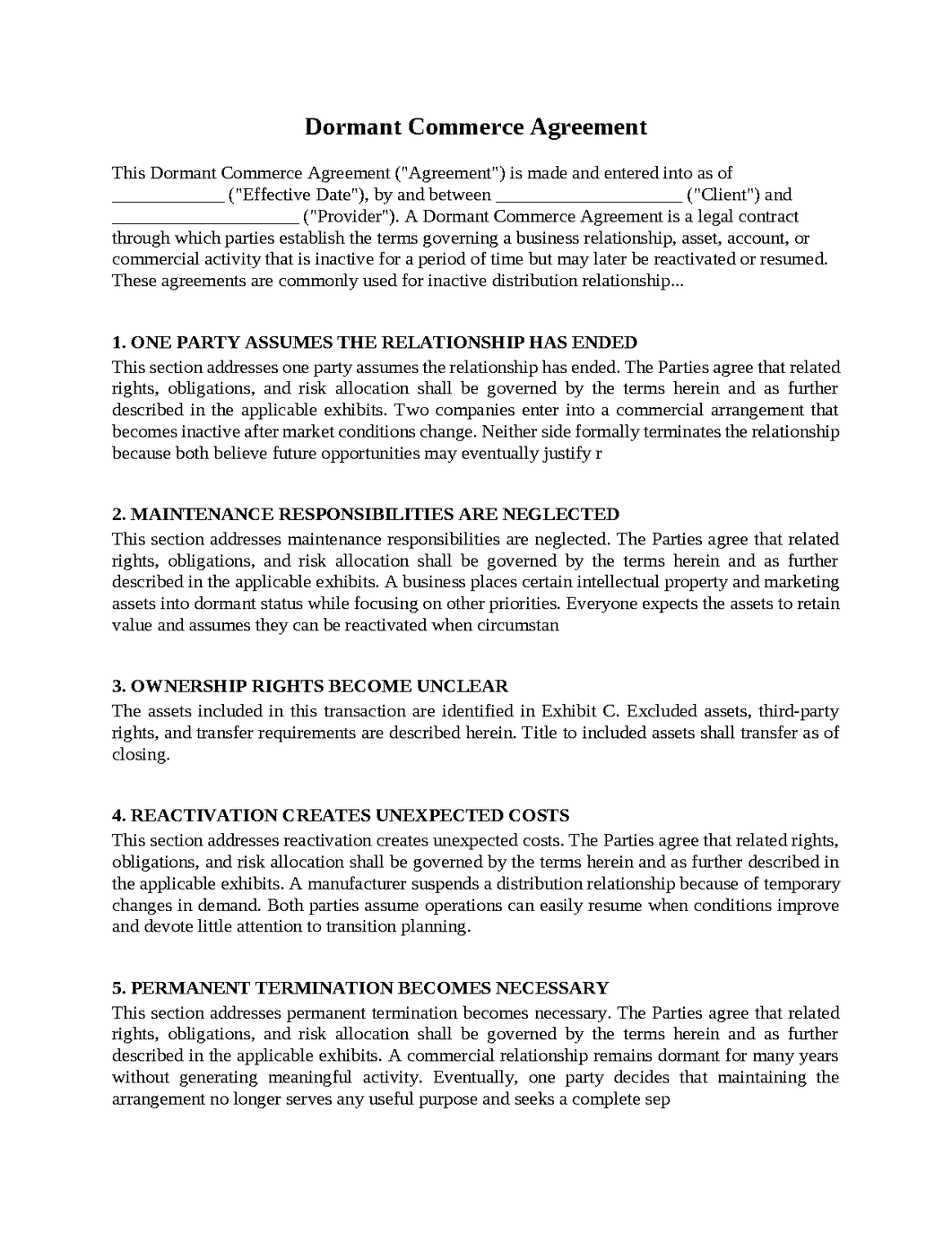
A Dormant Commerce Agreement is a legal contract through which parties establish the terms governing a business relationship, asset, account, or commercial activity that is inactive for a period of time but may later be reactivated or resumed. These agreements are commonly used for inactive distribution relationships, dormant joint ventures, intellectual property arrangements, suspended operations, and accounts that remain open despite little or no current activity. A Dormant Commerce Agreement typically addresses maintenance obligations, ownership rights, fees, notice requirements, reactivation procedures, and the circumstances under which the relationship may be terminated permanently. Because inactive arrangements often receive little attention over time, disputes can arise when expectations regarding future rights and responsibilities are not documented clearly. A carefully drafted Dormant Commerce Agreement helps establish certainty and preserve flexibility while protecting the interests of all parties involved.
One Party Assumes the Relationship Has Ended
Two companies enter into a commercial arrangement that becomes inactive after market conditions change. Neither side formally terminates the relationship because both believe future opportunities may eventually justify resuming operations.
Years pass with very little communication between the parties. Personnel changes occur, records become difficult to locate, and memories regarding the original arrangement begin fading. Eventually, market conditions improve and one party attempts to revive the relationship.
The party seeking reactivation believes the original agreement remains effective because no formal termination ever occurred. The other party believes the years of inactivity effectively ended the arrangement and assumes no continuing obligations exist. As discussions become more complicated, both sides realize they have very different expectations regarding whether the relationship survived.
To help avoid this problem, a Dormant Commerce Agreement should clearly establish the conditions under which inactivity affects the status of the relationship and define whether rights survive extended periods of nonuse.
Maintenance Responsibilities Are Neglected
A business places certain intellectual property and marketing assets into dormant status while focusing on other priorities. Everyone expects the assets to retain value and assumes they can be reactivated when circumstances improve.
As time passes, domain registrations lapse, licenses expire, and important records become outdated. By the time interest returns, restoring the assets requires significantly more effort and expense than originally anticipated.
One party believes the other was responsible for maintaining registrations and preserving important rights. The other party argues that the costs of maintaining inactive assets were never clearly assigned. As opportunities are lost and expenses increase, disagreements emerge regarding who should bear responsibility for the deterioration.
To help prevent these issues, a Dormant Commerce Agreement should clearly establish maintenance obligations and identify the party responsible for preserving valuable assets during periods of inactivity.
Ownership Rights Become Unclear
Several investors create a joint venture that eventually becomes inactive after economic conditions shift. Although active operations cease, no formal dissolution occurs because the owners hope to restart the business in the future.
Over the years, ownership interests change and new ventures emerge involving some of the same concepts and resources. Questions arise regarding who retains rights to customer relationships, trademarks, and intellectual property originally associated with the dormant venture.
Some owners believe the assets remain part of the inactive business and should only be used through mutual agreement. Others believe years of inactivity effectively abandoned the rights and permit individual owners to pursue new opportunities independently. As commercial value increases, disagreements become increasingly difficult to resolve.
To help avoid these problems, a Dormant Commerce Agreement should clearly establish ownership rights and explain how assets will be treated during prolonged periods of inactivity.
Reactivation Creates Unexpected Costs
A manufacturer suspends a distribution relationship because of temporary changes in demand. Both parties assume operations can easily resume when conditions improve and devote little attention to transition planning.
Several years later, renewed demand creates an opportunity to reactivate the arrangement. Unfortunately, technology systems, inventory procedures, and regulatory requirements have changed significantly since the relationship was originally established.
The manufacturer believes the distributor should absorb the costs associated with restarting operations because both parties stand to benefit from renewed business. The distributor believes the manufacturer should bear those expenses because it initiated the reactivation. As negotiations continue, disagreements emerge regarding how the financial burdens should be allocated.
To help prevent these issues, a Dormant Commerce Agreement should clearly establish reactivation procedures and define how expenses associated with restarting operations will be handled.
Permanent Termination Becomes Necessary
A commercial relationship remains dormant for many years without generating meaningful activity. Eventually, one party decides that maintaining the arrangement no longer serves any useful purpose and seeks a complete separation.
Although both sides initially expect the process to be straightforward, questions arise regarding records, intellectual property, surviving obligations, and potential claims that may still exist. The absence of recent communication makes resolving these issues more difficult than anyone expected.
One party believes all obligations should end immediately because the relationship has been inactive for so long. The other party believes certain rights and protections should continue even after formal termination. As discussions become more complex, both sides realize that years of inactivity did not eliminate the need for a clear exit strategy.
To help avoid this problem, a Dormant Commerce Agreement should clearly establish termination procedures and identify the obligations that survive after the relationship permanently ends.
Dormant Commerce Agreements are valuable tools that allow parties to preserve flexibility while maintaining important commercial relationships during periods of inactivity. However, issues involving assumptions about termination, neglected maintenance obligations, ownership disputes, reactivation costs, and permanent separation can become significant sources of conflict when expectations are not documented clearly. A carefully drafted Dormant Commerce Agreement provides a structured framework for protecting valuable rights and defining responsibilities over long periods of time. When prepared thoughtfully, it can reduce uncertainty, preserve opportunities, strengthen relationships, and provide the foundation necessary for managing inactive commercial arrangements effectively.

Get started with Upsign today!
Easily send, sign and track your documents