

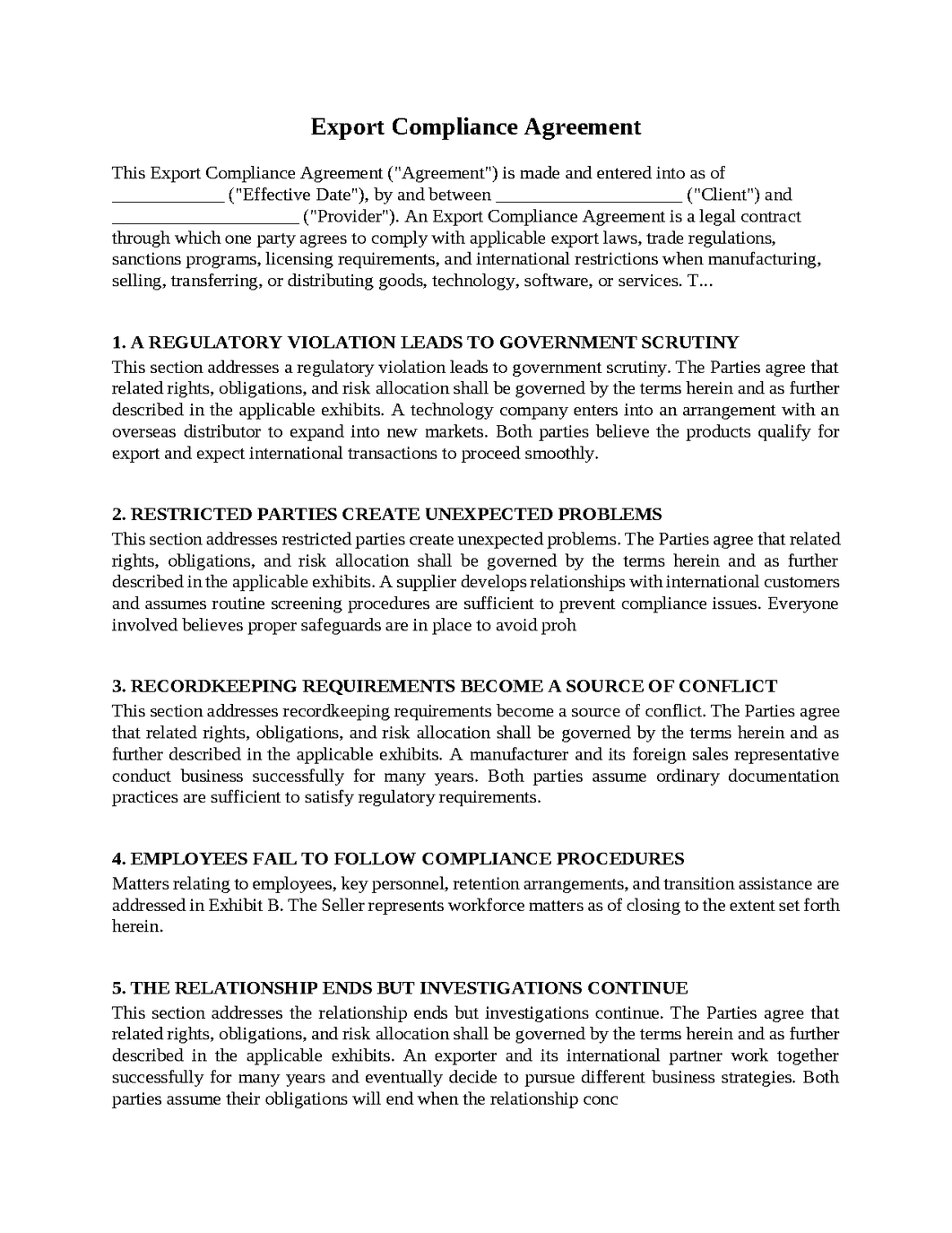
Export Compliance Agreement
An Export Compliance Agreement is a legal contract through which one party agrees to comply with applicable export laws, trade regulations, sanctions programs, licensing requirements, and international restrictions when manufacturing, selling, transferring, or distributing goods, technology, software, or services. These agreements are commonly used by manufacturers, defense contractors, software companies, logistics providers, distributors, and businesses engaged in international trade. An Export Compliance Agreement typically addresses regulatory responsibilities, licensing requirements, recordkeeping obligations, restricted-party screening, reporting requirements, and procedures governing violations or investigations. Because international trade laws are complex and violations can result in severe penalties, disputes can arise when expectations regarding compliance responsibilities are not documented clearly. A carefully drafted Export Compliance Agreement helps establish certainty and protect the interests of all parties involved.
A Regulatory Violation Leads to Government Scrutiny
A technology company enters into an arrangement with an overseas distributor to expand into new markets. Both parties believe the products qualify for export and expect international transactions to proceed smoothly.
As sales increase, regulators begin investigating whether certain shipments required licenses that were never obtained. Questions emerge regarding who was responsible for reviewing export classifications and securing approvals.
The manufacturer believes the distributor should have understood local requirements and notified the company of any restrictions. The distributor believes export licensing obligations rested primarily with the manufacturer and argues that it relied upon the information provided. As investigations continue, both parties become increasingly concerned about penalties and reputational harm.
To help avoid this problem, an Export Compliance Agreement should clearly establish regulatory responsibilities and define which party is responsible for obtaining necessary approvals and licenses.
Restricted Parties Create Unexpected Problems
A supplier develops relationships with international customers and assumes routine screening procedures are sufficient to prevent compliance issues. Everyone involved believes proper safeguards are in place to avoid prohibited transactions.
Several years later, authorities discover that one of the customers has connections to a sanctioned organization. Deliveries are suspended and questions arise regarding whether adequate due diligence was performed before the transactions occurred.
The supplier believes the distributor should have conducted more extensive reviews because it maintained direct contact with the customer. The distributor believes screening responsibilities belonged to the supplier because it controlled the products and shipping decisions. As concerns about legal exposure increase, tensions emerge regarding who failed to fulfill their obligations.
To help prevent these issues, an Export Compliance Agreement should clearly establish screening requirements and define the procedures used to identify restricted parties and prohibited transactions.
Recordkeeping Requirements Become a Source of Conflict
A manufacturer and its foreign sales representative conduct business successfully for many years. Both parties assume ordinary documentation practices are sufficient to satisfy regulatory requirements.
Following a government audit, officials request records concerning exports completed several years earlier. Certain documents cannot be located, and questions arise regarding who was responsible for preserving the information.
The manufacturer believes the representative should have retained records relating to customer communications and transaction details. The representative believes document retention responsibilities primarily belonged to the manufacturer because it controlled shipping and invoicing. As the audit expands, disagreements develop regarding compliance procedures and liability.
To help avoid these problems, an Export Compliance Agreement should clearly establish recordkeeping obligations and define how documentation will be maintained and shared.
Employees Fail to Follow Compliance Procedures
A defense contractor establishes relationships with international partners and implements policies intended to ensure compliance with export regulations. Everyone involved expects employees to follow those procedures consistently.
Over time, certain personnel begin bypassing internal controls to accelerate shipments and improve customer satisfaction. Eventually, management discovers that transactions occurred without the reviews required by company policies.
The contractor believes the partner should have reinforced compliance procedures and monitored employees more closely. The partner believes the contractor's training and oversight were inadequate and argues that individual misconduct caused the problem. As corrective actions become necessary, tensions arise regarding accountability.
To help prevent these issues, an Export Compliance Agreement should clearly establish training requirements and define the responsibilities associated with internal compliance programs.
The Relationship Ends but Investigations Continue
An exporter and its international partner work together successfully for many years and eventually decide to pursue different business strategies. Both parties assume their obligations will end when the relationship concludes.
Several months after termination, government agencies begin investigating transactions completed during the course of the relationship. Requests for records and explanations create new concerns regarding cooperation and legal responsibilities.
One party believes the other should assume responsibility because the questioned transactions were handled under its supervision. The other party believes compliance obligations were shared and expects continued assistance in responding to regulators. As legal costs increase, disagreements emerge regarding the obligations that survive termination.
To help avoid this problem, an Export Compliance Agreement should clearly establish post-termination obligations and identify the responsibilities that continue after the business relationship ends.
Export Compliance Agreements are valuable tools that help businesses navigate the complexities of international trade while reducing regulatory risks. However, issues involving licensing requirements, restricted parties, recordkeeping failures, employee misconduct, and post-termination investigations can become significant sources of conflict when expectations are not documented clearly. A carefully drafted Export Compliance Agreement provides a structured framework for allocating responsibilities and protecting the interests of everyone involved. When prepared thoughtfully, it can reduce uncertainty, strengthen compliance programs, preserve commercial relationships, and provide the foundation necessary for successful international operations.

Get started with Upsign today!
Easily send, sign and track your documents