

Family Partnership Agreement
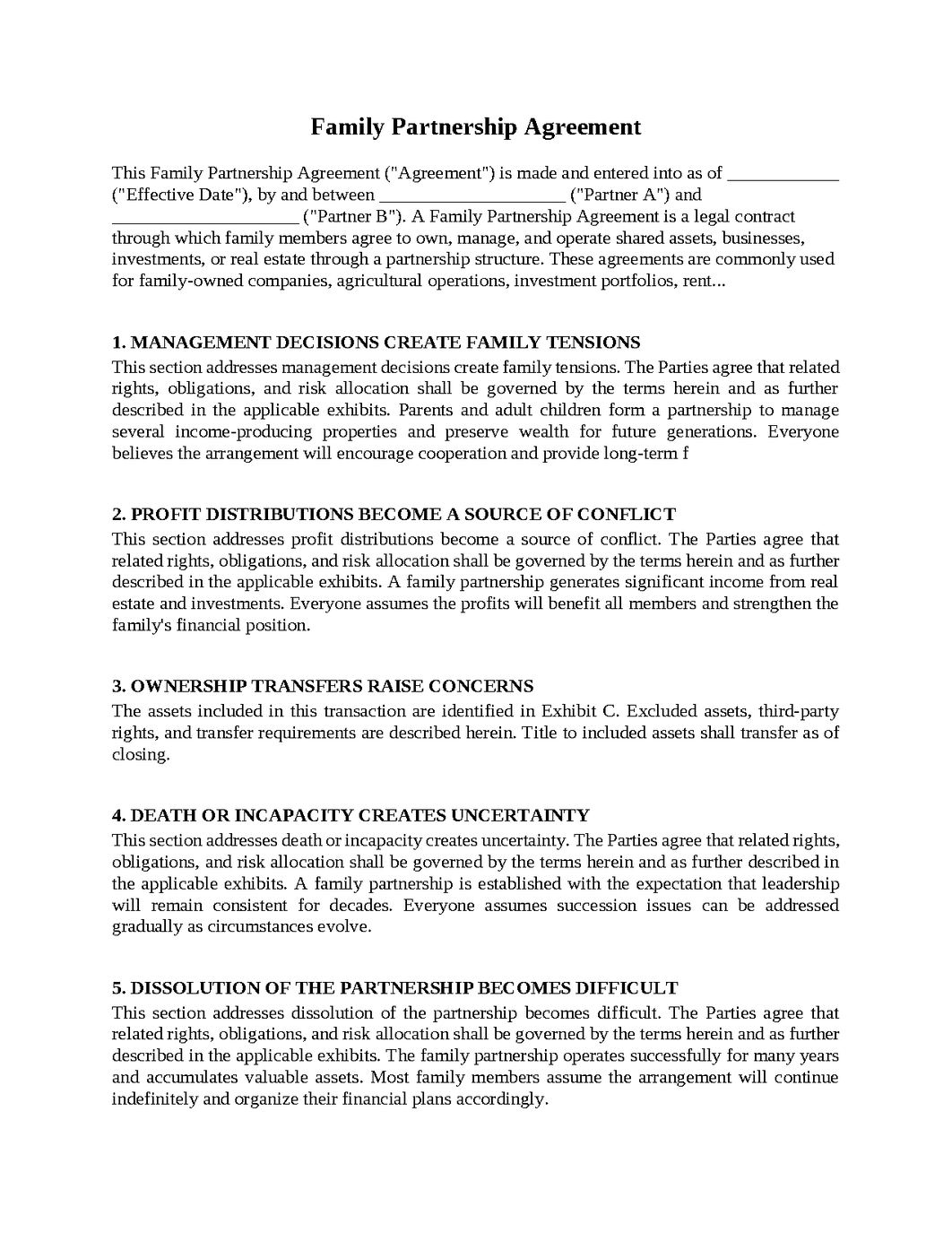
A Family Partnership Agreement is a legal contract through which family members agree to own, manage, and operate shared assets, businesses, investments, or real estate through a partnership structure. These agreements are commonly used for family-owned companies, agricultural operations, investment portfolios, rental properties, and multigenerational wealth planning. A Family Partnership Agreement typically addresses ownership interests, management authority, profit distributions, transfer restrictions, succession planning, and procedures governing disputes and dissolution. Because these arrangements combine financial interests with family relationships, disputes can arise when expectations regarding authority and responsibilities are not documented clearly. A carefully drafted Family Partnership Agreement helps establish certainty and protect the interests of all family members.
Management Decisions Create Family Tensions
Parents and adult children form a partnership to manage several income-producing properties and preserve wealth for future generations. Everyone believes the arrangement will encourage cooperation and provide long-term financial stability.
For many years, decisions are made collaboratively and the properties perform well. Over time, however, family members develop different opinions regarding investments, renovations, and expansion opportunities.
Some partners believe the business should continue operating conservatively to preserve assets and avoid unnecessary risks. Others believe growth opportunities justify additional investments and borrowing. As disagreements become more frequent, personal relationships begin affecting business decisions and tensions spread throughout the family.
To help avoid this problem, a Family Partnership Agreement should clearly establish management authority and define the procedures used to make important decisions.
Profit Distributions Become a Source of Conflict
A family partnership generates significant income from real estate and investments. Everyone assumes the profits will benefit all members and strengthen the family's financial position.
As individual financial circumstances change, certain partners begin depending on distributions to support personal expenses while others prefer retaining profits to expand the business. Different priorities create competing expectations regarding how earnings should be used.
Some partners believe regular distributions are appropriate because the assets produce reliable cash flow. Others believe preserving capital and reinvesting profits will create greater long-term value for future generations. As economic pressures increase, disagreements emerge regarding the timing and amount of distributions.
To help prevent these issues, a Family Partnership Agreement should clearly establish distribution policies and define how profits and losses will be allocated among partners.
Ownership Transfers Raise Concerns
A successful family business is operated through a partnership and ownership interests are gradually transferred to younger generations. Everyone believes the structure will simplify succession planning and preserve family control.
Several years later, one partner experiences financial difficulties and wishes to sell an ownership interest. Other family members become concerned that outsiders could gain influence over the business and disrupt longstanding relationships.
The partner seeking liquidity believes ownership rights should include the ability to transfer interests when circumstances require. The remaining partners believe protecting family control is essential and argue that restrictions are necessary to preserve stability. As personal needs evolve, tensions develop regarding who may acquire ownership interests.
To help avoid these problems, a Family Partnership Agreement should clearly establish transfer restrictions and define the procedures governing the sale or assignment of partnership interests.
Death or Incapacity Creates Uncertainty
A family partnership is established with the expectation that leadership will remain consistent for decades. Everyone assumes succession issues can be addressed gradually as circumstances evolve.
Unexpected health problems eventually affect one of the managing partners. Important decisions become more complicated and questions arise regarding who should assume responsibility for operations.
Certain family members believe leadership should naturally transition to the next generation. Others believe professional managers or outside advisors should be involved to avoid conflict and preserve continuity. As uncertainty increases, disagreements emerge regarding succession and decision-making authority.
To help prevent these issues, a Family Partnership Agreement should clearly establish succession procedures and define how authority will transfer following death, disability, or retirement.
Dissolution of the Partnership Becomes Difficult
The family partnership operates successfully for many years and accumulates valuable assets. Most family members assume the arrangement will continue indefinitely and organize their financial plans accordingly.
Changing priorities and differing visions eventually cause some partners to seek dissolution. Questions arise regarding property valuations, tax consequences, and the division of assets among family members.
Some partners believe the assets should remain together to maximize long-term value and preserve the family's legacy. Others believe dissolving the partnership will provide flexibility and reduce ongoing conflicts. As emotions become intertwined with financial concerns, disagreements emerge regarding how the assets should be distributed.
To help avoid this problem, a Family Partnership Agreement should clearly establish dissolution procedures and define the rights and obligations that apply when the partnership ends.
Family Partnership Agreements are valuable tools that allow families to manage businesses and investments while preserving wealth across generations. However, issues involving management authority, profit distributions, ownership transfers, succession planning, and dissolution can become significant sources of conflict when expectations are not documented clearly. A carefully drafted Family Partnership Agreement provides a structured framework for allocating responsibilities and protecting the interests of all family members. When prepared thoughtfully, it can reduce uncertainty, strengthen family relationships, encourage responsible stewardship, and provide the foundation necessary for long-term success and wealth preservation.

Get started with Upsign today!
Easily send, sign and track your documents