

Finder's Fee Agreement
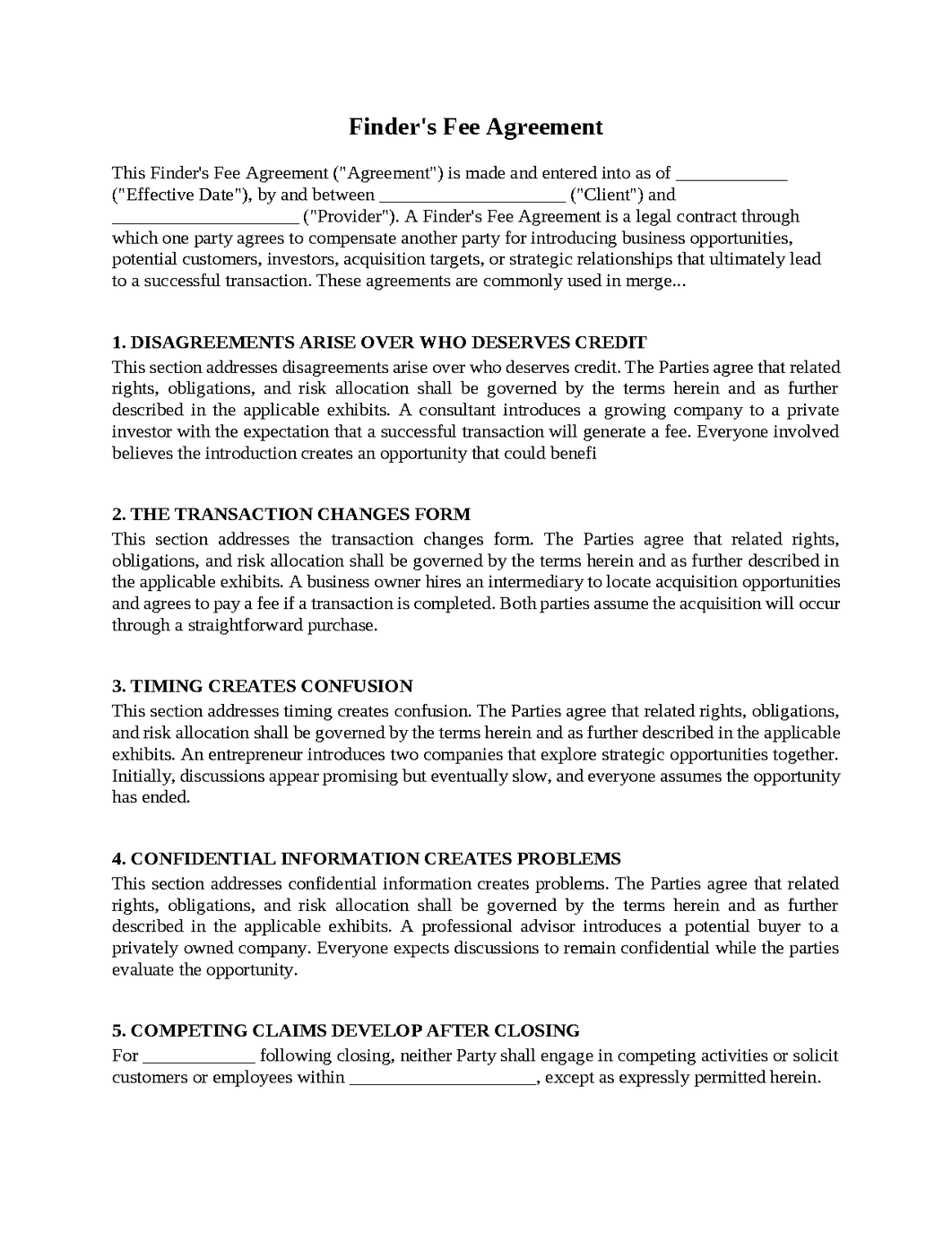
A Finder's Fee Agreement is a legal contract through which one party agrees to compensate another party for introducing business opportunities, potential customers, investors, acquisition targets, or strategic relationships that ultimately lead to a successful transaction. These agreements are commonly used in mergers and acquisitions, commercial real estate, private investments, equipment sales, business financing, and professional referrals. A Finder's Fee Agreement typically addresses the scope of introductions, compensation formulas, exclusivity provisions, confidentiality obligations, and procedures governing disputes and termination. Because introductions often evolve over long periods and involve multiple participants, disputes can arise when expectations regarding compensation and responsibilities are not documented clearly. A carefully drafted Finder's Fee Agreement helps establish certainty and protect the interests of everyone involved.
Disagreements Arise Over Who Deserves Credit
A consultant introduces a growing company to a private investor with the expectation that a successful transaction will generate a fee. Everyone involved believes the introduction creates an opportunity that could benefit all parties.
Over time, negotiations expand and additional advisors become involved. Months later, the investment closes after substantial work by attorneys, accountants, and management teams.
The consultant believes the original introduction was the reason the transaction occurred and expects compensation accordingly. The company believes later participants played a larger role and argues that the introduction alone should not justify a substantial payment. As the transaction becomes more valuable, tensions emerge regarding who deserves credit for the opportunity.
To help avoid this problem, a Finder's Fee Agreement should clearly establish what constitutes a qualifying introduction and define the circumstances under which compensation becomes payable.
The Transaction Changes Form
A business owner hires an intermediary to locate acquisition opportunities and agrees to pay a fee if a transaction is completed. Both parties assume the acquisition will occur through a straightforward purchase.
After discussions begin, the parties decide that a joint venture and long-term supply arrangement make more sense than an outright acquisition. Although the relationship creates significant economic value, the final structure differs from what everyone originally envisioned.
The intermediary believes the alternative arrangement resulted directly from the opportunity that was introduced and expects compensation. The business owner believes the agreement contemplated only a traditional acquisition and argues that no fee is owed. As revenues begin flowing from the new arrangement, disagreements develop regarding whether the transaction qualifies.
To help prevent these issues, a Finder's Fee Agreement should clearly establish which types of transactions trigger compensation and define how alternative structures will be treated.
Timing Creates Confusion
An entrepreneur introduces two companies that explore strategic opportunities together. Initially, discussions appear promising but eventually slow, and everyone assumes the opportunity has ended.
Several years later, after leadership changes and renewed interest, the companies complete a transaction that creates substantial value. Questions arise regarding whether the original introduction remains connected to the final deal.
The finder believes the relationship would never have existed without the original introduction and expects compensation. The parties involved believe too much time has passed and argue that the eventual transaction resulted from independent efforts. As financial benefits become apparent, tensions emerge regarding the duration of the finder's rights.
To help avoid these problems, a Finder's Fee Agreement should clearly establish the time period during which compensation rights remain effective.
Confidential Information Creates Problems
A professional advisor introduces a potential buyer to a privately owned company. Everyone expects discussions to remain confidential while the parties evaluate the opportunity.
As negotiations proceed, sensitive information regarding customers, finances, and operations is shared with multiple participants. Concerns arise that confidential information may be used improperly if the transaction fails.
The company believes protecting confidential information is essential and expects strict limitations on its use. The finder believes sharing information was necessary to facilitate discussions and argues that reasonable precautions were taken. As trust begins to erode, disagreements emerge regarding confidentiality obligations.
To help prevent these issues, a Finder's Fee Agreement should clearly establish confidentiality requirements and define how information may be used and disclosed.
Competing Claims Develop After Closing
A commercial real estate investor completes a successful transaction after receiving introductions from several individuals and advisors. Everyone assumes compensation issues will be resolved fairly after closing.
Following completion of the deal, multiple parties claim they were responsible for creating the opportunity and demand payment. The investor faces uncertainty regarding who should be compensated and in what amount.
Each claimant believes personal efforts and relationships played a critical role in bringing the parties together. The investor believes overlapping contributions make it difficult to determine who deserves compensation and worries about paying multiple fees. As competing demands increase, tensions develop regarding responsibility for resolving the claims.
To help avoid this problem, a Finder's Fee Agreement should clearly establish compensation rights and define the circumstances under which fees are earned and payable.
Finder's Fee Agreements are valuable tools that encourage introductions and create incentives for developing business opportunities. However, issues involving transaction credit, alternative deal structures, timing disputes, confidentiality concerns, and competing claims can become significant sources of conflict when expectations are not documented clearly. A carefully drafted Finder's Fee Agreement provides a structured framework for allocating responsibilities and protecting the interests of all parties involved. When prepared thoughtfully, it can reduce uncertainty, preserve professional relationships, encourage collaboration, and provide the foundation necessary for successful business transactions.

Get started with Upsign today!
Easily send, sign and track your documents