

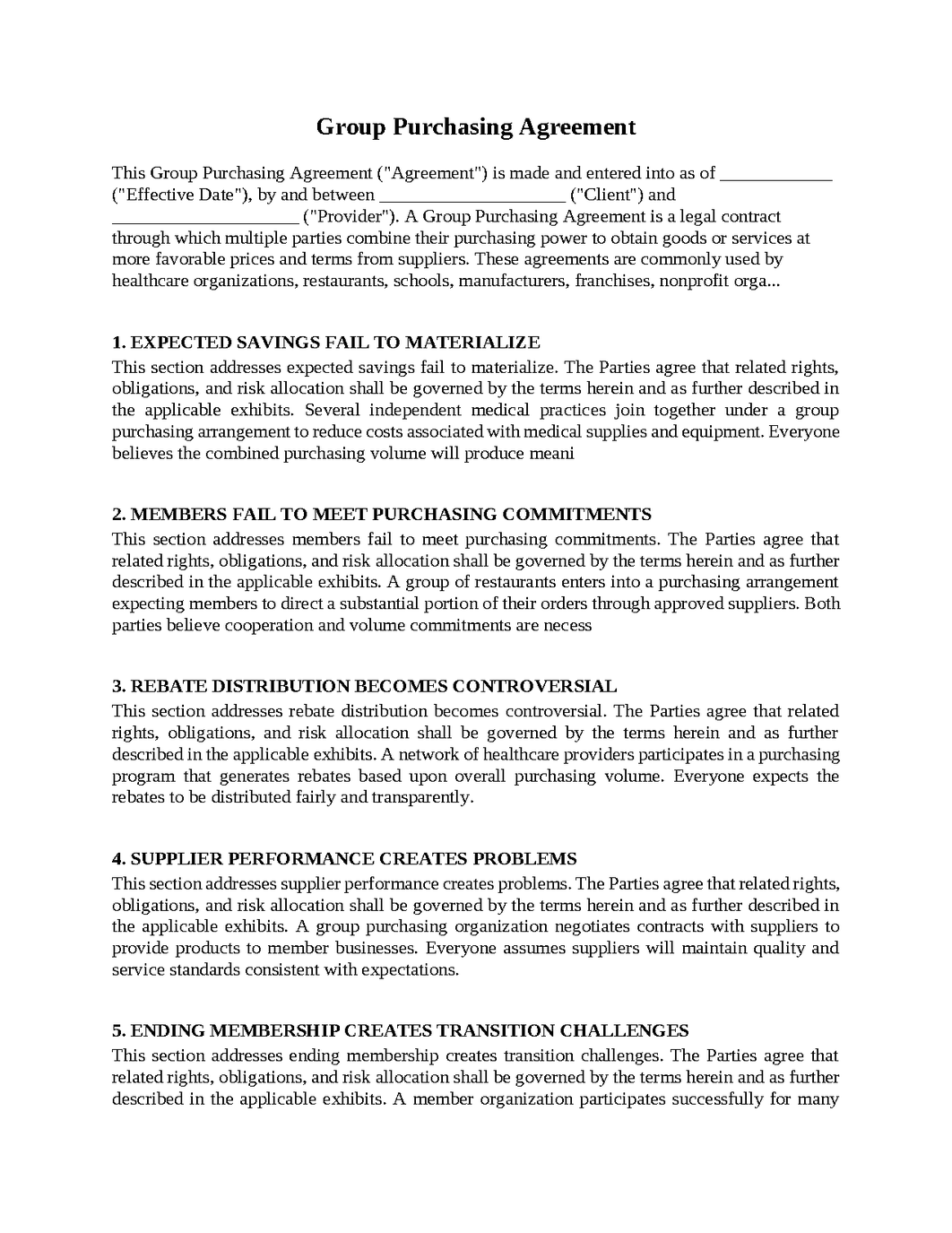
Group Purchasing Agreement
A Group Purchasing Agreement is a legal contract through which multiple parties combine their purchasing power to obtain goods or services at more favorable prices and terms from suppliers. These agreements are commonly used by healthcare organizations, restaurants, schools, manufacturers, franchises, nonprofit organizations, and trade associations seeking to reduce costs and improve efficiency. A Group Purchasing Agreement typically addresses membership requirements, pricing structures, purchasing obligations, rebate arrangements, supplier relationships, and procedures governing termination and disputes. Because group purchasing arrangements involve multiple participants with differing priorities, disputes can arise when expectations regarding savings and responsibilities are not documented clearly. A carefully drafted Group Purchasing Agreement helps establish certainty and protect the interests of all parties involved.
Expected Savings Fail to Materialize
Several independent medical practices join together under a group purchasing arrangement to reduce costs associated with medical supplies and equipment. Everyone believes the combined purchasing volume will produce meaningful savings and improve profitability.
Initially, discounts are achieved and participants are satisfied with the relationship. Over time, however, some suppliers increase prices and certain products become unavailable, reducing the financial benefits originally anticipated.
The members believe the purchasing organization should have negotiated better terms because cost savings were the primary reason for joining the arrangement. The purchasing organization believes changing market conditions and supplier limitations affected pricing and argues that reasonable efforts were made to secure favorable contracts. As frustrations increase, tensions emerge regarding whether the expected value is being delivered.
To help avoid this problem, a Group Purchasing Agreement should clearly establish pricing expectations and define the procedures used to evaluate supplier performance and savings.
Members Fail to Meet Purchasing Commitments
A group of restaurants enters into a purchasing arrangement expecting members to direct a substantial portion of their orders through approved suppliers. Both parties believe cooperation and volume commitments are necessary to preserve bargaining power.
As market conditions change, several participants begin purchasing products from outside vendors offering temporary discounts. Questions arise regarding whether those actions undermine the group's ability to negotiate favorable terms.
The purchasing organization believes members should honor their commitments because supplier relationships depend upon consistent volume. Certain members believe flexibility is necessary to remain competitive and argue that individual businesses should retain freedom to pursue better opportunities. As supplier relationships become strained, disagreements emerge regarding purchasing obligations.
To help prevent these issues, a Group Purchasing Agreement should clearly establish participation requirements and define the consequences associated with purchasing outside approved channels.
Rebate Distribution Becomes Controversial
A network of healthcare providers participates in a purchasing program that generates rebates based upon overall purchasing volume. Everyone expects the rebates to be distributed fairly and transparently.
As annual rebate payments increase, questions arise regarding how amounts should be calculated and whether certain members deserve larger shares because of their purchasing activity.
Some participants believe distributions should reflect individual contributions to the overall volume. Others believe rebates should be shared equally to encourage cooperation and maintain the strength of the group. As larger sums become involved, tensions develop regarding the proper allocation of the funds.
To help avoid these problems, a Group Purchasing Agreement should clearly establish rebate formulas and define how incentive payments will be distributed among participants.
Supplier Performance Creates Problems
A group purchasing organization negotiates contracts with suppliers to provide products to member businesses. Everyone assumes suppliers will maintain quality and service standards consistent with expectations.
Over time, delivery delays and quality concerns begin affecting operations. Several members experience shortages and customer complaints because products do not arrive according to schedule.
The members believe the purchasing organization should hold suppliers accountable because supplier management is central to the arrangement. The organization believes suppliers are independently responsible for their own performance and argues that disruptions occasionally occur despite reasonable oversight. As operational difficulties increase, disagreements emerge regarding responsibility for addressing supplier issues.
To help prevent these issues, a Group Purchasing Agreement should clearly establish supplier standards and define the procedures used to evaluate and replace vendors.
Ending Membership Creates Transition Challenges
A member organization participates successfully for many years and structures purchasing decisions around the expectation of continued participation. Both parties assume the relationship will remain beneficial indefinitely.
Eventually, changing priorities lead the member to withdraw from the arrangement. Questions arise regarding rebate rights, outstanding obligations, supplier contracts, and responsibilities associated with prior purchases.
The departing member believes a smooth transition is necessary to preserve operations and avoid disruptions. The purchasing organization believes contractual obligations should survive withdrawal and expects all outstanding commitments to be honored. As the separation unfolds, disagreements emerge regarding the rights and responsibilities that continue after membership ends.
To help avoid this problem, a Group Purchasing Agreement should clearly establish termination procedures and identify the obligations that survive the end of participation.
Group Purchasing Agreements are valuable tools that allow organizations to combine purchasing power and achieve efficiencies that would be difficult to obtain independently. However, issues involving savings expectations, purchasing commitments, rebate distributions, supplier performance, and post-termination obligations can become significant sources of conflict when expectations are not documented clearly. A carefully drafted Group Purchasing Agreement provides a structured framework for allocating responsibilities and protecting the interests of all participants. When prepared thoughtfully, it can reduce uncertainty, strengthen cooperation, improve supplier relationships, and provide the foundation necessary for long-term purchasing success.

Get started with Upsign today!
Easily send, sign and track your documents