

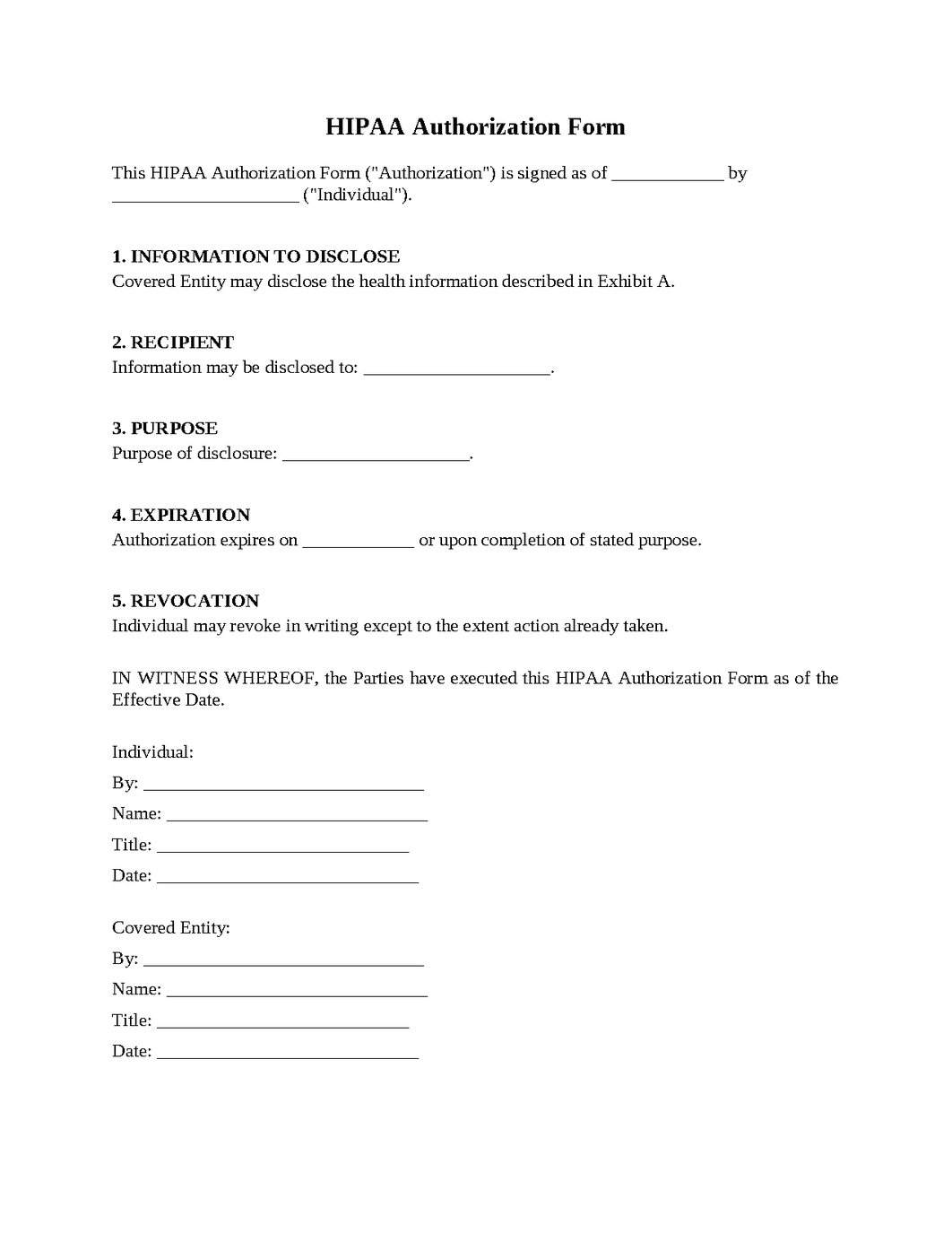
HIPAA Authorization Form
A HIPAA Authorization Form is a legal document that allows a patient to authorize the disclosure of protected health information to specific individuals, organizations, insurers, employers, attorneys, family members, or other designated recipients. These forms are governed by the Health Insurance Portability and Accountability Act (HIPAA) and are commonly used in insurance claims, legal proceedings, disability applications, family caregiving situations, employment matters, medical transfers, and healthcare coordination. Unlike a general Medical Release Form, a HIPAA Authorization Form focuses specifically on the disclosure of protected health information and establishes who may receive it, what information may be disclosed, and how long the authorization remains effective. Because medical information is highly sensitive and subject to strict privacy protections, disputes can arise when the scope of an authorization is unclear or when parties disagree about what information may be shared. A carefully drafted HIPAA Authorization Form helps protect patient privacy while allowing necessary information to be disclosed appropriately.
A Family Member Expects Access to Medical Information
An adult patient undergoes treatment for a serious medical condition requiring frequent appointments and ongoing care.
Because the treatment process is complex, the patient relies heavily on a close family member for transportation, scheduling, and communication with healthcare providers. The family member naturally assumes that access to medical information will be available whenever needed.
As treatment progresses, healthcare providers decline to discuss certain aspects of the patient's care because a HIPAA Authorization Form has not been completed. The family member becomes frustrated and believes participation in the patient's care should be enough to allow access to information.
The providers explain that privacy laws restrict the disclosure of protected health information without proper authorization from the patient. The patient intended to allow assistance but never completed the necessary paperwork.
The misunderstanding creates delays and confusion during a period when effective communication is especially important.
To help avoid this problem, a HIPAA Authorization Form should clearly identify authorized recipients and specify the medical information that may be disclosed to those individuals.
An Insurance Company Requests Broad Medical Records
An individual files a claim under a disability insurance policy following a significant medical event.
The insurance company requests a HIPAA Authorization Form so it can review relevant medical records and evaluate the claim. The claimant understands that some disclosure is necessary but expects the request to remain limited to information directly related to the disability.
After reviewing the authorization request, the claimant becomes concerned that the document appears broad enough to permit access to years of unrelated medical history. The insurance company believes comprehensive information is necessary to evaluate the claim fairly.
The claimant worries that sensitive information unrelated to the claim may be reviewed unnecessarily. The insurer believes narrower access could prevent a complete assessment of the claim.
The disagreement centers on balancing privacy interests with the need for sufficient information to process the claim.
To help prevent these issues, a HIPAA Authorization Form should clearly define the records being disclosed and limit access to information reasonably necessary for the intended purpose.
A Patient Wants to Revoke the Authorization
A patient signs a HIPAA Authorization Form allowing medical records to be shared with a third party.
At the time, the authorization appears beneficial because it supports a pending legal matter, insurance claim, or healthcare coordination effort. For several months, the arrangement functions as expected.
Later, circumstances change and the patient no longer wants the information shared. The patient submits a request to revoke the authorization and assumes that all future disclosures will stop immediately.
The recipient of the information argues that certain actions have already been taken in reliance upon the authorization. Healthcare providers must determine how the revocation affects future disclosures while recognizing that past disclosures cannot necessarily be undone.
The patient becomes frustrated because the practical effect of revocation is different from what was originally expected.
To help avoid these problems, a HIPAA Authorization Form should clearly explain how revocation works and identify any limitations on the ability to reverse disclosures that have already occurred.
The Authorization Expires During an Ongoing Matter
A patient signs a HIPAA Authorization Form in connection with a long-term legal proceeding.
At the time of signing, everyone expects the matter to conclude relatively quickly. The authorization includes an expiration date consistent with the anticipated timeline.
As the case progresses, unexpected delays occur. Discovery continues, additional medical evaluations become necessary, and the matter remains unresolved well beyond the original schedule.
Healthcare providers eventually refuse additional disclosures because the authorization has expired. Attorneys, insurers, and other parties become frustrated because important information can no longer be obtained without updated documentation.
The interruption creates delays and additional administrative burdens for everyone involved.
To help prevent these issues, a HIPAA Authorization Form should clearly address expiration dates and ensure that the authorization remains effective for the period reasonably necessary to accomplish its intended purpose.
Sensitive Information Is Shared More Broadly Than Expected
A patient authorizes the disclosure of medical records for a specific purpose.
The patient expects the information to be reviewed only by a limited group of individuals directly involved in the matter. After the records are released, however, the patient learns that the information has been shared among multiple departments, consultants, or affiliated organizations.
The patient believes the disclosure exceeded what was originally contemplated. The recipient believes the sharing was consistent with the authorization and necessary to complete the requested review.
Questions arise regarding who was authorized to receive the information and whether additional restrictions should have been imposed.
The disagreement highlights the importance of carefully defining the scope of permitted disclosures.
To help avoid these problems, a HIPAA Authorization Form should clearly identify authorized recipients, define the purpose of the disclosure, and specify any limitations on further sharing of protected health information.
HIPAA Authorization Forms play a critical role in balancing patient privacy with the practical need to share healthcare information in appropriate circumstances. However, issues involving family access, insurance investigations, revocation rights, expiration dates, and the scope of permitted disclosures can become significant sources of conflict when expectations are not documented clearly. A carefully drafted HIPAA Authorization Form provides a structured framework for protecting sensitive medical information while allowing necessary disclosures to occur. When prepared thoughtfully, it can reduce misunderstandings, support regulatory compliance, facilitate healthcare coordination, and protect the privacy interests of patients and their families.

Get started with Upsign today!
Easily send, sign and track your documents