

Patient Confidentiality Agreement
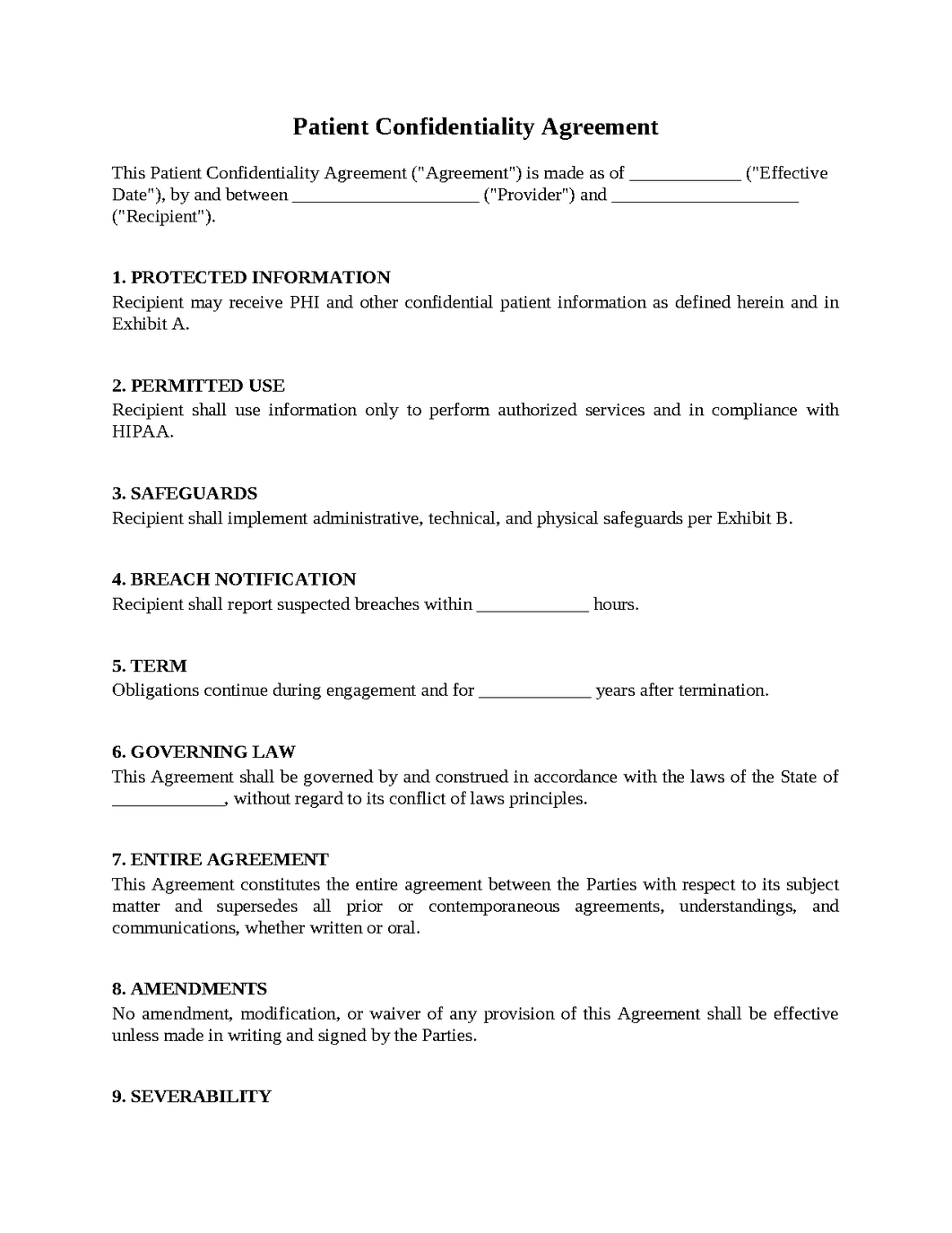
A Patient Confidentiality Agreement is a legal contract used to protect sensitive patient information from unauthorized disclosure, use, or access. These agreements are commonly used by healthcare providers, medical practices, hospitals, clinics, laboratories, billing companies, consultants, contractors, technology vendors, and employees who may encounter protected health information during the course of their work. Patient information often includes medical histories, diagnoses, treatment plans, insurance details, billing records, personal identifiers, and other highly sensitive data. Because healthcare organizations are subject to extensive privacy laws and regulatory requirements, unauthorized disclosures can result in significant legal liability, regulatory penalties, reputational damage, and loss of patient trust. A Patient Confidentiality Agreement helps establish clear expectations regarding the handling, protection, and disclosure of patient information.
An Employee Discusses Patient Information Outside the Workplace
A medical practice hires a new administrative employee responsible for scheduling appointments and managing patient records.
The employee quickly becomes familiar with many patients who regularly visit the practice. Over time, the employee begins discussing interesting patient situations with friends and family members outside of work.
The employee never shares complete medical files and does not believe any harm is being caused. However, enough details are disclosed that individuals in the community begin recognizing which patients are being discussed.
Eventually, a patient learns that personal medical information may have been shared improperly.
The patient files a complaint with practice management.
What initially appeared to the employee to be harmless conversation becomes a serious privacy concern. The practice must investigate the allegations, address patient concerns, and evaluate potential regulatory reporting obligations.
The employee argues that no malicious intent existed. The practice focuses on the fact that confidential information was disclosed regardless of intent.
To help avoid this problem, a Patient Confidentiality Agreement should clearly define confidential information, prohibit unauthorized disclosures both inside and outside the workplace, and explain that privacy obligations continue even when disclosures are informal or unintentional.
A Contractor Gains Access to More Information Than Necessary
A healthcare clinic hires an outside technology consultant to upgrade computer systems and improve cybersecurity protections.
To perform the work efficiently, the consultant receives access to certain systems that contain patient information.
Initially, the arrangement appears routine.
As the project progresses, however, the consultant accesses records unrelated to the assigned work. Although there is no evidence that information was misused, the clinic discovers that the consultant viewed patient data that was not necessary to complete the project.
Patients were never aware that their records could be accessed in this manner.
The clinic becomes concerned because privacy obligations often require limiting access to only those individuals who have a legitimate need to view patient information.
The consultant argues that access was available through the assigned credentials and that no improper use occurred.
The clinic responds that unauthorized access alone can create significant compliance concerns.
To reduce these risks, a Patient Confidentiality Agreement should clearly limit access to information necessary for assigned duties, establish minimum-necessary-use requirements, and prohibit access to records unrelated to authorized work activities.
A Former Employee Retains Patient Information
A billing specialist works for a healthcare provider for several years before accepting a position elsewhere.
Before leaving, the employee downloads various work files, believing the materials may be useful for future reference.
Months later, the healthcare provider discovers that patient-related information remains in the former employee's possession.
The employee insists that the information has not been used improperly and was retained unintentionally.
The provider nevertheless becomes concerned.
Patient records contain highly sensitive information, and retaining copies outside the organization's control creates ongoing privacy risks. The provider must evaluate whether legal obligations require notification, remediation efforts, or further investigation.
What initially appeared to be an innocent oversight becomes a significant compliance issue.
The situation becomes more complicated because the employee no longer works for the organization and may have access to systems or devices that the provider cannot monitor directly.
To help prevent these issues, a Patient Confidentiality Agreement should require the return or destruction of confidential information upon termination of employment or services. The agreement should also address personal devices, electronic records, backup files, and ongoing confidentiality obligations after the relationship ends.
A Vendor Experiences a Data Breach
A healthcare practice contracts with a third-party vendor to provide document management services.
The vendor stores large amounts of patient information electronically and appears to have appropriate security measures in place.
Several years into the relationship, the vendor experiences a cybersecurity incident.
Unauthorized individuals gain access to systems containing patient records. Investigators begin determining what information was exposed and how the breach occurred.
The healthcare practice quickly realizes that patients may hold the practice responsible even though the incident occurred at a vendor's facility.
Questions arise regarding security standards, reporting obligations, cooperation requirements, and financial responsibility for responding to the incident.
The vendor argues that sophisticated cyberattacks can affect any organization. The healthcare provider focuses on protecting patients and complying with legal obligations.
The resulting investigation becomes costly and time-consuming.
To reduce these risks, a Patient Confidentiality Agreement should establish security requirements, breach notification obligations, audit rights, cooperation procedures, and responsibility for costs associated with unauthorized disclosures or cybersecurity incidents.
Patient Information Is Used for an Unauthorized Purpose
A healthcare organization provides access to patient information for administrative purposes related to insurance verification and billing.
An employee later uses the information for unrelated activities, including contacting patients regarding a separate business opportunity.
Several patients become uncomfortable after receiving communications that appear connected to information obtained through their healthcare relationship.
Complaints are filed.
The organization investigates and discovers that patient information was used for purposes that were never authorized by the patients or the provider.
Although the information was accessed legitimately at first, the later use exceeded the scope of the employee's responsibilities.
The resulting situation damages patient trust and creates potential legal exposure.
The employee argues that no harm was intended and that the information was already available through workplace systems.
The organization focuses on the fact that confidential information was used for an unauthorized purpose.
To help avoid these disputes, a Patient Confidentiality Agreement should clearly restrict how patient information may be used, prohibit personal or commercial use of confidential data, and establish consequences for unauthorized access or use of protected information.
Patient trust is one of the most important assets in healthcare. Patients routinely share highly personal information with providers because they expect that information will remain confidential and secure. A Patient Confidentiality Agreement provides a structured framework for protecting patient information and establishing clear expectations regarding access, use, disclosure, and security. When drafted carefully, it can help reduce privacy risks, support regulatory compliance, protect patient trust, and provide important safeguards for healthcare organizations and the individuals who work with sensitive patient information.

Get started with Upsign today!
Easily send, sign and track your documents