

Partnership Agreement for Physicians
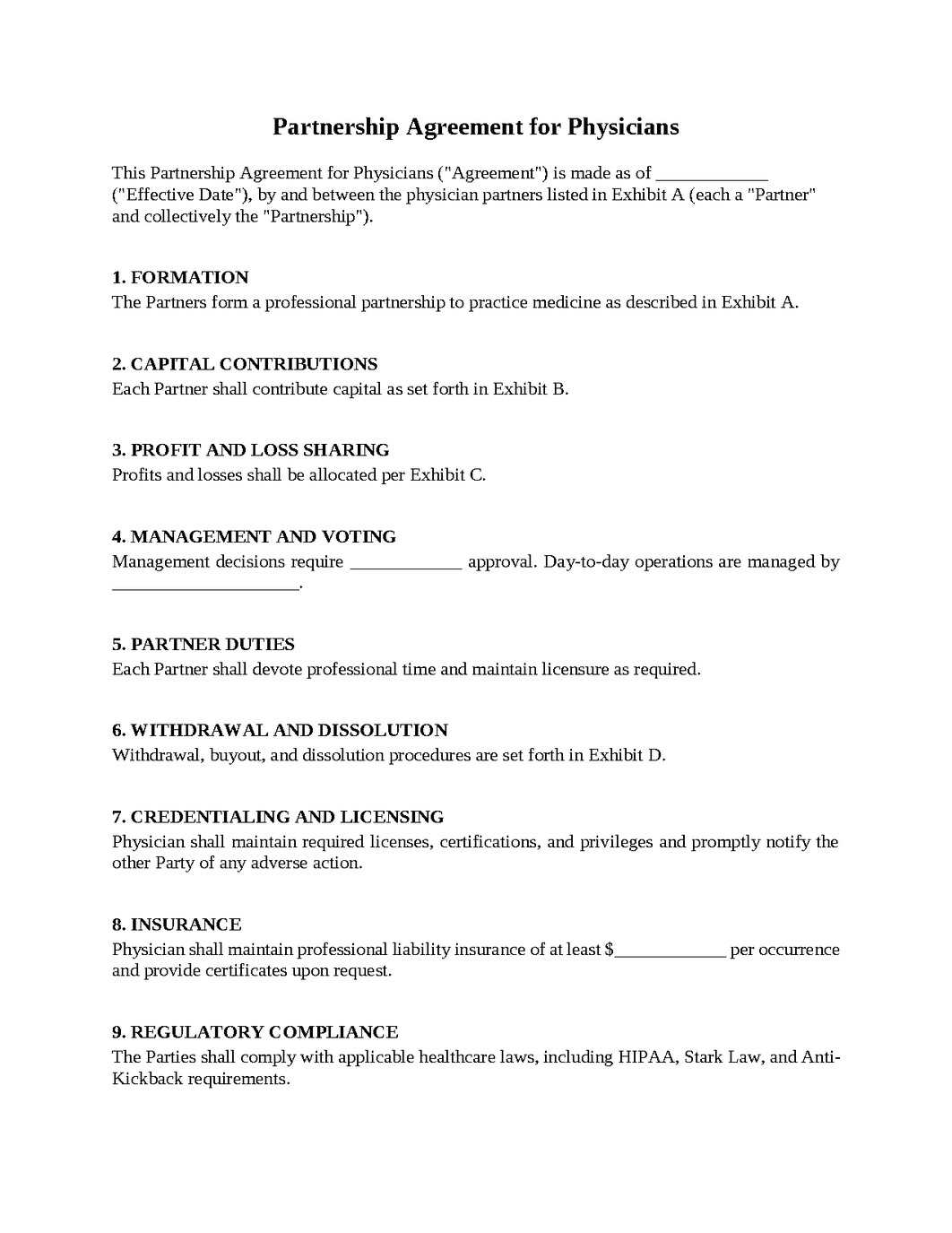
A Partnership Agreement for Physicians is a legal contract that governs the ownership, management, financial arrangements, and professional responsibilities of physicians operating a medical practice together. Unlike many other business partnerships, physician partnerships must address not only traditional business issues but also matters involving patient care, regulatory compliance, professional licensing, malpractice exposure, referral practices, physician compensation, and practice succession. These agreements are commonly used by primary care groups, specialty practices, surgical groups, and multi-physician clinics. Because physician practices often involve substantial investments of time, reputation, patient relationships, and financial resources, disputes can become particularly disruptive if expectations are not clearly documented. A well-drafted Partnership Agreement for Physicians helps establish clear rules for operating the practice and managing challenges that may arise throughout the partnership.
Productivity Differences Create Compensation Disputes
Three physicians form a medical practice and agree to share profits equally.
During the first several years, the arrangement works well because patient volumes and workloads remain relatively similar. Over time, however, differences begin to emerge.
One physician consistently sees more patients, performs additional procedures, and generates significantly greater revenue for the practice. Another physician reduces hours to accommodate personal commitments. The third physician falls somewhere in between.
As revenues grow, tensions begin developing.
The highest-producing physician believes compensation should reflect productivity. The other physicians argue that equal ownership should result in equal distributions of profits.
The disagreement becomes increasingly difficult because both perspectives appear reasonable. Ownership percentages remain equal, but revenue generation varies substantially.
The physicians begin questioning whether the compensation structure remains fair.
What started as a successful practice becomes distracted by internal financial disputes.
To help avoid this problem, a Partnership Agreement for Physicians should clearly address physician compensation, productivity-based incentives, profit-sharing formulas, and workload expectations. The agreement should establish how revenue, expenses, and distributions will be allocated when physician contributions differ significantly.
A Major Clinical Decision Leads to Management Deadlock
A group of physicians owns a successful specialty practice.
As healthcare technology evolves, the partners begin discussing whether to invest in expensive new diagnostic equipment. Some physicians believe the investment is necessary to remain competitive. Others are concerned about debt, implementation costs, and uncertain patient demand.
The disagreement becomes significant because the equipment represents a major financial commitment.
The physicians cannot reach consensus regarding whether the purchase should proceed. Meetings become increasingly contentious, and operational decisions are delayed while the debate continues.
Employees receive conflicting guidance, vendors grow frustrated, and strategic planning stalls.
The practice realizes that while it has clear clinical expertise, it lacks a structured process for resolving major business decisions.
What should be a thoughtful evaluation of a business opportunity becomes a source of conflict among partners.
To reduce these risks, a Partnership Agreement for Physicians should establish voting procedures, approval thresholds, and deadlock-resolution mechanisms for major financial, operational, and strategic decisions. These provisions help prevent important issues from paralyzing the practice.
A Physician Leaves and Takes Patients
A physician who helped build a successful practice decides to relocate to another city.
Initially, the departure appears manageable. The practice begins planning for patient transitions and recruitment efforts.
As the physician prepares to leave, however, concerns emerge regarding patient relationships. Some patients indicate they intend to follow the departing physician. Referral sources also begin directing business toward the physician's new practice.
The remaining partners become concerned that years of goodwill and marketing investments may leave with the departing physician.
The departing physician argues that patients should be free to choose their healthcare provider and that personal professional relationships cannot be restricted unfairly.
The remaining partners believe the practice deserves protection for the resources invested in developing those patient relationships.
The disagreement threatens what had been an otherwise amicable separation.
To help avoid these disputes, a Partnership Agreement for Physicians should address patient notification procedures, ownership of practice goodwill, non-solicitation provisions where permitted by law, referral relationships, and physician departure protocols. Clear procedures can reduce uncertainty during transitions.
Disability or Death Creates Financial Uncertainty
A physician partnership operates successfully for many years without major disruption.
Unexpectedly, one partner becomes unable to practice medicine due to a serious medical condition. The physician's income declines dramatically, but ownership rights remain unchanged.
Questions immediately arise.
Will the disabled physician continue receiving distributions? How will ownership be valued if a buyout becomes necessary? Can the practice afford to purchase the ownership interest while simultaneously recruiting a replacement physician?
The physician's family also seeks clarity regarding future financial arrangements.
The remaining partners want to support their colleague but must also protect the financial stability of the practice.
Without predetermined procedures, emotional and financial pressures quickly collide.
A difficult personal situation becomes even more challenging because expectations were never documented clearly.
To reduce these risks, a Partnership Agreement for Physicians should establish disability provisions, buy-sell arrangements, valuation methods, insurance requirements, and procedures for handling death, incapacity, or long-term absence. These provisions can provide certainty during highly stressful circumstances.
Regulatory and Compliance Problems Affect the Entire Practice
A multi-physician practice grows rapidly and begins participating in new healthcare programs and reimbursement arrangements.
One physician independently adopts documentation practices that eventually attract regulatory scrutiny. Auditors identify billing irregularities and launch an investigation.
Although the conduct primarily involves one physician, the entire practice becomes affected.
Legal expenses increase, administrative burdens expand, and reputational concerns begin affecting referral relationships. The remaining physicians become frustrated because they may share financial exposure arising from actions they neither approved nor supervised.
The physician involved argues that any mistakes were unintentional and related to complex reimbursement requirements.
The partnership now faces difficult questions regarding accountability, indemnification, and financial responsibility.
What began as an individual compliance issue becomes a practice-wide concern.
To help prevent these problems, a Partnership Agreement for Physicians should address compliance responsibilities, professional standards, billing practices, indemnification obligations, malpractice coverage, and procedures for handling regulatory investigations. Clearly defining these responsibilities can help protect both the practice and individual physicians.
Physician partnerships combine the complexities of healthcare delivery with the challenges of business ownership. Compensation disputes, management disagreements, physician departures, disability events, and regulatory concerns can all threaten the stability of an otherwise successful practice. A Partnership Agreement for Physicians provides a structured framework for addressing these issues before conflicts arise. When drafted carefully, it can help protect patient relationships, preserve professional partnerships, maintain regulatory compliance, and support the long-term success of the medical practice.

Get started with Upsign today!
Easily send, sign and track your documents