

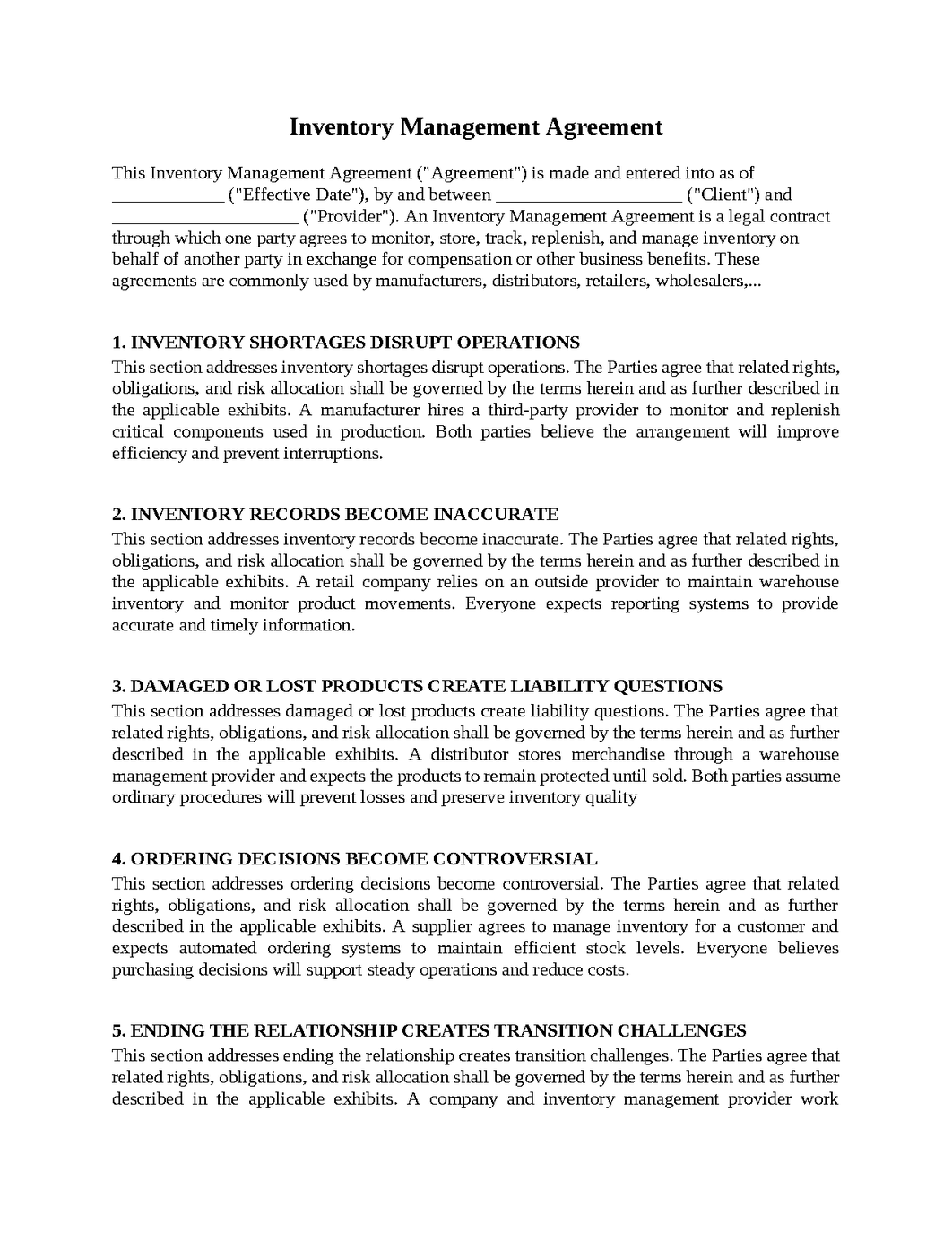
Inventory Management Agreement
An Inventory Management Agreement is a legal contract through which one party agrees to monitor, store, track, replenish, and manage inventory on behalf of another party in exchange for compensation or other business benefits. These agreements are commonly used by manufacturers, distributors, retailers, wholesalers, e-commerce companies, and third-party logistics providers seeking to maintain efficient supply chains and reduce operational risks. An Inventory Management Agreement typically addresses inventory levels, ordering procedures, reporting obligations, ownership rights, loss allocation, and procedures governing termination and disputes. Because inventory directly affects cash flow and customer satisfaction, disputes can arise when expectations regarding responsibilities and performance are not documented clearly. A carefully drafted Inventory Management Agreement helps establish certainty and protect the interests of both inventory owners and service providers.
Inventory Shortages Disrupt Operations
A manufacturer hires a third-party provider to monitor and replenish critical components used in production. Both parties believe the arrangement will improve efficiency and prevent interruptions.
For several years, inventory levels remain stable and production schedules proceed without difficulty. Eventually, however, demand increases unexpectedly and key items become unavailable, causing delays and missed customer commitments.
The manufacturer believes the inventory manager should have anticipated changes in demand because maintaining adequate supplies was one of the primary reasons for entering into the arrangement. The service provider believes unusual market conditions and supply chain disruptions affected availability and argues that reasonable efforts were made to avoid shortages. As production losses increase, tensions emerge regarding responsibility for the disruptions.
To help avoid this problem, an Inventory Management Agreement should clearly establish inventory targets and define the procedures governing replenishment and shortages.
Inventory Records Become Inaccurate
A retail company relies on an outside provider to maintain warehouse inventory and monitor product movements. Everyone expects reporting systems to provide accurate and timely information.
Over time, discrepancies begin appearing between physical inventory counts and computerized records. Missing items and unexpected variances create confusion and disrupt customer orders.
The retailer believes the inventory manager should bear responsibility because maintaining accurate records was central to the relationship. The service provider believes receiving errors and undocumented adjustments contributed to the discrepancies and argues that inventory accuracy depends on cooperation between both parties. As losses increase, disagreements emerge regarding accountability.
To help prevent these issues, an Inventory Management Agreement should clearly establish reporting requirements and define procedures for reconciling inventory discrepancies.
Damaged or Lost Products Create Liability Questions
A distributor stores merchandise through a warehouse management provider and expects the products to remain protected until sold. Both parties assume ordinary procedures will prevent losses and preserve inventory quality.
After several months, certain products are discovered to be damaged or missing. Questions arise regarding whether the losses occurred because of improper handling, theft, or conditions outside the warehouse's control.
The distributor believes the inventory manager should be responsible because the products were under its supervision. The warehouse provider believes packaging issues and external circumstances contributed to the losses and argues that liability should be limited. As replacement costs increase, tensions develop regarding financial responsibility.
To help avoid these problems, an Inventory Management Agreement should clearly establish liability provisions and define the procedures governing damaged or missing inventory.
Ordering Decisions Become Controversial
A supplier agrees to manage inventory for a customer and expects automated ordering systems to maintain efficient stock levels. Everyone believes purchasing decisions will support steady operations and reduce costs.
Changing market conditions and inaccurate forecasts eventually result in excessive inventory and slow-moving products. Questions arise regarding whether ordering decisions were appropriate.
The customer believes the inventory manager should have adjusted purchasing patterns because efficient inventory control was the primary objective of the arrangement. The provider believes demand forecasts supplied by the customer influenced ordering decisions and argues that responsibility should be shared. As storage costs increase, disagreements emerge regarding who should bear the losses.
To help prevent these issues, an Inventory Management Agreement should clearly establish forecasting responsibilities and define how purchasing decisions will be made.
Ending the Relationship Creates Transition Challenges
A company and inventory management provider work together successfully for many years and gradually integrate systems and reporting procedures. Both parties assume the relationship will continue indefinitely and organize operations around that expectation.
Eventually, changing priorities lead the company to select another provider. Questions arise regarding inventory transfers, access to records, outstanding invoices, and unfinished orders.
The company believes a smooth transition is necessary to avoid disruptions and preserve customer relationships. The provider believes all financial obligations should be satisfied before providing additional assistance and expects contractual rights to be respected. As the relationship concludes, disagreements emerge regarding the rights and responsibilities that survive termination.
To help avoid this problem, an Inventory Management Agreement should clearly establish termination procedures and identify the obligations that continue after the relationship ends.
Inventory Management Agreements are valuable tools that help businesses maintain efficient operations and reliable supply chains. However, issues involving inventory shortages, inaccurate records, damaged products, ordering decisions, and post-termination obligations can become significant sources of conflict when expectations are not documented clearly. A carefully drafted Inventory Management Agreement provides a structured framework for allocating responsibilities and protecting the interests of both inventory owners and service providers. When prepared thoughtfully, it can reduce uncertainty, strengthen business relationships, improve operational efficiency, and provide the foundation necessary for effective inventory management.

Get started with Upsign today!
Easily send, sign and track your documents