

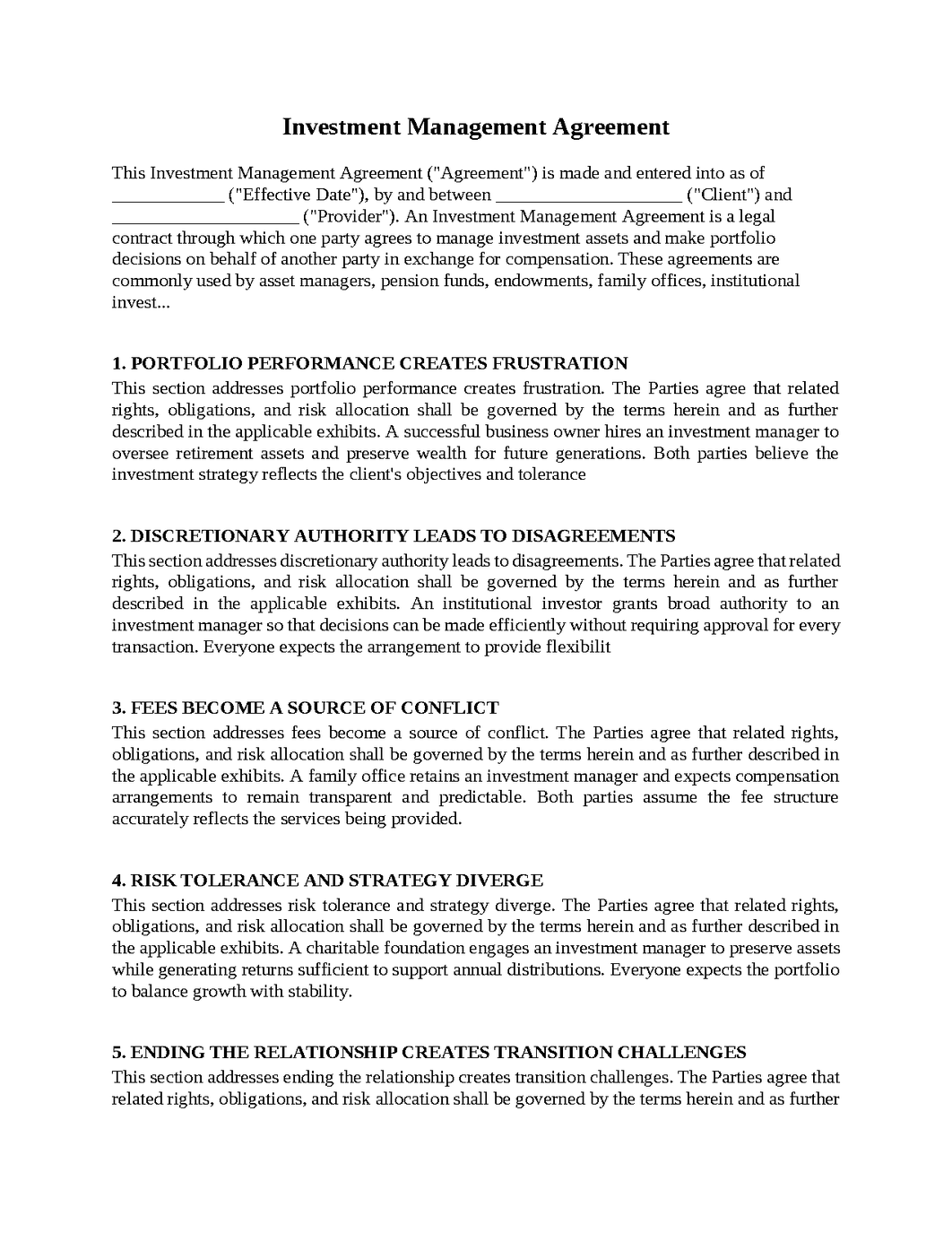
Investment Management Agreement
An Investment Management Agreement is a legal contract through which one party agrees to manage investment assets and make portfolio decisions on behalf of another party in exchange for compensation. These agreements are commonly used by asset managers, pension funds, endowments, family offices, institutional investors, and individuals seeking professional management of their financial assets. An Investment Management Agreement typically addresses investment objectives, discretionary authority, compensation arrangements, reporting requirements, risk guidelines, and procedures governing termination and disputes. Because investment decisions involve substantial financial consequences and changing market conditions, disputes can arise when expectations regarding responsibilities and authority are not documented clearly. A carefully drafted Investment Management Agreement helps establish certainty and protect the interests of both investment managers and clients.
Portfolio Performance Creates Frustration
A successful business owner hires an investment manager to oversee retirement assets and preserve wealth for future generations. Both parties believe the investment strategy reflects the client's objectives and tolerance for risk.
During the first several years, market conditions are favorable and portfolio performance meets expectations. Eventually, however, economic uncertainty and declining markets reduce account values and create concern about the direction of the portfolio.
The client believes the investment manager should have anticipated changing conditions and adjusted the portfolio because protecting assets was one of the primary reasons for seeking professional management. The manager believes market volatility affects all investors and argues that the strategy remained consistent with long-term objectives. As losses continue, tensions emerge regarding responsibility for performance.
To help avoid this problem, an Investment Management Agreement should clearly establish investment objectives and define the limitations applicable to portfolio performance.
Discretionary Authority Leads to Disagreements
An institutional investor grants broad authority to an investment manager so that decisions can be made efficiently without requiring approval for every transaction. Everyone expects the arrangement to provide flexibility and timely responses to changing markets.
As investment allocations evolve, several decisions produce results that differ from the client's expectations. Questions arise regarding whether certain transactions should have been discussed before execution.
The client believes major shifts should involve consultation because the assets represent important financial resources. The manager believes discretionary authority is essential to responding quickly to opportunities and risks and argues that the decisions were consistent with the agreed strategy. As account values fluctuate, disagreements emerge regarding the extent of decision-making authority.
To help prevent these issues, an Investment Management Agreement should clearly establish discretionary powers and define when client approval is required.
Fees Become a Source of Conflict
A family office retains an investment manager and expects compensation arrangements to remain transparent and predictable. Both parties assume the fee structure accurately reflects the services being provided.
As assets grow and investment strategies become more sophisticated, questions arise regarding management fees, incentive compensation, and additional expenses. Different interpretations create uncertainty regarding costs.
The client believes all charges should be fully disclosed because transparency is essential to maintaining trust. The manager believes the fee structure is customary and argues that compensation reflects the expertise and resources devoted to managing the assets. As balances increase, tensions develop regarding compensation.
To help avoid these problems, an Investment Management Agreement should clearly establish fee arrangements and define how expenses and performance-based compensation will be calculated.
Risk Tolerance and Strategy Diverge
A charitable foundation engages an investment manager to preserve assets while generating returns sufficient to support annual distributions. Everyone expects the portfolio to balance growth with stability.
Changing economic conditions and evolving priorities eventually lead to disagreements regarding investment risk. Questions arise concerning whether the portfolio should pursue aggressive growth or emphasize preservation.
The foundation believes protecting principal is essential because long-term charitable objectives depend upon preserving assets. The manager believes higher returns require accepting reasonable levels of risk and argues that long-term performance should remain the priority. As market conditions change, disagreements emerge regarding investment philosophy.
To help prevent these issues, an Investment Management Agreement should clearly establish risk guidelines and define the objectives governing portfolio decisions.
Ending the Relationship Creates Transition Challenges
An investment manager and client work together successfully for many years and gradually develop trust and familiarity with long-term goals. Both parties assume the relationship will continue indefinitely and organize plans around that expectation.
Eventually, changing circumstances lead the client to select another manager. Questions arise regarding account transfers, outstanding fees, records, and responsibilities associated with ongoing investments.
The client believes a smooth transition is necessary to avoid unnecessary disruptions and preserve continuity. The manager believes compensation and contractual obligations should be resolved before providing additional assistance and expects established procedures to be followed. As the relationship concludes, disagreements emerge regarding the rights and responsibilities that survive termination.
To help avoid this problem, an Investment Management Agreement should clearly establish termination procedures and identify the obligations that continue after the relationship ends.
Investment Management Agreements are valuable tools that allow investors to benefit from professional expertise while pursuing long-term financial goals. However, issues involving portfolio performance, discretionary authority, compensation arrangements, risk management, and post-termination obligations can become significant sources of conflict when expectations are not documented clearly. A carefully drafted Investment Management Agreement provides a structured framework for allocating responsibilities and protecting the interests of both managers and clients. When prepared thoughtfully, it can reduce uncertainty, strengthen professional relationships, promote transparency, and provide the foundation necessary for successful long-term investment management.

Get started with Upsign today!
Easily send, sign and track your documents