

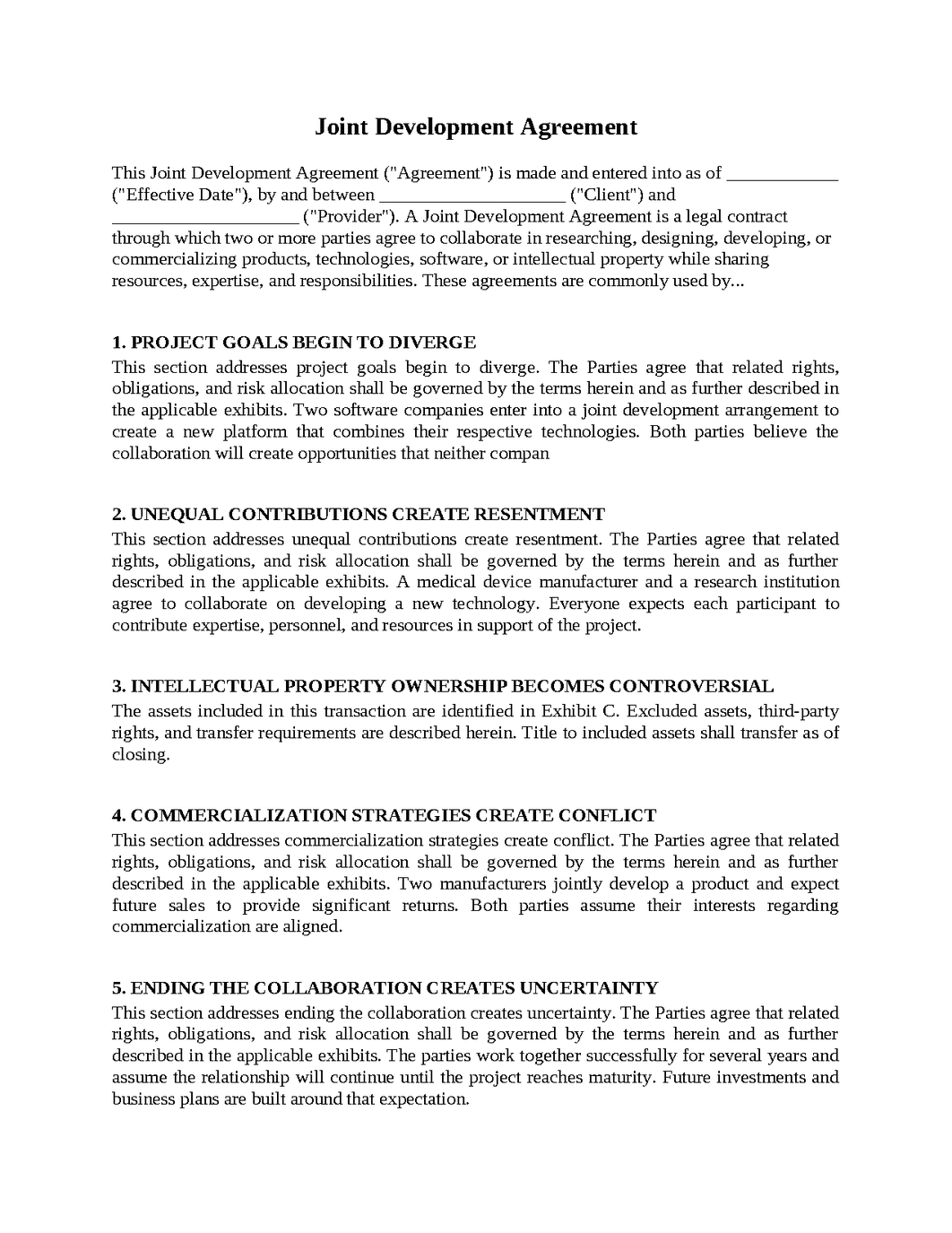
Joint Development Agreement
A Joint Development Agreement is a legal contract through which two or more parties agree to collaborate in researching, designing, developing, or commercializing products, technologies, software, or intellectual property while sharing resources, expertise, and responsibilities. These agreements are commonly used by technology companies, manufacturers, pharmaceutical businesses, universities, startups, and research organizations seeking to combine capabilities and accelerate innovation. A Joint Development Agreement typically addresses project objectives, intellectual property ownership, funding obligations, confidentiality requirements, commercialization rights, and procedures governing disputes and termination. Because collaborative projects involve multiple stakeholders with differing priorities, disputes can arise when expectations regarding contributions and rights are not documented clearly. A carefully drafted Joint Development Agreement helps establish certainty and protect the interests of all participants.
Project Goals Begin to Diverge
Two software companies enter into a joint development arrangement to create a new platform that combines their respective technologies. Both parties believe the collaboration will create opportunities that neither company could achieve independently.
Initially, development proceeds according to plan and communication remains strong. Over time, however, one company begins prioritizing speed to market while the other focuses on adding additional features and refining the product.
The first company believes rapid commercialization is essential because competitors are entering the market. The second company believes product quality and long-term functionality should take priority and argues that rushing development could create future problems. As milestones become more difficult to achieve, tensions emerge regarding the direction of the project.
To help avoid this problem, a Joint Development Agreement should clearly establish project objectives and define the procedures used to resolve disagreements regarding development priorities.
Unequal Contributions Create Resentment
A medical device manufacturer and a research institution agree to collaborate on developing a new technology. Everyone expects each participant to contribute expertise, personnel, and resources in support of the project.
As development progresses, one party invests significantly more time and resources than originally anticipated while the other becomes less involved. Questions arise regarding whether the burdens are being shared fairly.
The party making larger contributions believes compensation and ownership rights should reflect the increased effort because the success of the project depends upon meaningful participation. The other party believes the original arrangement should remain intact and argues that contributions cannot always be measured equally. As frustrations increase, disagreements emerge regarding fairness and responsibility.
To help prevent these issues, a Joint Development Agreement should clearly establish contribution requirements and define how changes in participation will affect the rights of the parties.
Intellectual Property Ownership Becomes Controversial
A startup and an engineering company work together to develop innovative technology and assume ownership questions will be straightforward. Both parties expect the collaboration to generate valuable intellectual property.
As inventions and software improvements emerge, questions arise regarding who owns newly created technology and whether each party may independently use the results.
The startup believes ownership should reflect the ideas and concepts that originally inspired the project. The engineering company believes its technical expertise and development efforts justify substantial ownership rights. As the commercial value of the technology increases, tensions develop regarding intellectual property rights.
To help avoid these problems, a Joint Development Agreement should clearly establish ownership provisions and define how newly developed intellectual property will be allocated.
Commercialization Strategies Create Conflict
Two manufacturers jointly develop a product and expect future sales to provide significant returns. Both parties assume their interests regarding commercialization are aligned.
Once development is complete, disagreements arise regarding pricing, distribution channels, and geographic markets. Different strategies emerge concerning how the product should be introduced.
One company believes aggressive expansion is necessary to maximize market share and capitalize on early opportunities. The other company believes a gradual approach will reduce risks and preserve profitability. As launch plans are delayed, disagreements emerge regarding commercialization rights and responsibilities.
To help prevent these issues, a Joint Development Agreement should clearly establish commercialization rights and define how strategic decisions will be made.
Ending the Collaboration Creates Uncertainty
The parties work together successfully for several years and assume the relationship will continue until the project reaches maturity. Future investments and business plans are built around that expectation.
Eventually, changing priorities lead one participant to withdraw from the collaboration. Questions arise regarding unfinished work, ownership of project materials, confidentiality obligations, and rights relating to future developments.
The departing party believes it should retain the benefits associated with its years of investment and contributions. The remaining party believes continuity is essential and expects ongoing rights necessary to complete and commercialize the project. As the relationship concludes, disagreements emerge regarding the obligations that survive termination.
To help avoid this problem, a Joint Development Agreement should clearly establish termination procedures and identify the rights and responsibilities that continue after the collaboration ends.
Joint Development Agreements are valuable tools that allow organizations to combine expertise and resources in pursuit of innovation and commercial success. However, issues involving project objectives, unequal contributions, intellectual property ownership, commercialization strategies, and post-termination obligations can become significant sources of conflict when expectations are not documented clearly. A carefully drafted Joint Development Agreement provides a structured framework for allocating responsibilities and protecting the interests of all participants. When prepared thoughtfully, it can reduce uncertainty, strengthen collaborative relationships, encourage innovation, and provide the foundation necessary for successful long-term development projects.

Get started with Upsign today!
Easily send, sign and track your documents