

Physician Billing Services Agreement
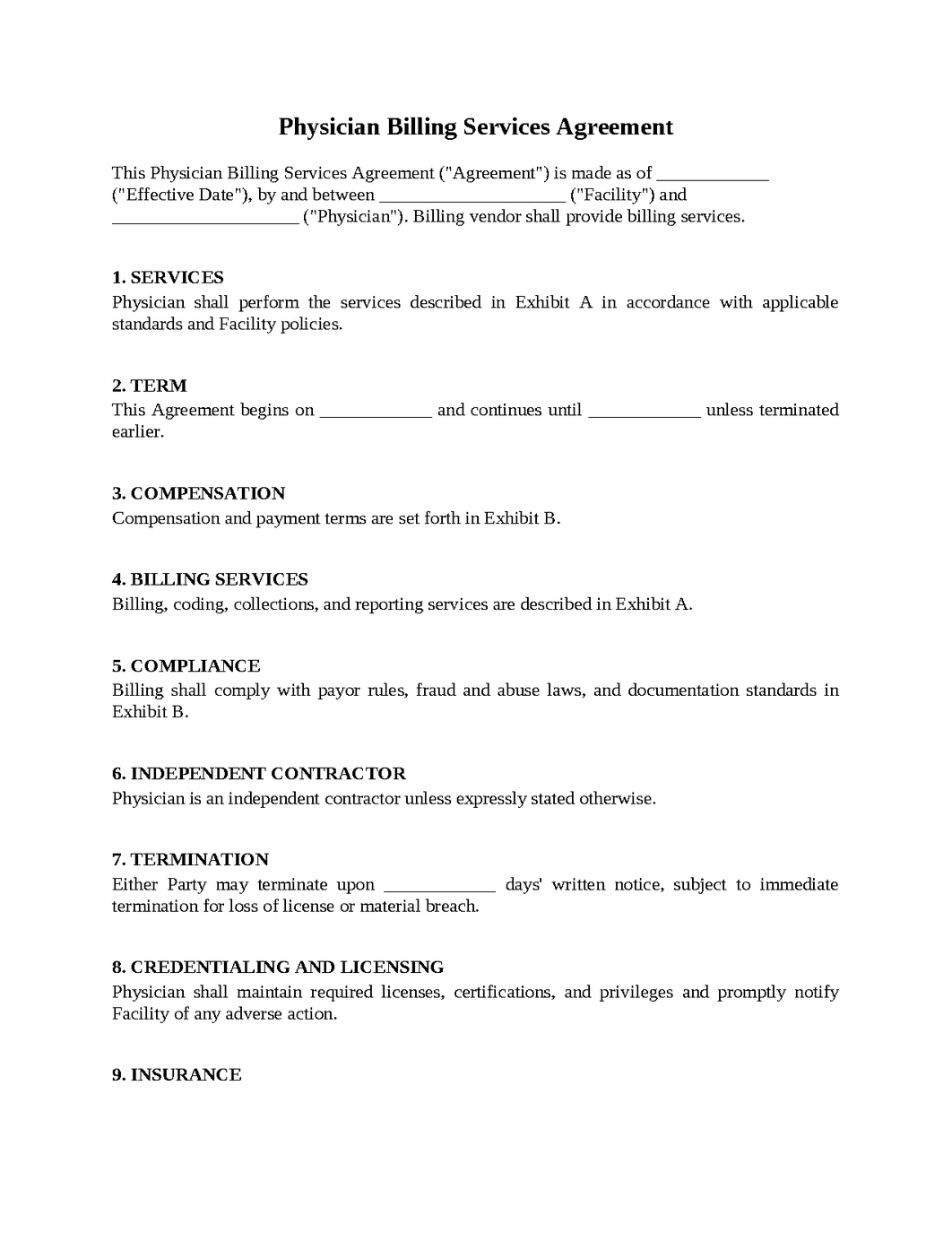
A Physician Billing Services Agreement is a legal contract that establishes the terms under which a billing company, revenue cycle management provider, medical billing firm, or administrative service organization performs billing and collection services on behalf of a physician practice. These agreements are common among independent physician groups, specialty practices, telemedicine providers, ambulatory surgery centers, and other healthcare organizations seeking assistance with claims processing, payment collection, coding support, denial management, and revenue cycle operations. Because billing directly affects practice revenue, regulatory compliance, patient satisfaction, and financial performance, disputes frequently arise when expectations are not clearly documented. A well-drafted Physician Billing Services Agreement helps define responsibilities and reduce operational and financial risk.
Claims Are Not Submitted on Time
A growing physician practice hires a billing company to manage insurance claims, patient statements, and payment collection activities. The physicians hope the arrangement will improve cash flow and allow staff to focus on patient care.
Initially, the transition appears successful. Claims are submitted regularly, reimbursement levels remain stable, and communication between the parties is positive. Over time, however, claim submission delays begin occurring. Certain encounters remain unbilled for weeks, while others miss payer filing deadlines altogether.
The practice notices declining cash flow and increasing accounts receivable balances. Physicians become concerned that delayed submissions are causing permanent revenue losses. The billing company explains that staffing shortages, software issues, and incomplete documentation contributed to the delays.
The practice believes the billing company failed to perform its responsibilities properly. The billing company argues that missing information from the practice made timely billing impossible.
To help avoid this problem, a Physician Billing Services Agreement should clearly establish claim submission timelines, documentation requirements, performance standards, and procedures for resolving billing delays. Clear operational expectations help protect practice revenue.
Coding Decisions Lead to Compliance Concerns
A physician practice relies on a billing company to assist with coding and reimbursement optimization. The billing company recommends several changes designed to improve collections and reduce claim denials.
At first, revenue improves significantly. During a payer audit, however, questions arise regarding coding practices used for certain services. Auditors request supporting documentation and challenge whether selected codes accurately reflect the services provided.
The physicians become concerned because they ultimately remain responsible for claims submitted under their provider numbers. The billing company insists that coding decisions were made in good faith and based on available information.
As the audit expands, both parties devote substantial resources to responding to inquiries and defending prior claims.
The disagreement highlights the risk that can arise when coding responsibilities and compliance obligations are not clearly defined.
To reduce these risks, a Physician Billing Services Agreement should clearly allocate coding responsibilities, establish compliance standards, define documentation requirements, and require cooperation during audits or investigations.
Fee Calculations Become a Source of Conflict
A billing company is compensated based on a percentage of collections generated for a physician practice.
Initially, the arrangement appears straightforward because collections are easy to track and both parties understand the compensation model. As the practice grows, however, additional revenue streams emerge. Ancillary services, facility fees, consulting income, and other payments begin flowing through the practice.
Questions quickly arise regarding which payments should be included when calculating billing fees. The billing company believes compensation applies broadly to all collected revenue. The physicians argue that certain income sources fall outside the scope of the agreement.
The disagreement becomes increasingly important as revenue grows and fee amounts increase.
Neither side believes it is acting unreasonably, but both interpret the agreement differently.
To help avoid these disputes, a Physician Billing Services Agreement should clearly define billable revenue categories, identify exclusions, establish accounting procedures, and create mechanisms for resolving compensation disagreements.
Patient Complaints Damage the Practice's Reputation
A billing company handles patient statements, payment plans, and collection activities on behalf of a physician practice.
Over time, the practice begins receiving complaints from patients regarding confusing invoices, aggressive collection communications, and difficulty resolving billing questions. Several patients express frustration directly to physicians during appointments.
The physicians worry that patient relationships are being harmed by billing practices outside their direct control. The billing company believes it is following industry-standard collection procedures and focusing appropriately on recovering outstanding balances.
As complaints increase, the practice becomes concerned that its reputation may suffer even though physicians are not directly involved in billing operations.
The issue creates tension because both parties have different priorities. The billing company focuses on collections, while the physicians emphasize patient satisfaction and long-term relationships.
To help prevent these problems, a Physician Billing Services Agreement should establish patient communication standards, define collection procedures, address complaint resolution processes, and create expectations regarding patient experience.
The Billing Relationship Ends and Records Are Difficult to Transfer
After working together for many years, a physician practice decides to switch billing providers.
Although both parties agree the transition should occur professionally, challenges emerge almost immediately. Open claims remain unresolved, patient balances are outstanding, appeals are pending, and critical billing records reside within the outgoing company's systems.
The practice wants immediate access to all records and operational information. The billing company agrees to cooperate but notes that significant time and effort will be required to organize and transfer years of data.
Questions arise regarding costs, timing, access rights, and responsibility for completing unresolved billing matters.
What should be a routine vendor transition becomes a complicated operational project.
To reduce these risks, a Physician Billing Services Agreement should establish transition procedures, define record-transfer obligations, address ownership of billing data, and require cooperation in completing outstanding claims and collection activities after termination.
Medical billing services play a critical role in the financial health of physician practices and healthcare organizations. However, issues involving claim submission, coding compliance, fee calculations, patient communications, and transition planning can become significant sources of conflict when expectations are not documented clearly. A carefully drafted Physician Billing Services Agreement provides a structured framework for managing these relationships and protecting all parties involved. When prepared thoughtfully, it can help improve revenue cycle performance, strengthen compliance efforts, reduce misunderstandings, and support the long-term success of the practice.

Get started with Upsign today!
Easily send, sign and track your documents