

Physician Collaboration Agreement
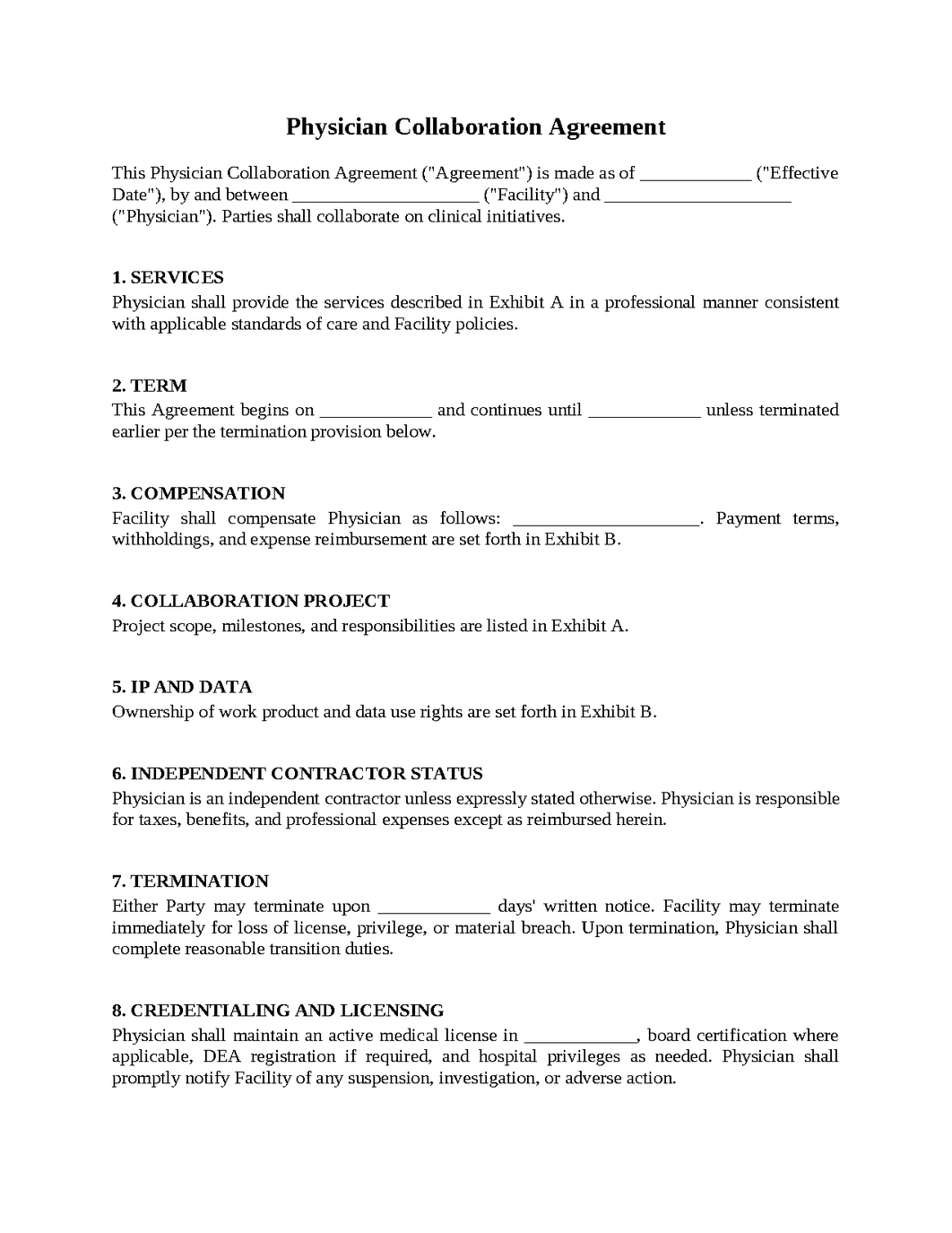
A Physician Collaboration Agreement is a legal contract that establishes the terms under which two or more physicians work together to coordinate patient care, share professional expertise, provide clinical support, or collaborate on healthcare services. These agreements are commonly used between specialists and primary care physicians, independent practices, physician networks, telemedicine providers, multi-disciplinary treatment teams, and healthcare organizations seeking to improve patient outcomes through coordinated care. Because collaborative relationships often involve shared responsibilities, overlapping decision-making, and complex patient care issues, disputes can arise when expectations are not documented clearly. A well-drafted Physician Collaboration Agreement helps define responsibilities, improve communication, and support effective clinical cooperation.
The Physicians Have Different Expectations About Decision-Making Authority
A primary care physician and an endocrinologist enter into a collaborative arrangement to improve care for patients with complex diabetes management needs. Both physicians believe the relationship will benefit patients by combining general medical oversight with specialized expertise.
Initially, communication is frequent and treatment decisions are coordinated effectively. As more patients enter the collaborative program, however, differences begin emerging regarding who has authority to make certain clinical decisions. The primary care physician believes overall treatment responsibility remains with the referring provider, while the specialist expects recommendations to be implemented unless there is a compelling reason not to do so.
Several patient cases highlight the disagreement. Medication changes recommended by the specialist are modified by the primary care physician, while certain treatment plans are implemented differently than originally discussed. Neither physician believes they are acting improperly, but both become frustrated by what they view as interference with their professional judgment.
The situation creates confusion not only for the physicians but also for staff members and patients who receive differing explanations regarding treatment plans. What began as a collaborative effort starts generating tension because decision-making authority was never clearly defined.
To help avoid this problem, a Physician Collaboration Agreement should clearly establish roles, responsibilities, and decision-making authority. The agreement should identify which physician maintains primary responsibility for patient care, how disagreements will be resolved, and when consultation is required before significant treatment decisions are made.
Communication Breakdowns Affect Patient Care
Two physician groups establish a collaborative arrangement to coordinate treatment for patients requiring ongoing specialty care. The goal is to improve outcomes by ensuring that information flows efficiently between providers.
During the first several months, the relationship functions well because patient volume remains manageable. As the program grows, however, communication challenges begin appearing. Consultation reports are delayed, test results are not transmitted promptly, and follow-up recommendations occasionally fail to reach the appropriate provider.
Neither group intentionally neglects its responsibilities, but increasing workloads and inconsistent procedures create gaps in communication. Physicians begin discovering important information during patient visits rather than through established reporting channels.
Patients become frustrated because they assume their providers are sharing information seamlessly. The physicians become concerned that delayed communication could eventually affect treatment decisions or continuity of care.
To reduce these risks, a Physician Collaboration Agreement should establish communication standards, reporting timelines, documentation requirements, and procedures for sharing clinical information. Clear expectations help ensure that important patient information is communicated consistently and efficiently.
Liability Concerns Arise After an Adverse Outcome
Two physicians collaborate on the treatment of a patient with a complicated medical condition requiring input from multiple specialties. Both physicians participate actively in developing the treatment plan and monitoring the patient's progress.
Despite everyone's best efforts, the patient experiences a serious complication. An investigation begins, and questions quickly arise regarding which physician was responsible for specific treatment decisions and follow-up activities.
One physician believes responsibility rested primarily with the specialist managing the condition. The specialist believes the referring physician retained overall responsibility for coordinating care. As attorneys and insurance carriers become involved, both physicians realize that the collaborative arrangement never clearly allocated responsibilities.
The uncertainty creates additional stress during an already difficult situation. What should be a straightforward review of clinical care becomes complicated by ambiguity regarding accountability.
To help avoid these disputes, a Physician Collaboration Agreement should clearly allocate responsibilities, identify areas of clinical authority, establish consultation requirements, and address liability considerations. Clarifying these issues beforehand can reduce confusion if adverse outcomes occur.
Technology and Telemedicine Create Operational Challenges
A rural physician collaborates with an urban specialist to provide telemedicine services for patients who otherwise would need to travel long distances for care. The arrangement is well received by patients and expands access to specialized treatment.
As the program grows, however, operational issues begin emerging. Questions arise regarding documentation standards, technology requirements, patient consent procedures, and responsibility for maintaining secure communication systems.
The rural physician assumes the specialist's organization manages technology compliance. The specialist assumes the local practice is responsible for many of the operational requirements. Neither side intentionally ignores these obligations, but important details fall into gray areas.
When a technology failure disrupts patient care and delays consultations, both parties begin reevaluating the arrangement. The incident highlights how collaborative relationships can become complicated when responsibilities are shared across different organizations.
To help prevent these issues, a Physician Collaboration Agreement should address technology requirements, telemedicine procedures, data security obligations, documentation standards, and operational responsibilities. Detailed provisions help ensure that both parties understand their roles in supporting the collaboration.
The Collaboration Ends Without a Transition Plan
Two physicians maintain a successful collaborative relationship for several years, jointly managing patients with chronic and complex medical conditions. Patients become accustomed to the arrangement and rely on coordinated care from both providers.
Eventually, one physician decides to relocate and discontinue participation in the collaboration. Although the decision is understandable, neither party has established a formal transition plan.
Dozens of patients remain in active treatment. Follow-up appointments are scheduled months in advance, ongoing care plans require monitoring, and referral pathways are built around the collaborative relationship.
As the departure approaches, staff members struggle to determine how patients should be reassigned and who is responsible for communicating changes. Patients become concerned about continuity of care, while the remaining physician faces increased workload and administrative demands.
What should be a manageable transition becomes unnecessarily disruptive because the collaboration agreement never addressed how the relationship would end.
To help avoid these problems, a Physician Collaboration Agreement should establish termination procedures, transition responsibilities, patient notification requirements, and protocols for transferring care. Careful planning helps protect patients and preserve continuity when the collaborative relationship concludes.
Physician collaborations can improve patient outcomes, expand access to specialized expertise, and strengthen the quality of healthcare delivery. However, issues involving decision-making authority, communication, liability, technology, and transition planning can create significant challenges when expectations are not documented clearly. A well-drafted Physician Collaboration Agreement provides a structured framework for managing these relationships and supporting effective professional cooperation. When prepared thoughtfully, it can help reduce misunderstandings, strengthen communication, protect patients, and promote long-term success for all parties involved.

Get started with Upsign today!
Easily send, sign and track your documents