

Physician Consulting Agreement
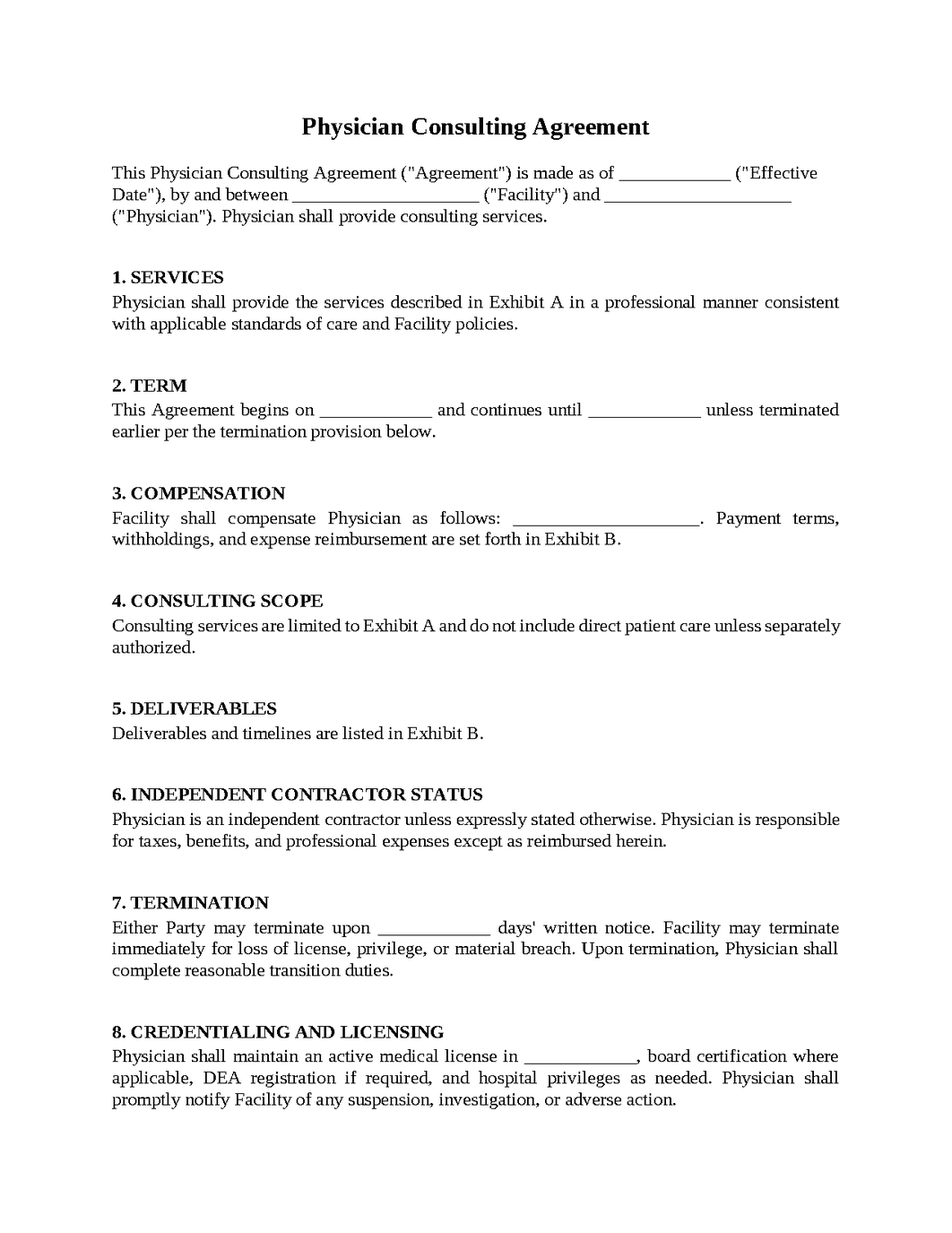
A Physician Consulting Agreement is a legal contract that establishes the terms under which a physician provides advisory, consulting, strategic, educational, research, product development, or subject-matter expertise services to a business, healthcare organization, pharmaceutical company, medical device manufacturer, insurance company, law firm, or other entity. Unlike clinical practice arrangements, consulting agreements generally focus on the physician's professional knowledge and experience rather than direct patient care. Because physician consultants often work in highly regulated industries involving healthcare laws, conflicts of interest, intellectual property, and confidentiality concerns, disputes can arise when expectations are not documented clearly. A well-drafted Physician Consulting Agreement helps define the consulting relationship and protect the interests of both parties.
The Consulting Scope Gradually Expands Beyond the Original Project
A medical device company hires a physician consultant to provide feedback on a new product being developed for use in outpatient surgical settings. During negotiations, both parties agree that the physician will review product specifications, participate in several advisory meetings, and provide clinical insights regarding usability and patient outcomes.
Initially, the assignment proceeds exactly as expected. The physician attends meetings, reviews materials, and submits recommendations. As development progresses, however, the company begins requesting additional services. The physician is asked to review marketing materials, assist with physician training programs, attend industry conferences, participate in investor presentations, and provide ongoing support to product development teams.
Although each request seems reasonable on its own, the cumulative workload becomes substantial. The physician spends far more time on consulting activities than originally anticipated and begins questioning whether the compensation still reflects the scope of services being provided.
The company believes these additional tasks are a natural extension of the consulting relationship. The physician views them as new projects requiring separate compensation and approval.
To help avoid this problem, a Physician Consulting Agreement should clearly define the scope of services, anticipated deliverables, time commitments, and procedures for approving additional work. The agreement should also address how compensation will be adjusted if consulting responsibilities expand beyond the original engagement.
Intellectual Property Ownership Becomes a Source of Dispute
A pharmaceutical company engages a physician consultant to help develop innovative treatment protocols and provide clinical feedback regarding future product opportunities.
Over the course of the engagement, the physician contributes several ideas that significantly influence the company's research and development efforts. Some of these recommendations eventually become incorporated into commercially successful products.
As the products gain market traction, questions begin emerging regarding ownership of the concepts and innovations developed during the consulting relationship. The physician believes certain ideas originated independently and should not automatically become company property.
The company takes a different view and argues that all work product created during the engagement belongs to the organization under the consulting arrangement.
Because the agreement contains only general references to intellectual property rights, neither party feels completely protected. What began as a collaborative relationship evolves into a disagreement regarding ownership of valuable innovations.
To reduce these risks, a Physician Consulting Agreement should clearly define ownership of intellectual property, identify what constitutes work product, address pre-existing intellectual property rights, and establish procedures for handling future inventions, discoveries, and developments.
Regulatory Concerns Arise Regarding Compensation
A healthcare company hires a respected physician to serve as a consultant and advisor. The arrangement includes compensation for attending meetings, reviewing materials, and providing strategic recommendations.
For several years, the relationship operates successfully. During a regulatory review, however, questions arise regarding the amount of compensation being paid and whether it accurately reflects the services being provided.
Investigators request documentation showing the physician's activities, hours worked, deliverables completed, and the basis for determining compensation. Unfortunately, the parties maintained only limited records because they viewed the consulting arrangement as straightforward.
The company becomes concerned about demonstrating that payments were commercially reasonable and supported by legitimate services. The physician worries that professional reputation could be affected by misunderstandings regarding the arrangement.
Although neither party intended to violate any regulations, inadequate documentation creates unnecessary scrutiny.
To help prevent these issues, a Physician Consulting Agreement should clearly describe consulting services, establish fair market value compensation, require activity documentation, and provide mechanisms for demonstrating compliance with applicable healthcare laws and regulations.
Confidential Information Is Used Improperly
A physician consultant works with a healthcare technology company developing a new software platform. During the engagement, the physician gains access to proprietary business plans, technical specifications, financial projections, and product development strategies.
Several months after the consulting relationship ends, the physician begins working with another company operating in a similar market. The original company becomes concerned that confidential information may influence the physician's work for the new organization.
The physician insists that professional expertise and industry knowledge cannot be separated easily from prior experiences. The company argues that certain information was provided with the expectation that it would remain confidential indefinitely.
The disagreement creates tension because both parties have legitimate interests they are attempting to protect. The physician wants freedom to pursue future opportunities, while the company wants to safeguard valuable proprietary information.
To help avoid these disputes, a Physician Consulting Agreement should clearly define confidential information, establish permissible uses, identify exclusions, and specify post-engagement confidentiality obligations. Detailed confidentiality provisions help protect sensitive information while allowing physicians to continue their professional careers.
The Consulting Relationship Ends During an Important Project
A healthcare startup hires a physician consultant to assist with the development of a new clinical service model. The physician becomes deeply involved in planning, training, regulatory review, and implementation efforts.
As the project approaches a critical phase, the company experiences financial challenges and decides to terminate several consulting relationships. The physician receives notice that the engagement will end immediately.
The physician is concerned because important deliverables remain unfinished and compensation questions remain unresolved. The company is focused on reducing expenses and believes termination rights permit the relationship to end without further obligations.
Both parties become frustrated as deadlines approach and project responsibilities remain uncertain. Stakeholders involved in the project are left wondering who will complete key tasks and how institutional knowledge will be transferred.
What should have been a routine contract termination becomes a complicated transition issue.
To help reduce these risks, a Physician Consulting Agreement should establish termination procedures, notice requirements, compensation for completed work, ownership of unfinished deliverables, and transition obligations. Clear exit provisions can help protect both parties when the relationship concludes unexpectedly.
Physician consulting relationships provide organizations with valuable clinical expertise while allowing physicians to apply their knowledge beyond direct patient care. However, disputes involving scope of services, intellectual property, compensation, confidentiality, and project transitions can quickly arise when expectations are not documented clearly. A well-drafted Physician Consulting Agreement provides a structured framework for defining responsibilities and protecting both parties. When prepared thoughtfully, it can help reduce misunderstandings, support regulatory compliance, preserve professional relationships, and promote successful consulting engagements.

Get started with Upsign today!
Easily send, sign and track your documents