

Physician Coverage Services Agreement
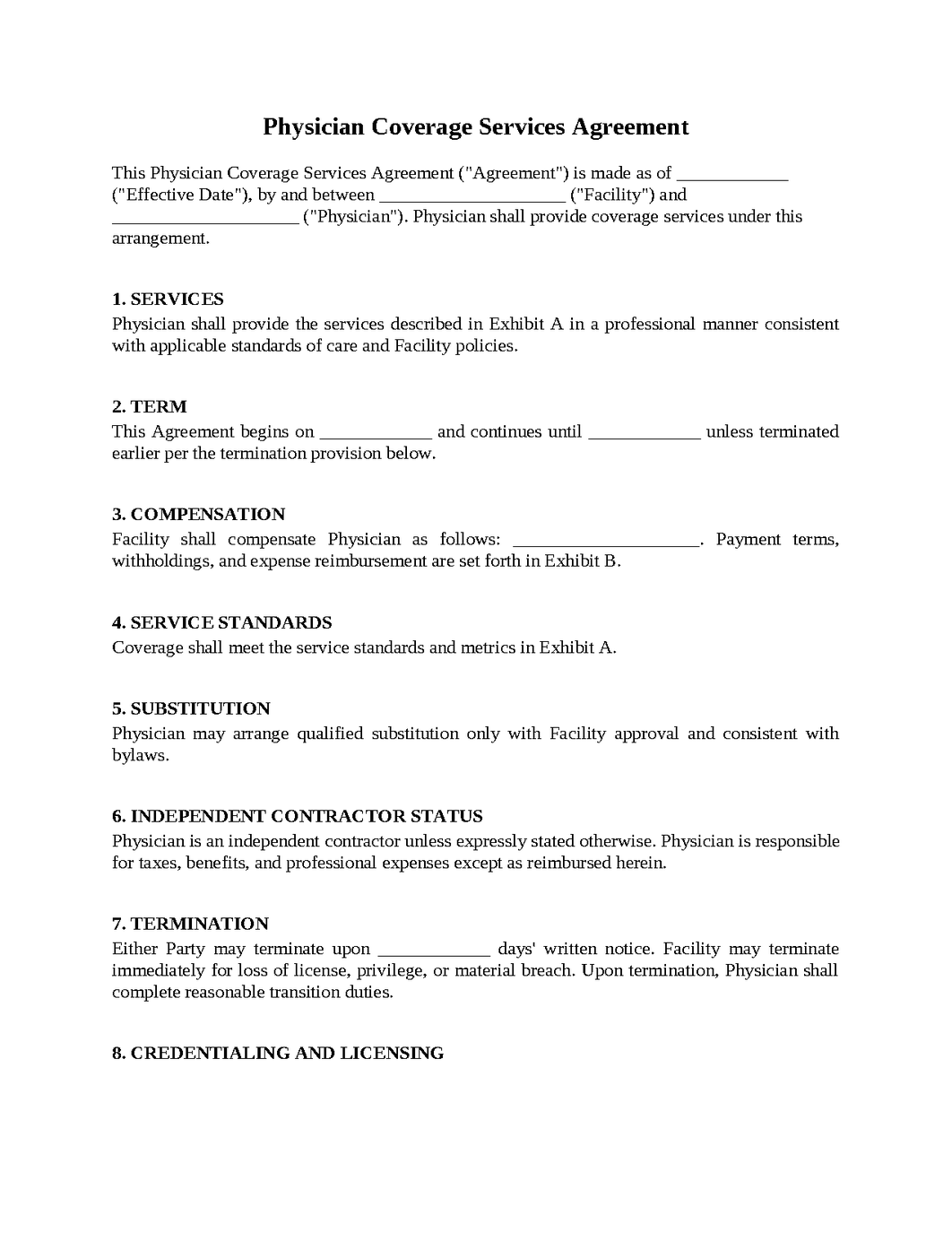
A Physician Coverage Services Agreement is a legal contract that establishes the terms under which a physician or physician group provides temporary or supplemental medical coverage services for another physician, practice, hospital, clinic, or healthcare organization. These agreements are commonly used during physician absences, staffing shortages, vacations, medical leave, recruitment gaps, seasonal demand increases, and practice transitions. The agreement typically addresses coverage schedules, patient care responsibilities, compensation, credentialing requirements, medical record access, malpractice coverage, and continuity-of-care obligations. Because temporary coverage arrangements often involve unfamiliar patients, time-sensitive medical decisions, and overlapping responsibilities between multiple providers, misunderstandings can create significant legal and operational risks. A well-drafted Physician Coverage Services Agreement helps ensure continuity of care while clearly defining each party's obligations.
The Covering Physician Inherits More Responsibility Than Expected
A multi-specialty medical practice hires a physician to provide temporary coverage while one of its partners takes a three-month medical leave. During initial discussions, the parties focus primarily on patient appointments, office hours, and anticipated patient volume.
The covering physician assumes responsibility will be limited to routine patient visits and urgent clinical matters arising during the coverage period. Shortly after beginning the assignment, however, additional responsibilities emerge. Staff members begin requesting assistance with prescription renewals, disability paperwork, insurance appeals, peer-to-peer reviews, and administrative matters that had accumulated before the leave began.
The physician becomes increasingly frustrated because many of these tasks involve significant time commitments and were never discussed during negotiations. Practice management believes the requests are reasonable because the absent physician would normally handle these responsibilities.
As the workload grows, tensions develop regarding what services are actually included in the arrangement. The disagreement is not caused by bad faith on either side but by differing assumptions regarding the scope of coverage.
To help avoid this problem, a Physician Coverage Services Agreement should clearly define covered services, identify administrative responsibilities, establish limits on non-clinical duties, and specify whether pre-existing patient matters are included within the physician's responsibilities. Detailed service descriptions help ensure both parties understand the expected workload.
Credentialing Delays Disrupt Patient Care
A hospital contracts with a physician to provide specialty coverage during a physician recruitment shortage. Both parties anticipate that services will begin promptly because the physician already maintains an active license and extensive clinical experience.
As the start date approaches, however, credentialing complications begin emerging. Certain records remain outstanding, hospital committee approvals take longer than expected, and payer enrollment requirements create unexpected delays.
The hospital expected the physician to begin seeing patients immediately. The physician assumed all credentialing requirements would be completed before the scheduled start date. As delays continue, patient appointments must be rescheduled and coverage gaps remain unresolved.
Frustration develops because each side believes the other should have anticipated the problem. The hospital faces operational challenges while the physician experiences lost income opportunities.
To reduce these risks, a Physician Coverage Services Agreement should establish credentialing responsibilities, identify required documentation, create realistic timelines, and address what happens if approvals are delayed. Clear procedures can help prevent disruptions before coverage services begin.
Access to Patient Information Is Inadequate
A physician agrees to provide temporary coverage for a busy internal medicine practice. The assignment requires managing ongoing patient care, reviewing test results, and responding to urgent medical concerns.
Although the physician receives basic access to the electronic health record system, important information proves difficult to locate. Historical treatment plans, specialist reports, medication changes, and prior physician notes are not organized consistently.
As patients present with complex medical histories, the physician must make treatment decisions without fully understanding prior care. The situation becomes particularly challenging when urgent decisions are required and the primary physician is unavailable for consultation.
The physician worries that incomplete information may affect patient outcomes. Practice administrators attempt to assist, but the lack of preparation creates ongoing operational difficulties.
To help avoid these problems, a Physician Coverage Services Agreement should address medical record access, information-sharing procedures, patient handoff requirements, and responsibilities for preparing clinical information before coverage begins. Thorough preparation helps ensure safe and effective patient care.
Compensation Disputes Arise Over Unexpected Workload
A healthcare organization hires a physician to provide temporary coverage under a compensation structure based on anticipated patient volume and service demands.
Initially, both parties believe the arrangement is fair. Within weeks, however, patient demand exceeds all projections. Appointment schedules become overloaded, consultation requests increase dramatically, and the physician spends significantly more time providing services than originally anticipated.
The physician believes compensation should be adjusted to reflect the increased workload. The healthcare organization points to the existing agreement and argues that the compensation structure remains unchanged regardless of patient volume.
As the assignment continues, dissatisfaction grows on both sides. The physician feels undercompensated while the organization worries about escalating costs.
What began as a straightforward staffing solution becomes a financial dispute that could have been avoided through more detailed planning.
To reduce these risks, a Physician Coverage Services Agreement should clearly identify compensation methodology, define productivity adjustments, establish review procedures for significant workload changes, and address circumstances that may justify revised compensation.
The Coverage Period Ends Without a Proper Transition
A physician successfully provides coverage services for several months while a medical practice recruits a permanent replacement.
As the assignment nears its conclusion, both parties focus primarily on the transition date. Less attention is given to patients with ongoing treatment plans, pending test results, specialist referrals, and unresolved medical concerns.
When the permanent physician arrives, confusion quickly develops. Certain follow-up appointments have not been scheduled, several diagnostic results remain outstanding, and patients are uncertain which physician is responsible for continuing care.
The covering physician believes responsibility ended with the final day of the assignment. The new physician assumes all significant matters were fully addressed before the transition occurred.
The resulting gaps create unnecessary risks for patients and frustration for everyone involved.
To help prevent these issues, a Physician Coverage Services Agreement should establish detailed transition procedures, define responsibilities for pending patient matters, require communication regarding unresolved issues, and create formal handoff protocols. Proper transition planning helps maintain continuity of care and reduce operational disruption.
Physician coverage services play a vital role in maintaining patient access to healthcare during staffing shortages, physician absences, and organizational transitions. However, issues involving service scope, credentialing, patient information access, compensation, and care transitions can create significant disputes if expectations are not documented clearly. A carefully drafted Physician Coverage Services Agreement provides a structured framework for addressing these concerns before problems arise. When prepared thoughtfully, it can help support continuity of care, reduce misunderstandings, protect professional relationships, and ensure that patients continue receiving high-quality medical services throughout the coverage period.

Get started with Upsign today!
Easily send, sign and track your documents