

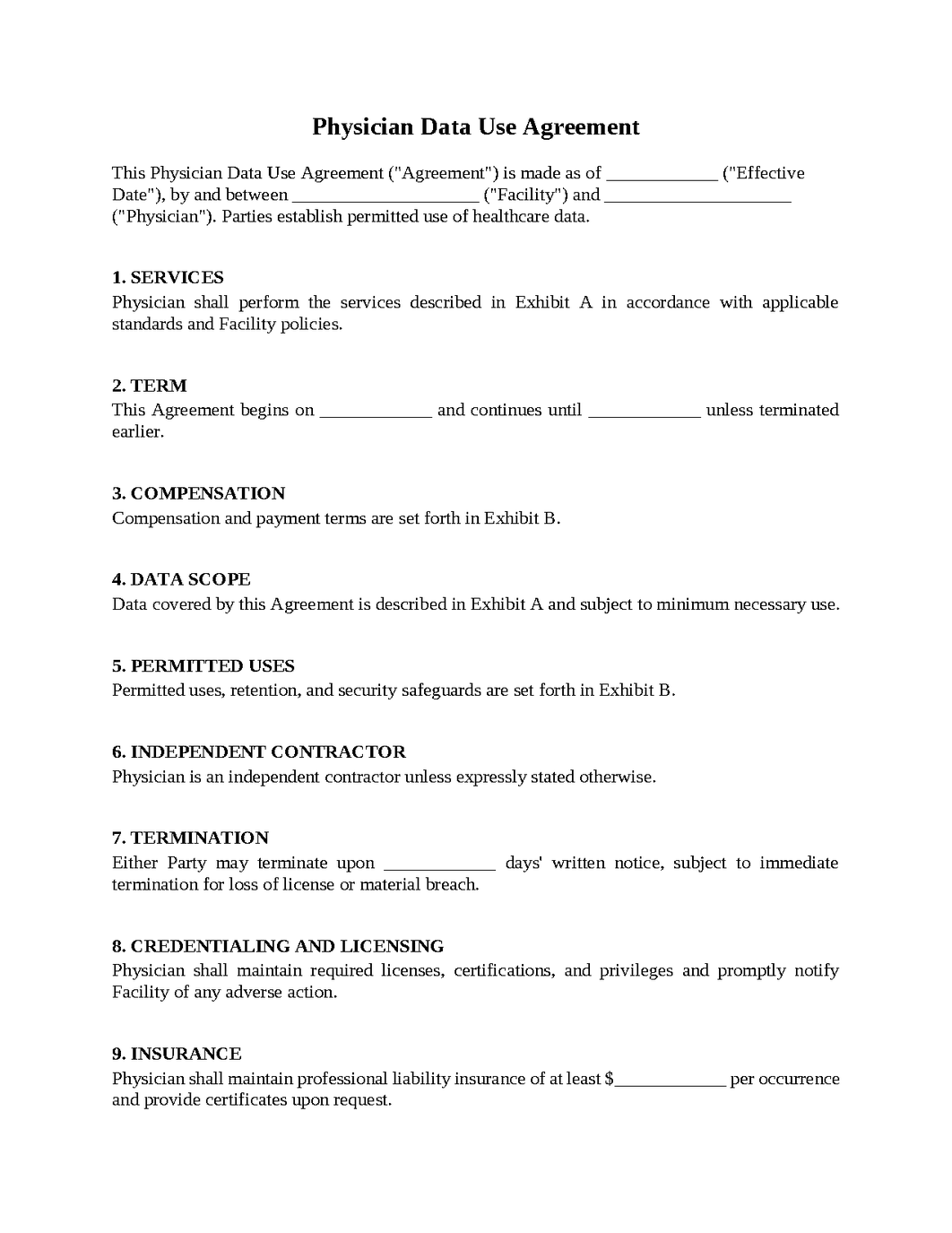
Physician Data Use Agreement
A Physician Data Use Agreement is a legal contract that establishes the terms under which a physician, medical practice, healthcare organization, research institution, or third party may access, share, analyze, use, or disclose healthcare-related data. These agreements are commonly used in clinical research, healthcare analytics, population health initiatives, quality improvement programs, artificial intelligence projects, payer collaborations, and healthcare technology partnerships. A Physician Data Use Agreement typically addresses permitted uses of data, privacy requirements, security obligations, ownership rights, regulatory compliance, confidentiality protections, and restrictions on further disclosure. Because healthcare data is highly sensitive and subject to extensive legal regulation, disputes can arise when expectations regarding data access and use are not clearly documented. A well-drafted Physician Data Use Agreement helps protect patient information while supporting legitimate business, research, and healthcare objectives.
The Parties Disagree About How Data Can Be Used
A healthcare technology company enters into an agreement with a physician group to analyze patient data and develop tools designed to improve clinical decision-making.
Initially, both parties focus on the project's goals and expected benefits. The physician group believes the data will be used solely for the specific analytics project described during negotiations. Several months later, however, the technology company begins exploring additional applications for the information, including new product development initiatives and broader market analysis efforts.
The physician group becomes concerned that the data is being used beyond the original purpose. The company argues that the additional uses are consistent with the spirit of the collaboration and create value for all participants.
As discussions continue, both sides realize they interpreted the agreement differently. What began as a promising partnership becomes a disagreement regarding the scope of permitted data use.
To help avoid this problem, a Physician Data Use Agreement should clearly define authorized uses of data, identify prohibited activities, establish approval procedures for new uses, and specify whether data may be used for future projects beyond the original engagement.
Data Security Responsibilities Become Unclear
A physician practice shares healthcare data with a third-party analytics provider to support population health management initiatives.
The parties assume appropriate security measures are in place because both organizations routinely handle sensitive information. Over time, however, questions emerge regarding cybersecurity responsibilities, access controls, encryption standards, and vendor oversight.
A security incident eventually occurs involving unauthorized access to certain datasets. While the incident is contained quickly, both parties begin examining their respective obligations under the agreement.
The physician practice believes the analytics provider was responsible for safeguarding the information. The provider argues that certain security requirements were never specified clearly and that responsibility was intended to be shared.
The disagreement creates significant operational and legal concerns because healthcare data protection obligations are substantial.
To reduce these risks, a Physician Data Use Agreement should establish detailed security requirements, define technical safeguards, allocate cybersecurity responsibilities, require incident reporting procedures, and establish standards for vendor management and access controls.
Ownership of Derived Data Creates Conflict
A physician organization provides data to a healthcare analytics company that uses advanced technology to generate predictive models, benchmarking tools, and performance insights.
The project produces valuable results that neither party anticipated initially. The physician organization believes the value stems largely from the underlying clinical data it provided. The analytics company argues that its technology, expertise, and analytical methods created the new insights.
As commercial opportunities emerge, both sides begin questioning who owns the derived information and whether either party can use the results independently.
The disagreement becomes increasingly important because the newly created data products have significant business value.
Neither side anticipated the issue because early discussions focused on data sharing rather than ownership of future outputs.
To help prevent these disputes, a Physician Data Use Agreement should clearly address ownership of source data, derived data, analytical outputs, algorithms, and future developments created through the relationship. Detailed ownership provisions help eliminate uncertainty as projects evolve.
Regulatory Compliance Becomes a Source of Concern
A physician group enters into a data-sharing arrangement with a healthcare research organization to support outcomes analysis and quality improvement initiatives.
Initially, the collaboration appears compliant with applicable healthcare regulations. As the project expands, however, questions arise regarding patient authorization requirements, de-identification standards, disclosure limitations, and compliance with evolving privacy regulations.
Different advisors provide conflicting interpretations regarding what activities are permitted. The physician group becomes concerned about potential regulatory exposure, while the research organization believes the activities remain lawful and appropriate.
Neither party wants to interrupt the project, but uncertainty regarding compliance obligations begins affecting decision-making and project planning.
The issue becomes increasingly complex as new uses for the data are proposed.
To help avoid these problems, a Physician Data Use Agreement should clearly address applicable legal requirements, establish compliance obligations, define de-identification standards, require cooperation during audits or investigations, and provide procedures for addressing regulatory changes.
The Relationship Ends but Data Remains in Use
A physician organization and healthcare technology company collaborate successfully for several years under a data-sharing arrangement.
Eventually, the parties decide to end the relationship and pursue separate strategic objectives. Although the business relationship concludes amicably, questions immediately arise regarding what happens to the data already shared.
The physician organization wants assurance that information will be returned, deleted, or protected appropriately. The technology company has integrated portions of the data into analytical models, historical reports, and ongoing operational systems.
Both parties believe they have legitimate interests to protect. The physician organization focuses on privacy and control, while the technology company wants to preserve work product developed during the engagement.
Without clear contractual guidance, the transition becomes far more complicated than expected.
To reduce these risks, a Physician Data Use Agreement should establish post-termination obligations, define data return and destruction requirements, address retention rights, and clarify what happens to derived information and analytical outputs after the relationship ends.
Healthcare data has become one of the most valuable assets in modern medicine, supporting research, innovation, quality improvement, and operational efficiency. However, issues involving authorized uses, security obligations, ownership rights, regulatory compliance, and post-termination data management can quickly become sources of conflict when expectations are not documented clearly. A carefully drafted Physician Data Use Agreement provides a structured framework for managing these relationships and protecting all parties involved. When prepared thoughtfully, it can help safeguard patient information, support compliance efforts, reduce misunderstandings, and promote successful data-driven healthcare initiatives.

Get started with Upsign today!
Easily send, sign and track your documents