

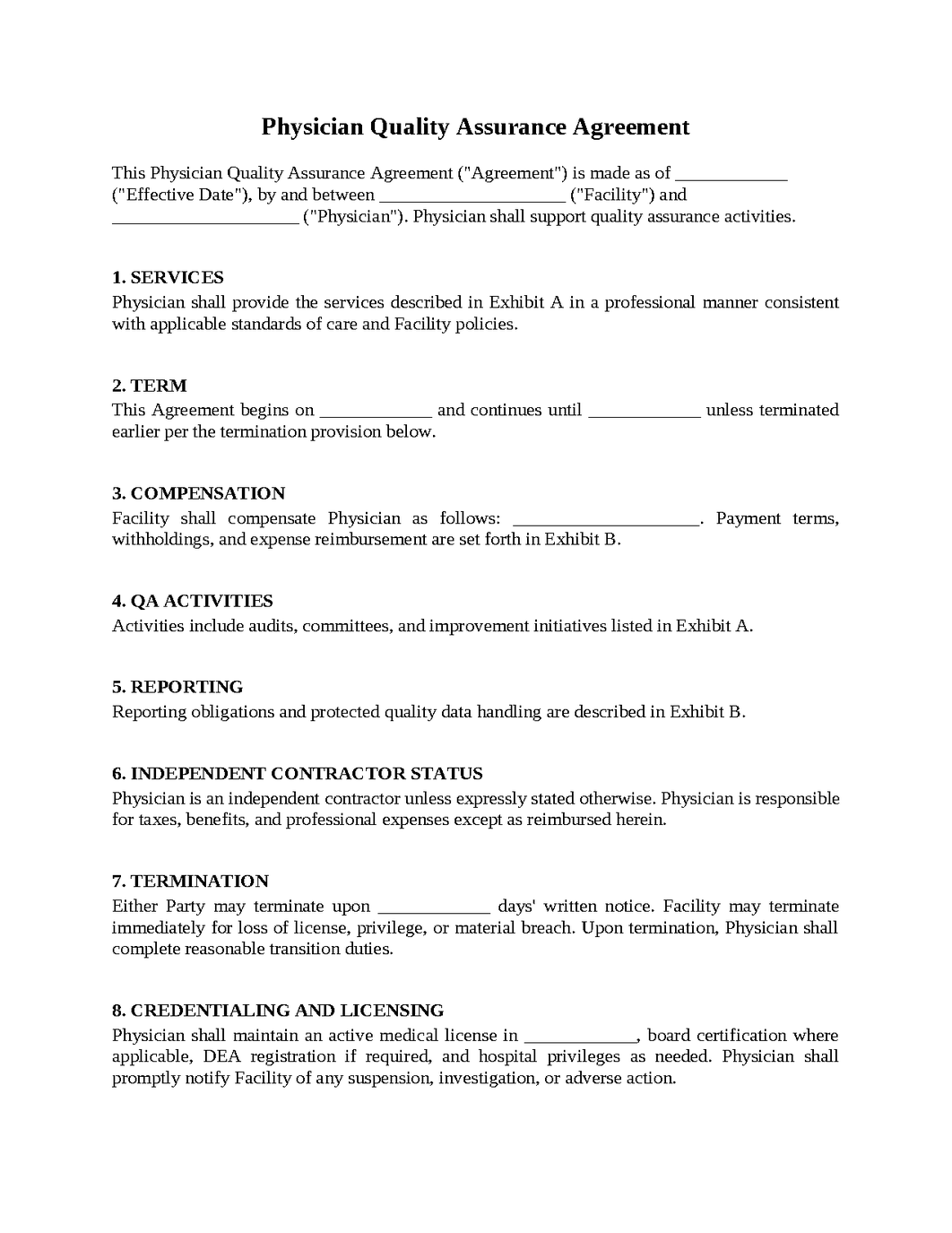
Physician Quality Assurance Agreement
A Physician Quality Assurance Agreement is a legal contract that establishes the terms under which a physician provides quality assurance, quality improvement, clinical oversight, patient safety review, compliance monitoring, or performance evaluation services for a healthcare organization. These agreements are commonly used by hospitals, ambulatory surgery centers, physician groups, healthcare systems, long-term care facilities, telemedicine providers, and specialty practices seeking to improve clinical outcomes and maintain regulatory compliance. Because quality assurance activities often involve reviewing patient care, evaluating physician performance, identifying deficiencies, and recommending corrective actions, disputes can arise when responsibilities and expectations are not clearly documented. A well-drafted Physician Quality Assurance Agreement helps create a structured framework for quality oversight while protecting the interests of the organization, providers, and patients.
Quality Metrics Are Poorly Defined
A healthcare system hires a physician to oversee quality assurance efforts for several outpatient clinics. Leadership wants to improve patient outcomes, reduce operational inefficiencies, and strengthen compliance with internal standards.
At the outset, everyone agrees that quality improvement is important. However, the agreement describes the physician's responsibilities using broad language such as "improve quality" and "enhance patient outcomes" without identifying specific performance measures.
As the program develops, the physician focuses on reducing hospital readmissions, improving follow-up care, and increasing preventive screening rates. Hospital administrators, meanwhile, prioritize patient satisfaction scores, appointment access, and documentation accuracy.
After a year of work, both sides believe progress has been made, yet they disagree about whether the physician has achieved the expected objectives. The physician points to measurable clinical improvements, while administrators focus on operational metrics that have changed very little.
The disagreement creates frustration because neither party can point to clearly defined standards that determine success.
To help avoid this problem, a Physician Quality Assurance Agreement should identify specific quality metrics, establish measurement methodologies, define reporting requirements, and explain how performance will be evaluated. Objective standards help ensure that everyone is working toward the same goals.
Recommendations Are Ignored by Management
A physician is retained to review patient safety issues and identify opportunities for improving clinical operations within a growing healthcare organization.
After several months of analysis, the physician prepares detailed recommendations addressing staffing concerns, documentation deficiencies, and workflow problems that may affect patient care. The recommendations are submitted to management along with proposed implementation plans.
Although leadership thanks the physician for the work, few of the recommendations are actually implemented. Budget concerns, competing priorities, and operational constraints delay corrective action repeatedly.
As time passes, several of the same issues continue generating patient complaints and compliance concerns. The physician becomes frustrated because quality assurance efforts appear ineffective when recommendations are routinely ignored.
Management argues that implementation decisions involve operational considerations beyond the physician's authority. The physician believes the organization is failing to address identified risks.
To reduce these risks, a Physician Quality Assurance Agreement should clearly define the physician's authority, establish procedures for reviewing recommendations, identify implementation responsibilities, and require formal responses to significant quality concerns. Clear governance procedures help prevent misunderstandings about how recommendations will be handled.
Quality Reviews Trigger Professional Disputes
A physician serving in a quality assurance role reviews several patient care incidents involving another physician within the organization.
The review identifies opportunities for improvement and recommends additional training regarding certain clinical procedures. The physician being reviewed strongly disagrees with the conclusions and believes the evaluation is unfair.
What began as a routine quality improvement effort quickly becomes personal. The reviewed physician argues that the evaluator lacks sufficient context and has misunderstood the circumstances surrounding the patient encounters.
The quality assurance physician believes the findings are supported by objective evidence and consistent with organizational standards. Other providers begin paying close attention because they worry similar reviews could affect their own professional standing.
The dispute gradually shifts focus away from patient care improvement and toward questions about fairness, process, and professional reputation.
To help avoid these problems, a Physician Quality Assurance Agreement should establish review procedures, define evaluation criteria, address conflict-of-interest concerns, and provide mechanisms for physicians to respond to findings. Transparent processes help maintain confidence in quality assurance activities.
Regulatory Audits Reveal Documentation Problems
A healthcare organization relies on a physician to oversee quality assurance efforts and demonstrate compliance with accreditation and regulatory requirements.
The physician conducts reviews regularly, participates in committee meetings, and provides guidance regarding patient safety initiatives. Although substantial work is performed, documentation practices are inconsistent because the organization focuses primarily on operational improvements rather than recordkeeping.
Several years later, regulators conduct an audit and request evidence supporting quality assurance activities. The organization struggles to locate complete records showing what reviews were performed, what findings were identified, and how corrective actions were implemented.
The physician remembers many of the initiatives clearly, but memories alone are insufficient to satisfy auditors. Management becomes concerned because quality improvement efforts that genuinely occurred cannot always be demonstrated effectively.
The audit becomes far more stressful and time-consuming than expected because documentation standards were never clearly established.
To help prevent these issues, a Physician Quality Assurance Agreement should require detailed recordkeeping, establish documentation standards, identify retention requirements, and specify responsibility for maintaining quality assurance records. Strong documentation supports both compliance and organizational accountability.
The Quality Assurance Relationship Ends During an Active Investigation
A physician has served as the quality assurance lead for a healthcare organization for several years. During that time, the physician develops quality programs, oversees patient safety reviews, and manages numerous improvement initiatives.
While an important quality investigation is underway, the physician decides to accept another professional opportunity and terminate the relationship. The departure occurs sooner than expected, leaving several projects incomplete.
The organization suddenly faces uncertainty regarding who will assume responsibility for ongoing investigations, pending corrective action plans, and communications with regulators. Staff members depend heavily on the physician's institutional knowledge and understanding of prior quality initiatives.
The departing physician wants to assist with the transition but also needs to focus on new professional obligations. The organization wants continuity but lacks a clear transition plan.
What should be a manageable leadership change becomes operationally disruptive because responsibilities for active matters were never addressed.
To help avoid these problems, a Physician Quality Assurance Agreement should establish notice requirements, transition obligations, cooperation duties, and procedures for transferring ongoing projects and investigations. Thoughtful transition planning helps ensure that important quality initiatives continue without interruption.
Physician quality assurance programs play a critical role in improving patient outcomes, promoting safety, supporting compliance, and strengthening healthcare operations. However, issues involving performance metrics, implementation authority, professional reviews, documentation requirements, and leadership transitions can become significant challenges when expectations are not documented clearly. A carefully drafted Physician Quality Assurance Agreement provides a structured framework for managing these responsibilities and supporting effective quality improvement efforts. When prepared thoughtfully, it can help reduce misunderstandings, strengthen accountability, support regulatory compliance, and promote excellence in patient care.

Get started with Upsign today!
Easily send, sign and track your documents