

Physician Recruitment Services Agreement
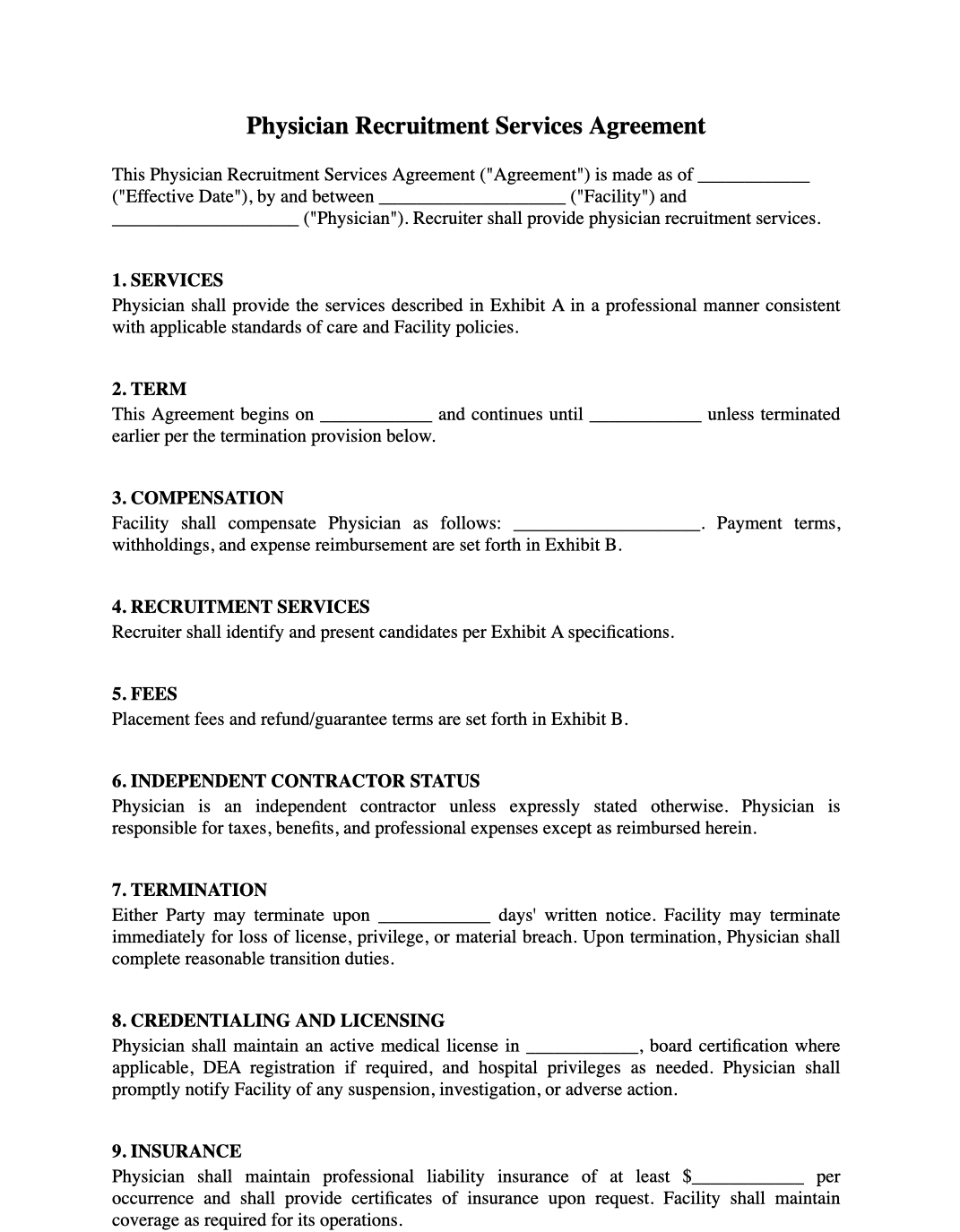
A Physician Recruitment Services Agreement is a legal contract that establishes the terms under which a recruiter, recruiting firm, staffing agency, or placement organization assists a healthcare provider in identifying, evaluating, and hiring physicians. These agreements are commonly used by hospitals, healthcare systems, physician groups, clinics, urgent care networks, and specialty practices seeking to fill physician vacancies. A Physician Recruitment Services Agreement typically addresses recruiting services, candidate sourcing, placement fees, exclusivity provisions, candidate ownership rights, guarantees, confidentiality obligations, and termination procedures. Because physician recruitment often involves significant financial commitments and lengthy hiring processes, disputes can arise when expectations are not clearly documented. A well-drafted Physician Recruitment Services Agreement helps align incentives and reduce misunderstandings throughout the recruitment process.
The Employer Hires a Candidate but Refuses to Pay the Placement Fee
A physician recruiting firm is engaged by a regional healthcare system to identify candidates for a difficult-to-fill specialty position. The recruiter spends months sourcing candidates, conducting screenings, coordinating interviews, and facilitating discussions between the parties.
Eventually, a qualified physician is introduced and progresses through the hiring process. Although negotiations initially move slowly, the healthcare system eventually hires the physician several months after the introduction.
When the recruiter submits an invoice for the placement fee, the healthcare system argues that the recruiter was not the primary reason the physician accepted the position. Administrators claim that internal recruiting efforts and physician referrals played a substantial role in the hiring decision.
The recruiting firm disagrees and points to documentation showing that the candidate was first introduced through the recruiting engagement. What began as a successful placement becomes a dispute over compensation and credit for the hire.
To help avoid this problem, a Physician Recruitment Services Agreement should clearly define candidate ownership rights, identify when placement fees become earned, establish tracking procedures for introductions, and specify how disputes regarding candidate sourcing will be resolved. Clear fee provisions help prevent disagreements after successful placements occur.
Multiple Recruiters Claim Ownership of the Same Candidate
A healthcare organization hires several recruiting firms simultaneously to help fill a physician vacancy. Each recruiter begins sourcing candidates and submitting physician profiles for consideration.
Several weeks later, a highly qualified candidate is presented to the healthcare organization. As hiring discussions progress, a second recruiting firm claims it had previously communicated with the same physician and believes it should receive credit for the introduction.
The healthcare organization now faces competing claims regarding who first sourced the candidate. Both recruiting firms produce emails, call logs, and records supporting their position.
The dispute becomes increasingly complicated because the physician interacted with multiple recruiters over an extended period. The healthcare organization wants to move forward with the hire but is concerned about potential liability if the wrong recruiter is paid.
To reduce these risks, a Physician Recruitment Services Agreement should clearly define candidate submission procedures, establish ownership periods, require written candidate presentations, and identify how competing claims will be handled. Detailed candidate ownership provisions can eliminate significant uncertainty.
The Physician Leaves Shortly After Being Hired
A recruiting firm successfully places a physician with a growing medical group. Both the physician and employer appear enthusiastic, and the placement fee is paid according to the agreement.
Within six months, however, the physician resigns unexpectedly. The physician cites cultural fit concerns, scheduling issues, and differences between the position as described during recruitment and the actual working environment.
The medical group becomes frustrated because it invested significant time and money in the hiring process. Administrators demand a refund of the recruitment fee and argue that the placement was unsuccessful.
The recruiting firm responds that it fulfilled its obligation by identifying and placing a qualified physician. The recruiter believes factors beyond its control caused the employment relationship to fail.
What began as a successful recruitment effort becomes a disagreement regarding guarantees and financial responsibility.
To help avoid these problems, a Physician Recruitment Services Agreement should clearly address replacement guarantees, refund policies, eligibility requirements, and circumstances under which credits or replacement searches will be provided. Detailed guarantee provisions help establish expectations if a placement does not last.
Confidential Information Is Shared Improperly
A healthcare organization engages a recruiting firm to conduct a confidential search for a physician leader. The position is highly sensitive because the current physician has not yet announced plans to retire.
The recruiting firm receives access to confidential strategic plans, compensation structures, organizational goals, and leadership discussions. During the search process, information about the opportunity begins circulating within the medical community.
Although no one can determine exactly how the information spread, rumors eventually reach employees, competitors, and even the physician whose position is expected to be replaced.
The healthcare organization becomes concerned that confidential business information has been compromised. The recruiting firm insists that reasonable precautions were taken and that confidentiality obligations were respected.
The resulting tension damages trust and complicates the recruitment effort.
To help prevent these issues, a Physician Recruitment Services Agreement should clearly define confidential information, establish security obligations, restrict unauthorized disclosures, and identify remedies for confidentiality breaches. Strong confidentiality provisions help protect sensitive organizational information.
The Recruitment Relationship Ends Before the Search Is Complete
A hospital engages a physician recruitment firm to fill several specialty positions as part of a long-term expansion initiative.
After months of recruiting activity, organizational priorities change. Budget pressures emerge, leadership changes occur, and the hospital decides to suspend several recruitment efforts.
The recruiting firm has already invested significant time sourcing candidates, advertising positions, conducting interviews, and coordinating site visits. The hospital believes it should be free to discontinue the search based on changing business needs.
Questions immediately arise regarding reimbursement for expenses, payment for work already performed, ownership of candidate relationships, and the status of physicians currently progressing through the hiring process.
Neither party anticipated ending the relationship before the search was completed.
To help avoid these problems, a Physician Recruitment Services Agreement should establish termination rights, identify payment obligations for partially completed work, address expense reimbursement, and define responsibilities regarding active candidates when the relationship ends. Clear termination provisions help reduce disputes during unexpected business changes.
Physician recruitment services play an essential role in helping healthcare organizations attract qualified physicians in an increasingly competitive market. However, issues involving placement fees, candidate ownership, guarantee obligations, confidentiality, and contract termination can quickly become sources of conflict when expectations are not documented clearly. A carefully drafted Physician Recruitment Services Agreement provides a structured framework for managing these relationships and protecting all parties involved. When prepared thoughtfully, it can help reduce misunderstandings, improve hiring outcomes, safeguard confidential information, and support successful long-term recruitment efforts.

Get started with Upsign today!
Easily send, sign and track your documents