

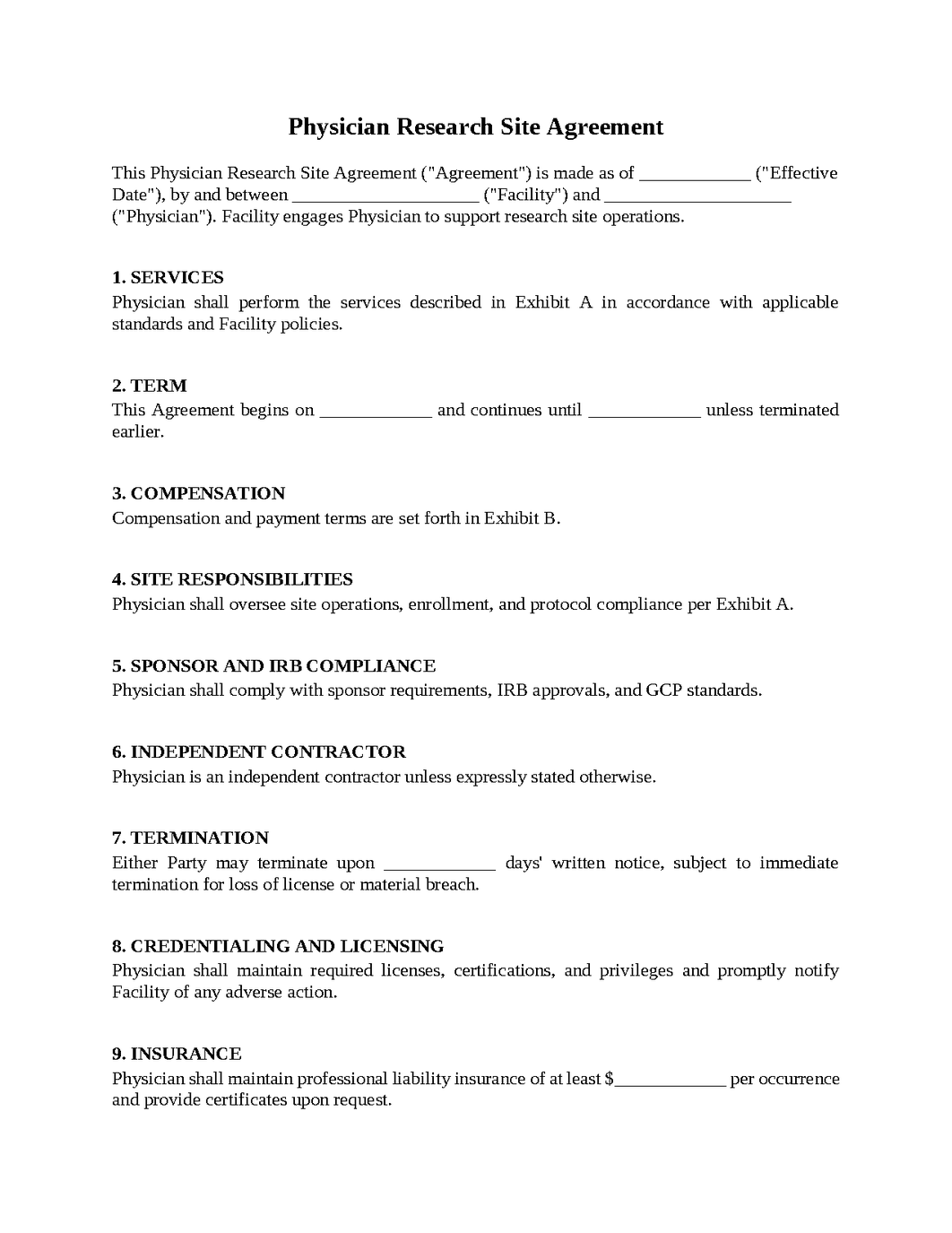
Physician Research Site Agreement
A Physician Research Site Agreement is a legal contract that establishes the terms under which a physician and research site participate in a clinical study, medical trial, observational research project, registry, or other sponsored research initiative. These agreements are commonly used by pharmaceutical companies, biotechnology firms, medical device manufacturers, contract research organizations, hospitals, universities, and independent research clinics. A Physician Research Site Agreement typically addresses site responsibilities, patient enrollment, protocol compliance, staffing requirements, regulatory obligations, compensation, data ownership, confidentiality, and study termination procedures. Because research sites serve as the operational foundation of many clinical studies, disputes can arise when expectations are not clearly documented. A well-drafted Physician Research Site Agreement helps protect participants, preserve data integrity, and support successful study execution.
The Site Lacks Resources to Meet Study Requirements
A pharmaceutical company selects a physician's clinic to serve as a research site for a large clinical trial. During the selection process, the site presents itself as experienced, well-staffed, and capable of meeting enrollment and compliance objectives.
Initially, both parties are confident in the arrangement. After the study begins, however, operational challenges emerge. Research coordinators are stretched across multiple projects, patient scheduling becomes difficult, and data-entry backlogs begin accumulating.
The sponsor becomes concerned because study timelines are slipping and protocol deadlines are being missed. The physician argues that patient care responsibilities and staffing limitations were not fully considered when enrollment targets were established.
Neither side disputes the importance of the study, but both become frustrated as performance expectations diverge from operational realities.
To help avoid this problem, a Physician Research Site Agreement should clearly define staffing requirements, resource commitments, site capabilities, and performance expectations. The agreement should also establish procedures for addressing operational deficiencies before they jeopardize study success.
Sponsor Monitoring Visits Reveal Compliance Problems
A research site participates in a multi-year clinical trial involving extensive documentation, participant monitoring, and regulatory reporting.
For months, the study appears to be progressing successfully. During a routine monitoring visit, however, sponsor representatives identify several compliance concerns. Documentation is incomplete, delegation logs contain inconsistencies, and certain protocol-required activities were not performed within required timeframes.
The physician believes patient safety was never compromised and that most issues are administrative in nature. The sponsor views the deficiencies more seriously because regulatory agencies often focus heavily on procedural compliance.
As corrective action plans are developed, tensions increase regarding responsibility for the findings. The physician points to staffing shortages and operational challenges, while the sponsor emphasizes the site's contractual obligations.
The relationship becomes strained because expectations regarding compliance oversight were never fully aligned.
To reduce these risks, a Physician Research Site Agreement should clearly define compliance obligations, monitoring procedures, corrective action requirements, and site responsibilities for maintaining study documentation and regulatory readiness.
Enrollment Incentives Create Financial Disputes
A biotechnology company compensates a research site based on patient enrollment, study visits, and completion of protocol milestones.
At the beginning of the trial, the payment structure appears straightforward. As enrollment increases, however, disagreements emerge regarding which participants qualify for compensation and when payments become earned.
The physician believes compensation should be paid once participants complete major study milestones. The sponsor argues that certain data verification and documentation requirements must be satisfied before payment is released.
The disagreement becomes increasingly significant as enrollment grows and larger amounts of compensation become involved. Both parties believe their interpretation of the agreement is reasonable.
What should have been a routine payment process evolves into an ongoing financial dispute.
To help avoid these problems, a Physician Research Site Agreement should clearly define compensation triggers, payment schedules, invoice requirements, milestone completion standards, and dispute-resolution procedures. Detailed financial provisions help prevent misunderstandings regarding compensation.
Data Ownership Becomes a Major Point of Contention
A physician research site contributes substantial patient data to a successful clinical study. Over several years, the site recruits participants, collects information, manages follow-up visits, and supports data analysis efforts.
After the study concludes, the physician wants to use portions of the data for additional academic research and future publications. The sponsor believes all study data belongs exclusively to the organization because it funded the research.
The physician argues that significant contributions were made by the site and that access to data is necessary for scientific advancement. The sponsor worries about intellectual property rights, confidentiality obligations, and future commercial opportunities.
Neither party anticipated the disagreement because the focus remained on study execution rather than post-study rights.
As new research opportunities emerge, the issue becomes increasingly important.
To help prevent these disputes, a Physician Research Site Agreement should clearly address data ownership, access rights, future use permissions, publication rights, and restrictions on secondary analyses. Detailed data provisions help eliminate uncertainty after the study ends.
The Sponsor Terminates the Study Unexpectedly
A research site invests substantial resources in a long-term clinical trial. Staff members are hired, equipment is purchased, training programs are completed, and operational systems are established to support the study.
Several years into the project, the sponsor decides to terminate the study due to strategic business considerations unrelated to site performance. Enrollment stops immediately, but significant obligations remain.
Participants require follow-up care, records must be maintained, study staff need guidance regarding future responsibilities, and outstanding expenses remain unpaid. The physician believes the sponsor should continue funding activities necessary to complete these obligations.
The sponsor believes certain responsibilities belong to the site regardless of the study's status. Questions arise regarding final payments, participant communications, record retention, and ongoing regulatory requirements.
What should have been an orderly study conclusion becomes a complicated transition process.
To reduce these risks, a Physician Research Site Agreement should establish termination procedures, define post-study responsibilities, address final compensation obligations, and allocate responsibility for participant follow-up, record retention, and regulatory compliance after study closure.
Research sites play a critical role in the successful execution of clinical studies and medical research programs. However, issues involving operational resources, compliance requirements, compensation, data ownership, and study termination can become significant sources of conflict when expectations are not documented clearly. A carefully drafted Physician Research Site Agreement provides a structured framework for managing these relationships and protecting all parties involved. When prepared thoughtfully, it can help strengthen compliance, support scientific integrity, protect participant welfare, and promote successful research outcomes.

Get started with Upsign today!
Easily send, sign and track your documents