

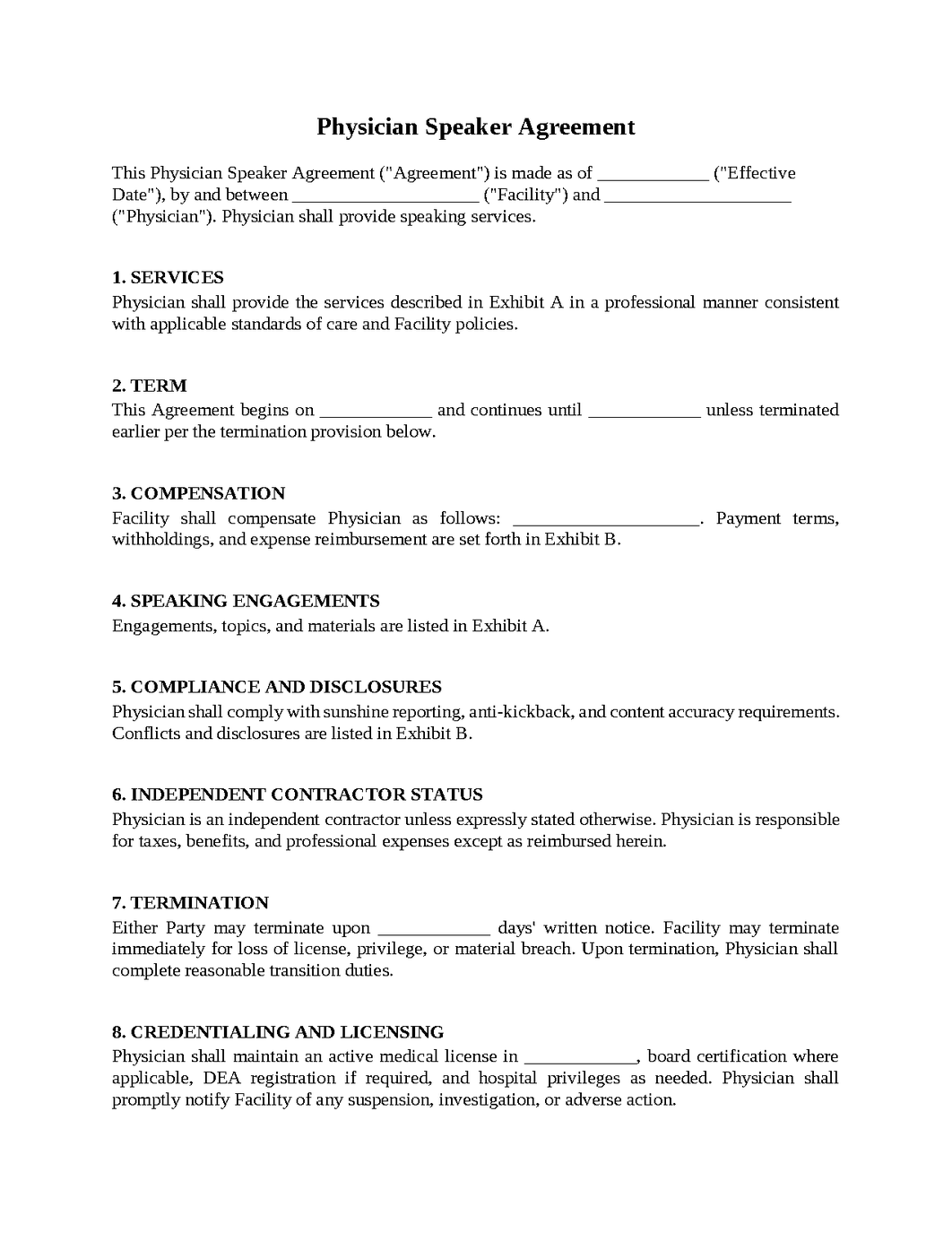
Physician Speaker Agreement
A Physician Speaker Agreement is a legal contract that establishes the terms under which a physician provides educational presentations, training sessions, conference lectures, product discussions, continuing education programs, or other speaking services on behalf of a healthcare organization, pharmaceutical company, medical device manufacturer, professional association, or educational institution. Physician speakers are often engaged because of their clinical expertise, professional credibility, and ability to communicate complex medical concepts to healthcare professionals and other audiences. Because physician speaking arrangements frequently involve compensation, regulatory requirements, promotional activities, and intellectual property concerns, disputes can arise when expectations are not documented clearly. A well-drafted Physician Speaker Agreement helps define responsibilities while protecting both the physician and the sponsoring organization.
The Organization Expects Promotional Advocacy Rather Than Education
A medical device company recruits a respected physician to speak at a series of educational programs for healthcare professionals. During initial discussions, the company emphasizes the educational nature of the presentations and explains that attendees will benefit from the physician's clinical experience.
The physician agrees because the opportunity aligns with professional interests and allows for meaningful discussion of patient care practices. As presentation dates approach, however, company representatives begin requesting changes to the content. Certain product benefits are emphasized heavily, while discussion of competing approaches and clinical limitations is discouraged.
The physician becomes uncomfortable because the presentations are starting to resemble promotional events rather than balanced educational programs. The company argues that highlighting its products is appropriate because the events are sponsored specifically to support product awareness.
Tension develops as both parties realize they have fundamentally different expectations regarding the purpose of the speaking engagement. The physician wants to maintain professional credibility and independence, while the company wants messaging that supports business objectives.
To help avoid this problem, a Physician Speaker Agreement should clearly define the nature of the presentations, establish content development responsibilities, preserve the physician's professional independence, and specify whether the engagement is educational, promotional, or a combination of both. Clear expectations help prevent conflicts regarding presentation content.
Compensation Creates Compliance Concerns
A pharmaceutical company assembles a physician speaker program to educate healthcare professionals about treatment options for a particular medical condition. Several physicians are engaged to present educational content at conferences and professional meetings.
The company establishes compensation based on the physician's expertise, preparation time, and speaking responsibilities. Initially, the arrangement appears routine and beneficial for all parties.
During a compliance review, however, questions arise regarding how compensation was determined and whether payments accurately reflect legitimate speaking services. Auditors request documentation showing attendance records, presentation materials, preparation efforts, and evidence that the speaking engagements actually occurred as described.
The company discovers that documentation practices have been inconsistent. Some events were documented thoroughly, while others have limited supporting records. The physicians become concerned because they want assurance that participation in the program will not create professional or regulatory difficulties.
Although everyone acted in good faith, insufficient documentation creates unnecessary scrutiny.
To reduce these risks, a Physician Speaker Agreement should clearly define services, establish compensation consistent with fair market value, require documentation of presentations, and address applicable compliance obligations. Thorough records help demonstrate the legitimacy of the arrangement.
Presentation Materials Become a Source of Disagreement
A healthcare company hires a physician to deliver educational presentations at industry conferences throughout the year.
The physician invests significant effort creating slides, case studies, and educational materials based on years of clinical experience. The presentations are well received, and attendees consistently provide positive feedback.
As the relationship continues, the company begins using portions of the physician's materials in other programs and marketing initiatives. The physician is surprised because no permission was requested, and certain materials reflect substantial personal effort and expertise.
The company believes the materials were developed as part of the speaking engagement and therefore belong to the organization. The physician believes ownership should remain with the creator unless otherwise agreed.
The disagreement becomes increasingly significant as the presentations gain value and wider distribution.
To help avoid these disputes, a Physician Speaker Agreement should clearly address ownership of presentation materials, licensing rights, modifications, future use permissions, and intellectual property considerations. Defining these issues early helps prevent misunderstandings later.
Confidential Information Is Disclosed During a Presentation
A physician participates in a speaker program involving emerging healthcare technologies and innovative treatment approaches.
In preparation for the presentation, the sponsoring company provides confidential information regarding future product developments, research findings, and strategic initiatives. The physician understands that the information is sensitive but also wants to provide a meaningful and informative presentation.
During a question-and-answer session, an audience member asks about future developments in the field. While attempting to answer thoughtfully, the physician references information that the company considers confidential.
The disclosure is unintentional, but company leadership becomes concerned that proprietary information may now be circulating publicly. The physician argues that no confidential documents were shared and that the comments were made in good faith.
The incident creates tension because both parties have different views regarding what information should have remained confidential.
To help prevent these issues, a Physician Speaker Agreement should clearly define confidential information, establish presentation review procedures when appropriate, and provide guidance regarding disclosures that may occur during audience interactions. Clear confidentiality provisions help protect sensitive information.
The Speaking Relationship Ends in the Middle of a Program
A physician enters into a year-long speaking arrangement involving multiple conferences, training events, and educational programs across the country.
Several successful events take place, and both parties appear satisfied with the relationship. Midway through the program, however, the sponsoring organization restructures its educational initiatives and decides to reduce spending on speaker programs.
The physician receives notice that future engagements are being canceled. At the same time, travel plans have already been made, preparation time has been invested, and several event organizers are expecting the physician's participation.
Questions immediately arise regarding cancellation fees, reimbursement of expenses, ownership of prepared materials, and obligations to third-party event organizers.
Neither party anticipated the disruption, and both are uncertain about their responsibilities.
To reduce these risks, a Physician Speaker Agreement should establish termination procedures, cancellation rights, expense reimbursement policies, and obligations relating to scheduled events. Clear termination provisions help minimize confusion and financial loss when circumstances change unexpectedly.
Physician speaker programs can provide significant educational value while allowing healthcare organizations to share important clinical information with professional audiences. However, issues involving presentation content, compensation, intellectual property, confidentiality, and program termination can quickly create disputes if expectations are not documented carefully. A well-drafted Physician Speaker Agreement provides a structured framework for managing these relationships and protecting all parties involved. When prepared thoughtfully, it can help support compliance, preserve professional credibility, reduce misunderstandings, and promote successful educational programs.

Get started with Upsign today!
Easily send, sign and track your documents