

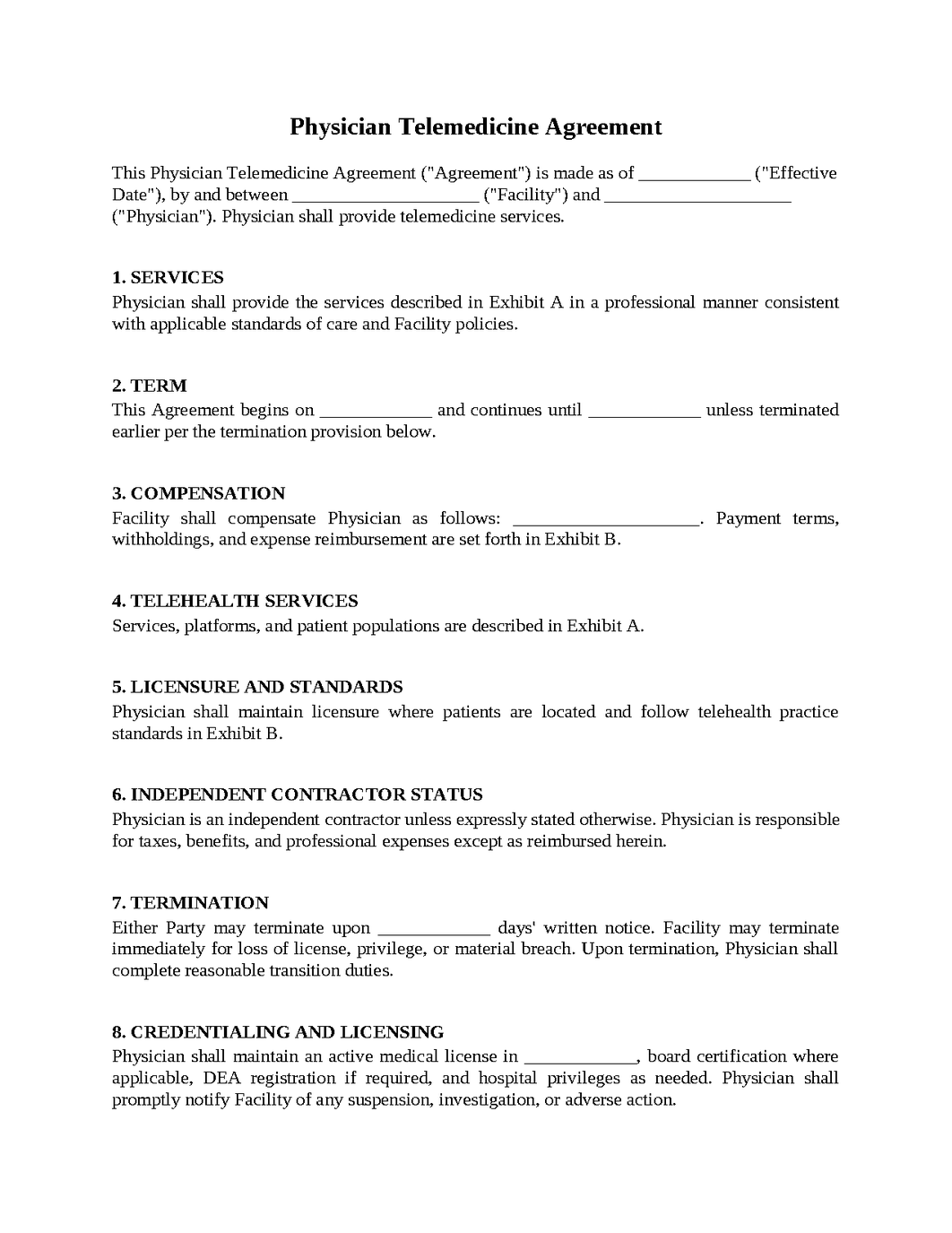
Physician Telemedicine Agreement
A Physician Telemedicine Agreement is a legal contract that establishes the terms under which a physician provides medical services through telehealth technologies rather than traditional in-person visits. These agreements are commonly used by hospitals, telehealth platforms, physician groups, healthcare systems, employers, specialty providers, and virtual care companies. A Physician Telemedicine Agreement typically addresses the scope of services, technology requirements, licensing obligations, patient eligibility, documentation standards, reimbursement procedures, malpractice coverage, privacy requirements, and regulatory compliance. Because telemedicine often involves patients located in different jurisdictions, technology-dependent care, and evolving regulatory requirements, disputes can arise when responsibilities are not documented clearly. A well-drafted Physician Telemedicine Agreement helps protect both parties while supporting safe and effective virtual care delivery.
Licensing Requirements Create Unexpected Problems
A telehealth company contracts with a physician to provide virtual consultations for patients across multiple states. During onboarding, both parties focus heavily on scheduling, technology systems, and patient demand.
Initially, services are provided successfully in several jurisdictions where the physician already holds active licenses. As patient demand grows, however, the company begins scheduling consultations involving patients located in additional states.
The physician assumes the company has verified that all regulatory requirements have been satisfied. The company assumes the physician is responsible for understanding licensing restrictions and ensuring compliance with applicable laws.
Several months later, questions arise regarding services provided to patients in a jurisdiction where licensing requirements were not fully satisfied. Both parties become concerned about potential regulatory consequences.
The disagreement is not caused by intentional misconduct but rather by differing assumptions regarding responsibility for compliance.
To help avoid this problem, a Physician Telemedicine Agreement should clearly allocate responsibility for licensing compliance, identify approved service jurisdictions, establish verification procedures, and require prompt notification when licensing status changes. Clear compliance provisions can significantly reduce regulatory risk.
Technology Failures Disrupt Patient Care
A physician enters into an agreement with a virtual care platform that promises reliable technology and seamless patient interactions.
For several months, the system performs well. As patient volume increases, however, technology issues become more frequent. Video connections fail unexpectedly, patient records load slowly, and communication interruptions occur during consultations.
The physician becomes frustrated because technical problems interfere with patient care and increase appointment times. Patients complain about delays and incomplete consultations. The telehealth company argues that occasional disruptions are unavoidable and that the physician should adapt to temporary issues.
The physician responds that reliable technology is essential to providing safe medical services and maintaining professional standards.
What initially appeared to be a technology issue evolves into a disagreement regarding operational responsibilities and service expectations.
To reduce these risks, a Physician Telemedicine Agreement should establish technology standards, identify system support obligations, define downtime procedures, and allocate responsibility for maintaining the infrastructure necessary to provide services. Detailed operational provisions help ensure continuity of care.
Documentation Standards Become a Source of Dispute
A healthcare organization hires physicians to provide telemedicine consultations for patients seeking urgent care services.
At the outset, everyone assumes that documentation requirements will mirror traditional clinical practice. As the program expands, however, questions arise regarding what information must be recorded during virtual encounters.
The organization expects detailed documentation regarding patient location, consent, technology used, and limitations associated with remote evaluations. Some physicians believe standard clinical notes satisfy professional requirements and are surprised by the additional documentation expectations.
When reimbursement audits occur, several encounters are questioned because required telemedicine-specific information is missing from patient records.
The physicians argue that expectations were never communicated clearly. The organization insists that proper documentation is essential for compliance and reimbursement.
To help prevent these issues, a Physician Telemedicine Agreement should clearly define documentation standards, identify telehealth-specific recordkeeping requirements, and establish procedures for maintaining compliant patient records.
Malpractice Coverage Does Not Match the Service Model
A physician provides telemedicine services through a national virtual care platform while maintaining a separate in-person medical practice.
Both parties assume that professional liability insurance has been addressed appropriately because the physician already maintains malpractice coverage. The agreement references insurance generally but provides little detail regarding telemedicine-specific risks.
Several years later, a patient files a claim involving a virtual consultation. During the insurance review process, questions arise regarding whether the existing policy covers services provided through the telehealth platform and whether coverage extends to all jurisdictions involved.
The physician assumes protection exists because professional services were provided within the scope of practice. The platform assumes the physician's policy covers all aspects of the arrangement.
The resulting uncertainty creates significant legal and financial concerns before the claim itself is even evaluated.
To help avoid these problems, a Physician Telemedicine Agreement should clearly identify insurance requirements, address telemedicine-specific liability coverage, establish minimum policy limits, and define responsibility for maintaining adequate protection throughout the relationship.
Patient Care Responsibilities Become Unclear After the Visit
A physician provides virtual consultations for a telemedicine company specializing in primary care and chronic disease management.
Many patient encounters result in treatment recommendations, medication adjustments, diagnostic testing, or referrals for additional care. While the virtual visit itself may be completed successfully, questions often arise regarding what happens afterward.
Patients assume the telemedicine physician will continue monitoring results and coordinating follow-up care. The telemedicine company believes ongoing management belongs to the patient's local providers. The physician assumes certain responsibilities transfer automatically after the consultation concludes.
As test results return and follow-up questions emerge, confusion develops regarding who is responsible for ongoing care.
The uncertainty creates frustration for patients and increases the risk that important issues may not receive timely attention.
To reduce these risks, a Physician Telemedicine Agreement should clearly define follow-up responsibilities, establish communication procedures with local providers, address continuity-of-care obligations, and specify how post-visit patient concerns will be handled. Clear expectations help ensure that patients receive appropriate ongoing care.
Telemedicine continues to expand access to healthcare and create new opportunities for physicians and healthcare organizations. However, issues involving licensing, technology, documentation, malpractice coverage, and continuity of care can quickly become significant challenges when responsibilities are not documented clearly. A carefully drafted Physician Telemedicine Agreement provides a structured framework for managing these relationships and supporting high-quality virtual care. When prepared thoughtfully, it can help reduce misunderstandings, strengthen compliance efforts, protect professional relationships, and improve patient outcomes in an increasingly digital healthcare environment.

Get started with Upsign today!
Easily send, sign and track your documents