

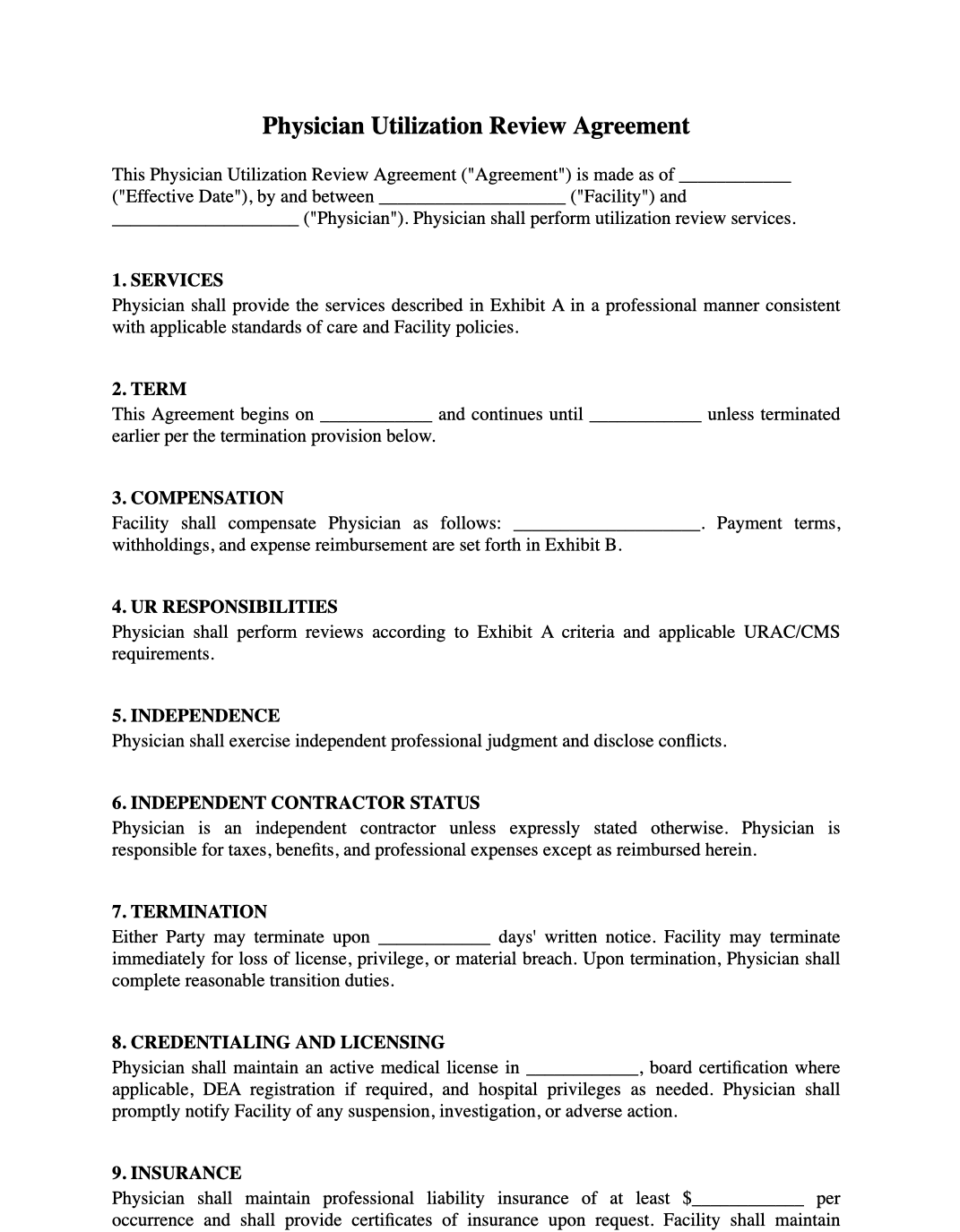
Physician Utilization Review Agreement
A Physician Utilization Review Agreement is a legal contract that establishes the terms under which a physician reviews medical services, treatment plans, admissions, procedures, and healthcare resource utilization to determine whether care is medically necessary, appropriate, efficient, and compliant with applicable guidelines. These agreements are commonly used by hospitals, health plans, insurance companies, managed care organizations, accountable care organizations, government healthcare programs, and third-party review entities. Because utilization review decisions can directly affect patient care, provider reimbursement, regulatory compliance, and healthcare costs, disputes frequently arise when responsibilities and expectations are not clearly documented. A well-drafted Physician Utilization Review Agreement helps create a fair and consistent review process while protecting the interests of patients, providers, and healthcare organizations.
Medical Necessity Standards Are Interpreted Differently
A health plan hires a physician to conduct utilization reviews for high-cost procedures and inpatient admissions. The physician is expected to evaluate whether requested services meet established medical necessity criteria and align with accepted clinical guidelines.
Initially, the review process functions smoothly because most cases fit clearly within established standards. Over time, however, more complex cases begin reaching the physician. Certain patients present with unusual medical histories, overlapping conditions, or circumstances that do not fit neatly within existing review criteria.
The physician approves several requests based on clinical judgment and experience, believing the services are appropriate despite technical guideline limitations. Health plan administrators become concerned that approvals are being granted too broadly and may increase costs unnecessarily.
The physician argues that patient care requires flexibility and individualized assessment. Administrators emphasize the importance of consistent application of utilization standards. What begins as a difference in professional judgment gradually develops into a disagreement regarding how medical necessity should be evaluated.
To help avoid this problem, a Physician Utilization Review Agreement should clearly identify the clinical standards, guidelines, and review criteria that will be used. The agreement should also address situations involving exceptions and establish procedures for handling cases that fall outside standard review parameters.
Turnaround Time Expectations Create Conflict
A managed care organization contracts with a physician to review authorization requests for specialty procedures and hospital admissions. Both parties understand that timely decisions are important because treatment plans often depend upon review outcomes.
At the beginning of the relationship, review volumes remain manageable and response times meet expectations. As enrollment grows, however, the number of requests increases significantly. The physician receives a growing backlog of cases, many of which require extensive record review before decisions can be made.
Providers begin complaining about delays. Patients become frustrated when treatment decisions are postponed. The managed care organization expects rapid turnaround times, while the physician believes thorough clinical review should not be sacrificed for speed.
The disagreement escalates because both sides are focused on legitimate concerns. The organization wants operational efficiency, while the physician prioritizes careful clinical analysis.
To reduce these risks, a Physician Utilization Review Agreement should establish turnaround requirements, define urgent and non-urgent review categories, identify staffing expectations, and provide procedures for managing unusually high review volumes. Clear performance standards help prevent disputes regarding timeliness.
Denials Lead to Provider Challenges
A physician reviewer routinely evaluates requests for advanced imaging studies, specialty treatments, and extended hospital stays.
Most decisions are accepted without issue. Occasionally, however, requests are denied because they fail to satisfy established medical necessity requirements. Several providers begin challenging those decisions and requesting reconsideration.
One physician in particular repeatedly disputes review outcomes, arguing that the utilization reviewer lacks direct knowledge of the patient's condition. The treating physician believes clinical judgment at the bedside should receive greater weight than standardized review criteria.
The utilization reviewer maintains that decisions are based on objective standards and consistent application of organizational policies. As appeals increase, the relationship between reviewers and treating providers becomes strained.
What began as a routine review process starts generating tension throughout the provider network.
To help prevent these issues, a Physician Utilization Review Agreement should establish appeal procedures, define reconsideration rights, identify documentation requirements, and create clear communication channels between reviewers and treating providers. Structured dispute-resolution processes can help reduce conflict and improve transparency.
Documentation Deficiencies Create Compliance Problems
A healthcare organization relies on physician reviewers to support regulatory compliance and demonstrate that utilization review activities are conducted appropriately.
The physician performs reviews consistently and makes well-reasoned decisions based on available information. However, documentation practices vary significantly. Some cases contain detailed notes explaining the rationale for decisions, while others contain only brief summaries.
During a regulatory audit, reviewers are asked to provide evidence supporting numerous prior decisions. Although the physician remembers the review process generally, the documentation is insufficient to explain the reasoning behind certain determinations.
The organization becomes concerned because even accurate decisions can be difficult to defend when supporting records are incomplete. Regulators focus not only on outcomes but also on the consistency and quality of the review process itself.
The audit consumes substantial resources and creates avoidable compliance concerns.
To help avoid these problems, a Physician Utilization Review Agreement should establish documentation standards, record retention requirements, review protocols, and quality control procedures. Strong documentation practices help protect both the reviewer and the organization.
The Review Relationship Ends During a Large Case Backlog
A physician has provided utilization review services for several years and has become familiar with the organization's systems, policies, and provider network.
Eventually, the physician decides to pursue other opportunities and provides notice of resignation. At the time notice is given, hundreds of pending cases remain in various stages of review, and several complex appeals are awaiting final decisions.
The organization worries about maintaining continuity and avoiding delays in patient care. The physician wants to assist with the transition but also needs to focus on future professional commitments.
Questions arise regarding responsibility for pending reviews, unfinished appeals, documentation transfer, and training of replacement reviewers. Because no transition procedures were established previously, both parties struggle to determine how responsibilities should be handed off.
What should be a routine professional transition becomes significantly more complicated than expected.
To help prevent these issues, a Physician Utilization Review Agreement should establish notice requirements, transition obligations, cooperation duties, and procedures for transferring pending matters. Thoughtful transition planning helps ensure continuity and reduces operational disruption.
Physician utilization review programs play an essential role in balancing patient care needs, healthcare resources, regulatory compliance, and cost management. However, issues involving medical necessity standards, review timelines, provider appeals, documentation requirements, and reviewer transitions can become significant sources of conflict when expectations are not documented clearly. A carefully drafted Physician Utilization Review Agreement provides a structured framework for managing these responsibilities and supporting fair, consistent review processes. When prepared thoughtfully, it can help improve decision-making, strengthen compliance efforts, reduce disputes, and support high-quality healthcare delivery.

Get started with Upsign today!
Easily send, sign and track your documents