

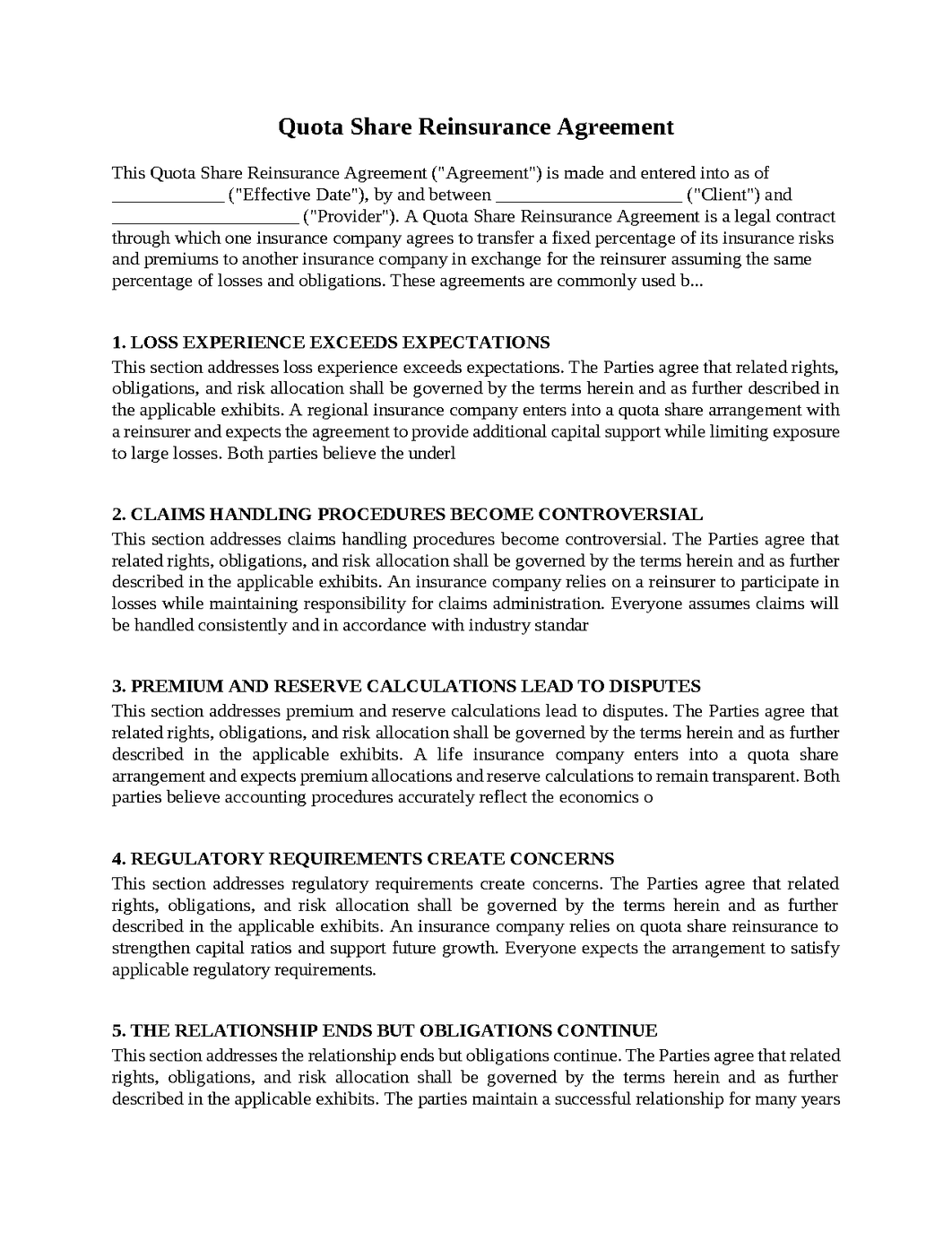
Quota Share Reinsurance Agreement
A Quota Share Reinsurance Agreement is a legal contract through which one insurance company agrees to transfer a fixed percentage of its insurance risks and premiums to another insurance company in exchange for the reinsurer assuming the same percentage of losses and obligations. These agreements are commonly used by property and casualty insurers, life insurance companies, specialty insurers, and reinsurers seeking to spread risk, preserve capital, and improve financial stability. A Quota Share Reinsurance Agreement typically addresses the percentage of risks ceded, premium allocations, claims handling responsibilities, reporting requirements, reserve obligations, and procedures governing disputes and termination. Because both parties share premiums and losses proportionately, disputes can arise when expectations regarding responsibilities and calculations are not documented clearly. A carefully drafted Quota Share Reinsurance Agreement helps establish certainty and protect the interests of both the ceding insurer and the reinsurer.
Loss Experience Exceeds Expectations
A regional insurance company enters into a quota share arrangement with a reinsurer and expects the agreement to provide additional capital support while limiting exposure to large losses. Both parties believe the underlying risks are reasonably predictable.
Initially, claims activity remains within expectations and the arrangement performs successfully. Over time, however, catastrophic events and rising claim frequencies result in losses that exceed projected amounts.
The ceding insurer believes the purpose of the agreement was to share losses proportionately because unexpected events affect both parties equally. The reinsurer believes underwriting assumptions proved inaccurate and argues that risk characteristics were not fully anticipated. As claim payments increase, tensions emerge regarding financial responsibilities.
To help avoid this problem, a Quota Share Reinsurance Agreement should clearly establish the percentage of risks transferred and define the obligations associated with loss sharing.
Claims Handling Procedures Become Controversial
An insurance company relies on a reinsurer to participate in losses while maintaining responsibility for claims administration. Everyone assumes claims will be handled consistently and in accordance with industry standards.
As significant claims arise, questions emerge regarding settlement decisions and whether claim payments are being managed appropriately. Different expectations create uncertainty regarding control over the claims process.
The reinsurer believes careful oversight is necessary because claim decisions directly affect its financial obligations. The ceding insurer believes operational control should remain with the company handling policyholder relationships and argues that prompt settlements benefit everyone involved. As losses increase, disagreements emerge regarding claims administration.
To help prevent these issues, a Quota Share Reinsurance Agreement should clearly establish claims handling procedures and define the authority granted to each party.
Premium and Reserve Calculations Lead to Disputes
A life insurance company enters into a quota share arrangement and expects premium allocations and reserve calculations to remain transparent. Both parties believe accounting procedures accurately reflect the economics of the arrangement.
As the portfolio grows, questions arise regarding reserve assumptions, premium adjustments, and reporting practices. Different interpretations create uncertainty regarding amounts owed between the parties.
The reinsurer believes financial reporting should accurately reflect underlying risks because reserve adequacy is essential to maintaining stability. The ceding insurer believes its accounting practices are appropriate and argues that assumptions should remain consistent with historical methods. As balances increase, tensions develop regarding financial calculations.
To help avoid these problems, a Quota Share Reinsurance Agreement should clearly establish accounting methods and define the procedures governing premiums, reserves, and reporting.
Regulatory Requirements Create Concerns
An insurance company relies on quota share reinsurance to strengthen capital ratios and support future growth. Everyone expects the arrangement to satisfy applicable regulatory requirements.
As regulations evolve, questions arise regarding reserve credits, solvency requirements, and reporting obligations. Concerns increase regarding whether the arrangement continues to provide the intended financial benefits.
The ceding insurer believes regulatory compliance is essential because capital treatment affects operations and future expansion. The reinsurer believes changing standards create uncertainty and argues that both parties share responsibility for adapting to new requirements. As scrutiny increases, disagreements emerge regarding accountability.
To help prevent these issues, a Quota Share Reinsurance Agreement should clearly establish compliance responsibilities and define the obligations relating to regulatory reporting and solvency requirements.
The Relationship Ends but Obligations Continue
The parties maintain a successful relationship for many years and assume the arrangement will continue indefinitely. Long-term plans and financial strategies are built around that expectation.
Eventually, changing priorities lead one side to terminate the agreement. Questions arise regarding existing policies, unpaid claims, reserve liabilities, and responsibilities associated with risks already assumed.
The ceding insurer believes continuing support is necessary because policyholders and existing obligations remain in force. The reinsurer believes future obligations should be limited to the risks already accepted and expects contractual rights to be respected. As the relationship concludes, disagreements emerge regarding the rights and responsibilities that survive termination.
To help avoid this problem, a Quota Share Reinsurance Agreement should clearly establish termination procedures and identify the rights and responsibilities that continue after the relationship ends.
Quota Share Reinsurance Agreements are valuable tools that allow insurance companies to share risks, preserve capital, and support growth while maintaining financial stability. However, issues involving loss experience, claims handling, premium calculations, regulatory compliance, and post-termination obligations can become significant sources of conflict when expectations are not documented clearly. A carefully drafted Quota Share Reinsurance Agreement provides a structured framework for allocating responsibilities and protecting the interests of both ceding insurers and reinsurers. When prepared thoughtfully, it can reduce uncertainty, strengthen industry relationships, improve risk management, and provide the foundation necessary for successful reinsurance arrangements.

Get started with Upsign today!
Easily send, sign and track your documents