

Real Estate Commission Agreement
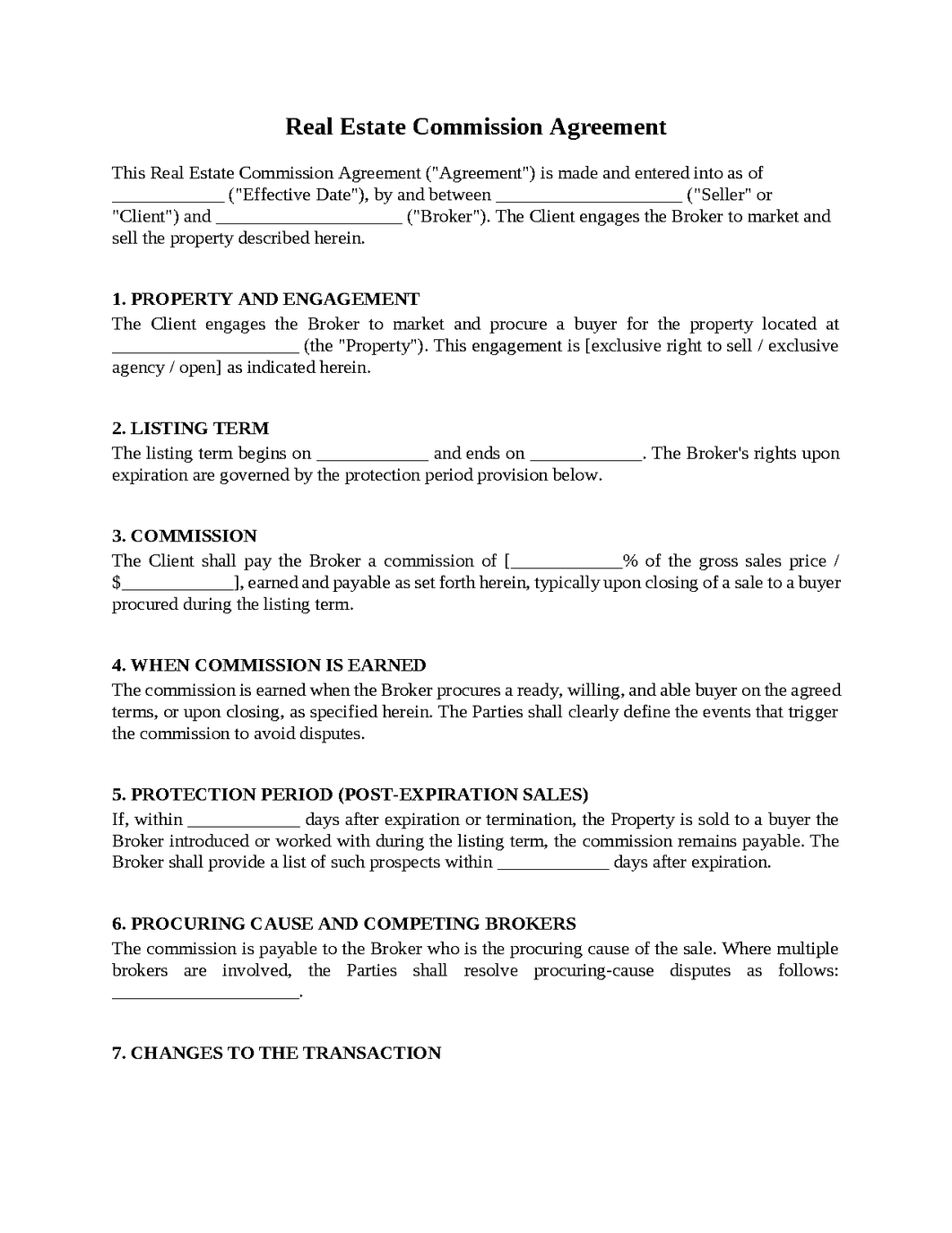
A Real Estate Commission Agreement is a legal contract that establishes the terms under which a real estate broker, agent, or brokerage firm earns compensation for assisting with the sale, purchase, lease, or transfer of real property. These agreements are commonly used in residential sales, commercial transactions, land acquisitions, investment property deals, and leasing arrangements. A Real Estate Commission Agreement typically addresses commission rates, payment triggers, exclusivity rights, listing periods, broker responsibilities, and circumstances under which commissions become earned. Because commissions can involve substantial sums of money and transactions often evolve over many months, disputes frequently arise when expectations regarding compensation are not documented clearly. A well-drafted Real Estate Commission Agreement helps protect both property owners and real estate professionals while reducing the likelihood of commission-related conflicts.
The Property Sells After the Listing Expires
A property owner hires a real estate broker to market a commercial property and locate potential buyers.
During the listing period, the broker invests substantial time and resources into advertising the property, contacting prospects, arranging showings, and negotiating with interested parties. Several potential buyers express interest, but no transaction closes before the listing agreement expires.
Months later, one of the buyers originally introduced by the broker purchases the property directly from the owner. The owner believes no commission is owed because the listing period has ended. The broker argues that the sale resulted directly from efforts performed during the engagement.
What initially appears to be a straightforward transaction becomes a dispute regarding who was responsible for producing the buyer.
Neither party necessarily acted improperly, but the agreement did not clearly address post-expiration transactions.
To help avoid this problem, a Real Estate Commission Agreement should clearly define protection periods, identify circumstances under which commissions remain payable after expiration, and establish procedures for documenting prospective buyers introduced during the engagement.
Multiple Brokers Claim They Procured the Buyer
A property owner works with several brokers while attempting to sell a valuable investment property.
Over time, multiple brokers introduce prospective buyers and participate in various discussions. Eventually, a transaction closes successfully and the property is sold.
Shortly after closing, more than one broker claims entitlement to a commission. Each broker believes individual efforts played a critical role in producing the buyer and facilitating the transaction.
The property owner becomes caught between competing claims and is uncertain which broker should receive compensation. The brokers present different versions of events and point to separate interactions with the buyer.
What should be a celebratory closing becomes a complicated commission dispute.
To reduce these risks, a Real Estate Commission Agreement should clearly define procuring cause standards, establish documentation procedures, and specify how commission claims will be evaluated if multiple brokers become involved.
The Transaction Changes Before Closing
A broker successfully introduces a buyer to a property owner and negotiations begin.
Initially, the transaction involves a direct sale at a specific purchase price. As discussions continue, however, the parties modify the structure significantly. Portions of the deal involve seller financing, additional property interests, and contingent future payments.
When the transaction closes, questions arise regarding how the broker's commission should be calculated. The owner believes compensation should be based only on the cash received at closing. The broker believes the commission should reflect the total economic value of the transaction.
The disagreement becomes significant because the revised structure differs substantially from the original proposal.
Neither side anticipated the issue when negotiations began.
To help prevent these problems, a Real Estate Commission Agreement should clearly define how commissions are calculated, address non-cash consideration, and establish procedures for valuing complex transaction structures.
The Seller Refuses an Offer the Broker Believes Satisfies the Agreement
A homeowner hires a broker under an agreement providing for a commission if the broker produces a buyer willing to purchase the property under specified terms.
After several weeks of marketing, the broker presents an offer that closely matches the listing price and major transaction terms. The seller decides not to proceed because personal circumstances have changed and selling is no longer desirable.
The broker believes the commission has been earned because a qualified buyer was produced. The seller argues that no commission should be due because no sale occurred.
The disagreement centers on whether compensation depends on producing a qualified buyer or completing a successful closing.
Both parties believed they understood the arrangement, yet their expectations differ dramatically.
To help avoid these issues, a Real Estate Commission Agreement should clearly identify when commissions become earned, define qualified buyer standards, and explain whether compensation depends upon closing the transaction.
A Lease Transaction Creates Long-Term Commission Questions
A property owner hires a broker to locate commercial tenants for a retail property.
The broker successfully negotiates a lease with a new tenant and receives an initial commission. Several years later, the tenant exercises renewal options, expands into additional space, and negotiates amendments that significantly increase rental payments.
Questions arise regarding whether the broker is entitled to additional commissions related to the expanded relationship.
The owner believes the original commission satisfied all obligations. The broker argues that future lease expansions and renewals were contemplated by the original transaction.
As the value of the lease relationship grows, the financial significance of the disagreement increases as well.
To reduce these risks, a Real Estate Commission Agreement should clearly address renewals, expansions, extensions, and future transactions involving tenants introduced by the broker. Detailed commission provisions help prevent uncertainty years after the original transaction occurs.
Real Estate Commission Agreements play a critical role in defining compensation rights and expectations within real estate transactions. However, issues involving expired listings, competing brokers, changing transaction structures, qualified buyers, and long-term leasing relationships can become significant sources of conflict when expectations are not documented clearly. A carefully drafted Real Estate Commission Agreement provides a structured framework for managing these relationships and protecting all parties involved. When prepared thoughtfully, it can help reduce misunderstandings, support successful transactions, preserve professional relationships, and ensure that compensation is earned and paid according to clearly defined standards.

Get started with Upsign today!
Easily send, sign and track your documents