

Revenue Sharing Agreement
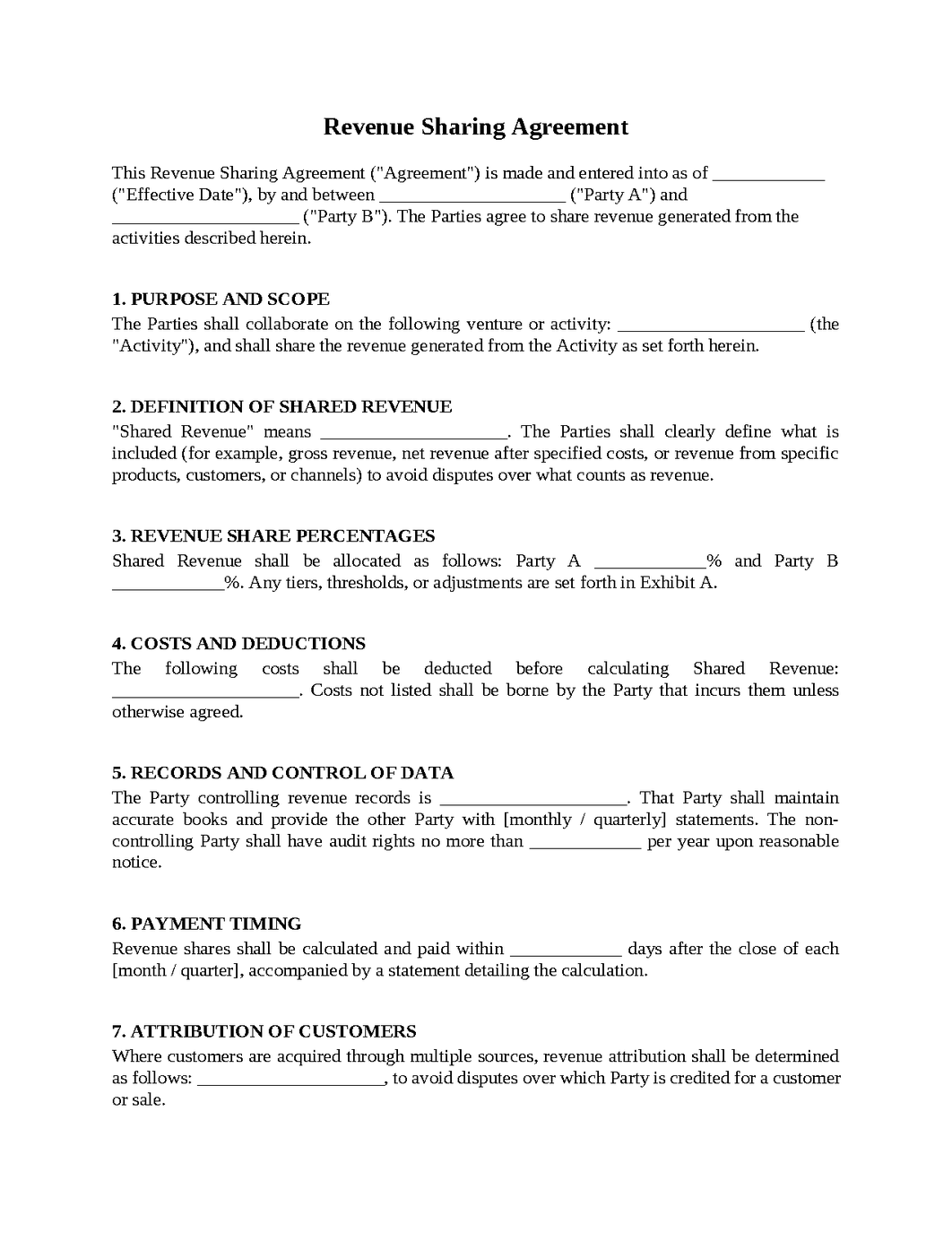
A Revenue Sharing Agreement is a legal contract that establishes the terms under which two or more parties share revenue generated from a business, product, service, project, marketing campaign, partnership, or commercial relationship. Unlike a Profit Sharing Agreement, which focuses on net profits after expenses, a Revenue Sharing Agreement typically allocates a percentage of gross revenue or specified revenue streams before certain expenses are deducted. These agreements are commonly used among software companies, affiliates, strategic partners, distributors, content creators, licensors, referral partners, investors, and joint venture participants. Because compensation is tied directly to revenue generation, disputes can arise when revenue calculations, reporting obligations, and payment rights are not clearly documented. A well-drafted Revenue Sharing Agreement helps align incentives and reduce future conflicts.
The Parties Disagree About What Revenue Is Included
A software company partners with a marketing firm to launch a new subscription service.
To align incentives, the parties agree that the marketing firm will receive a percentage of revenue generated from customers acquired through the campaign. Initially, the arrangement appears straightforward because only one product is being offered.
Over time, however, the software company introduces premium upgrades, consulting services, training programs, and additional subscription tiers. Revenue begins flowing from multiple sources connected to the same customer relationships.
The marketing firm believes all revenue generated from referred customers should be included in the sharing arrangement. The software company believes only the original subscription revenue qualifies.
The disagreement becomes increasingly significant as customer spending increases.
Neither side intended confusion, but both interpret the agreement differently.
To help avoid this problem, a Revenue Sharing Agreement should clearly define qualifying revenue, identify excluded revenue sources, and establish detailed calculation procedures for all compensation obligations.
One Party Controls the Revenue Records
A content creator enters into a revenue-sharing arrangement with a digital platform.
The platform collects payments from customers, processes transactions, and maintains all revenue records. The creator relies entirely on reports provided by the platform to determine compensation.
As the business grows, questions arise regarding refunds, discounts, promotional pricing, and transaction fees. The creator becomes concerned that reported revenue may not accurately reflect the amounts generated.
The platform insists that calculations are accurate and consistent with industry practices. The creator wants greater transparency and independent verification rights.
Trust begins to erode because one party controls all of the information necessary to calculate payments.
To reduce these risks, a Revenue Sharing Agreement should establish reporting requirements, define accounting standards, provide audit rights, and identify the records that must be maintained to support revenue calculations.
Customers Are Acquired Through Multiple Sources
A referral partner and a service provider enter into a revenue-sharing arrangement intended to reward new customer introductions.
For several years, the arrangement functions successfully. Eventually, certain customers interact with multiple marketing channels before making purchasing decisions.
The referral partner claims that several customers originated from its efforts and should generate revenue-sharing payments. The service provider argues that those customers were acquired through advertising campaigns, internal sales efforts, or other business development activities.
The parties disagree regarding which source should receive credit for generating the revenue.
What began as a simple compensation arrangement becomes increasingly difficult to administer.
To help prevent these issues, a Revenue Sharing Agreement should establish attribution rules, define qualifying customer acquisition methods, and identify procedures for resolving disputes regarding customer ownership.
Revenue Continues After the Relationship Ends
A consultant helps a company launch a new service and negotiates a percentage of future revenue generated by the business.
Several years later, the consulting relationship ends. The service remains successful and continues generating substantial revenue long after the consultant's involvement concludes.
The consultant believes revenue-sharing payments should continue because the original contribution helped create the business opportunity. The company believes compensation should end when the consulting relationship terminates.
The disagreement becomes significant because ongoing revenue far exceeds what either party originally anticipated.
Neither side fully considered the long-term implications when the agreement was signed.
To reduce these risks, a Revenue Sharing Agreement should clearly define payment duration, establish termination rules, identify survival provisions, and specify whether revenue-sharing rights continue after the business relationship ends.
The Business Is Acquired by Another Company
A startup enters into a revenue-sharing arrangement with a strategic partner as part of a product launch.
Several years later, the startup is acquired by a larger company. The acquiring company inherits the business but questions whether it must continue honoring the existing revenue-sharing arrangement.
The strategic partner argues that the agreement remains binding and should survive the acquisition. The acquiring company believes the transaction fundamentally changed the relationship and may alter future obligations.
The issue becomes increasingly important because future revenue projections are substantial.
What began as a partnership issue becomes a major transactional concern.
To help avoid these problems, a Revenue Sharing Agreement should address mergers, acquisitions, asset sales, and successor obligations. Clear change-of-control provisions help prevent uncertainty if ownership changes.
Revenue Sharing Agreements can be effective tools for aligning incentives and rewarding parties who contribute to business growth. However, issues involving revenue definitions, reporting transparency, customer attribution, post-termination payments, and business acquisitions can become significant sources of conflict when expectations are not documented clearly. A carefully drafted Revenue Sharing Agreement provides a structured framework for managing these relationships and protecting all parties involved. When prepared thoughtfully, it can help reduce misunderstandings, improve accountability, strengthen partnerships, and support long-term commercial success.

Get started with Upsign today!
Easily send, sign and track your documents