

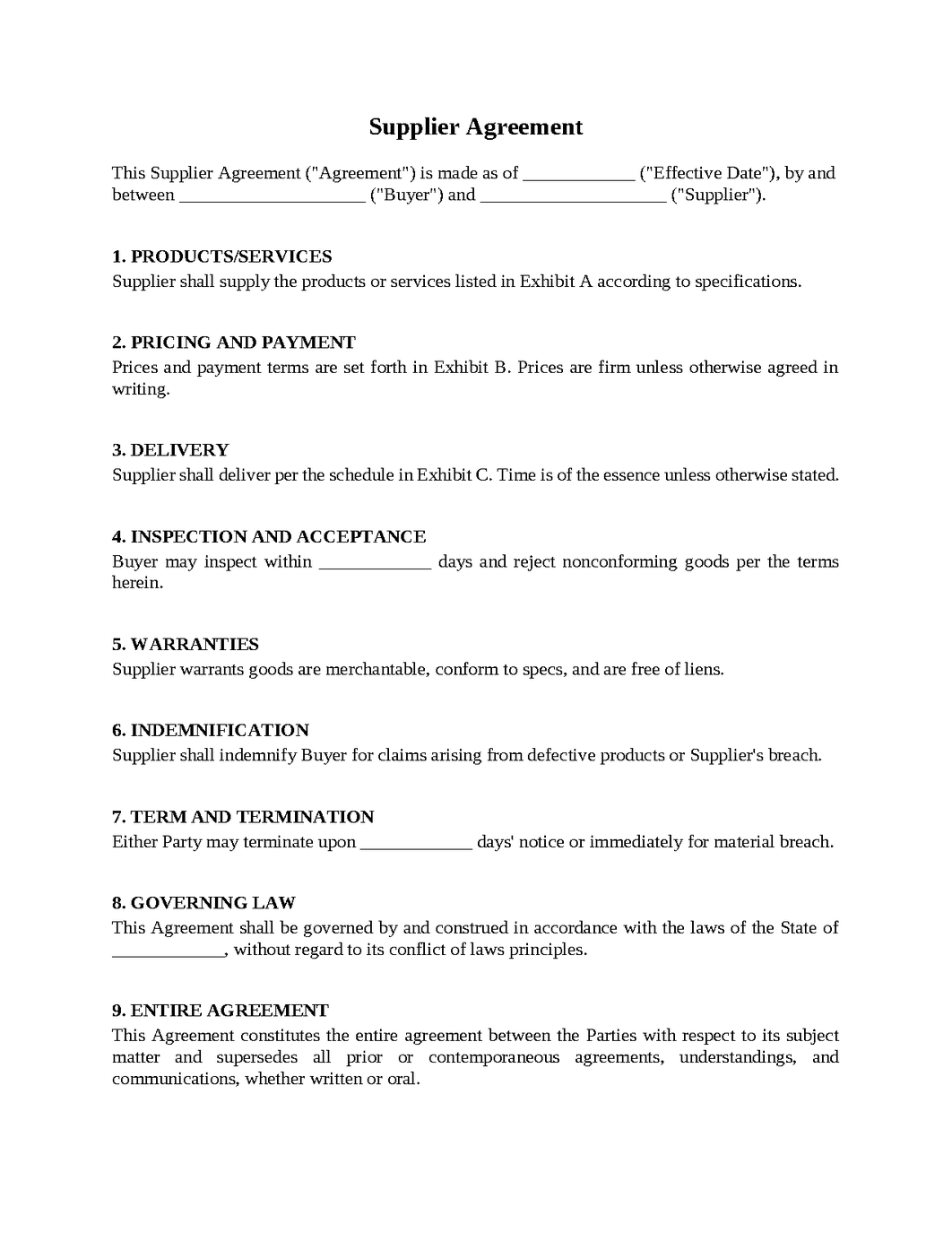
Supplier Agreement
A Supplier Agreement is a legal contract that establishes the terms under which a supplier provides goods, materials, components, inventory, equipment, or related services to a customer or business. Supplier Agreements are commonly used in manufacturing, retail, healthcare, technology, construction, food distribution, logistics, and wholesale industries. These agreements typically address pricing, delivery schedules, quality standards, payment terms, warranties, inventory requirements, and termination rights. Because businesses often depend heavily on suppliers to maintain operations and satisfy customer demand, disputes can arise when expectations regarding performance and reliability are not documented clearly. A well-drafted Supplier Agreement helps protect both suppliers and customers while promoting stable long-term business relationships.
Product Quality Does Not Meet Expectations
A manufacturer enters into a long-term relationship with a supplier that provides critical components used in finished products.
Initially, deliveries arrive on time and quality standards are met consistently. Over time, however, the manufacturer begins receiving products that appear inconsistent with prior shipments.
Some components fail quality inspections, while others require additional rework before they can be incorporated into production. The manufacturer believes the supplier is no longer meeting agreed standards.
The supplier argues that the products remain commercially acceptable and within reasonable tolerances.
The disagreement becomes significant because quality issues affect production schedules and customer satisfaction.
To help avoid this problem, a Supplier Agreement should clearly define product specifications, establish quality standards, identify inspection procedures, and explain the remedies available if products fail to meet agreed requirements.
Delivery Delays Disrupt Operations
A business relies on a supplier for inventory necessary to fulfill customer orders.
The supplier understands that timely deliveries are essential because the customer maintains limited inventory reserves. For several years, deliveries occur according to schedule.
Unexpected challenges eventually arise, causing repeated shipping delays. Production schedules are interrupted, customer orders are postponed, and business relationships become strained.
The customer believes the supplier should have taken steps to prevent disruptions. The supplier points to transportation issues, labor shortages, or other factors outside its control.
The disagreement grows because the consequences of delay affect multiple parts of the business.
To reduce these risks, a Supplier Agreement should establish delivery requirements, define acceptable lead times, address delay notifications, and identify remedies available when shipments are not delivered as agreed.
Prices Increase Unexpectedly
A company enters into a supply arrangement expecting stable pricing for important materials.
The business uses the pricing information to forecast costs, prepare budgets, and negotiate contracts with its own customers. As market conditions change, the supplier seeks substantial price increases.
The supplier argues that higher material costs, labor expenses, and market pressures make the increases necessary. The customer believes the original pricing should remain in effect for a longer period.
The disagreement creates uncertainty because future profitability depends on predictable costs.
Neither side anticipated the magnitude of the pricing changes.
To help prevent these issues, a Supplier Agreement should clearly establish pricing terms, identify adjustment mechanisms, define notice requirements, and explain when price changes may occur.
Inventory Shortages Lead to Allocation Disputes
A supplier serves multiple customers and experiences a sudden shortage of available inventory.
Demand exceeds expectations, and the supplier cannot satisfy every order in full. The supplier must decide how limited inventory will be allocated among customers.
One customer believes it should receive priority because of its long-standing relationship and historical purchasing volume. The supplier believes inventory should be distributed according to broader business considerations.
The disagreement becomes increasingly important because the customer's operations depend on receiving adequate supply.
What began as a temporary shortage becomes a dispute regarding fairness and priority.
To help avoid these problems, a Supplier Agreement should address allocation procedures, identify priority rights where applicable, and establish expectations for managing shortages and supply disruptions.
The Relationship Ends Abruptly
A supplier and customer work together successfully for many years.
Eventually, one party decides to terminate the relationship due to changing business strategies, performance concerns, or market conditions. At the time of termination, open purchase orders, inventory commitments, tooling investments, and outstanding obligations remain unresolved.
The customer wants sufficient time to locate alternative suppliers and avoid operational disruptions. The supplier wants clarity regarding future obligations and inventory commitments.
Questions arise regarding final deliveries, outstanding payments, confidential information, and transition responsibilities.
What should be a business decision becomes an operational challenge.
To reduce these risks, a Supplier Agreement should establish termination procedures, define notice requirements, address existing purchase orders, and identify responsibilities during any transition period.
Supplier Agreements are essential tools for managing commercial relationships involving the ongoing provision of goods and materials. However, issues involving product quality, delivery performance, pricing changes, inventory shortages, and termination procedures can become significant sources of conflict when expectations are not documented clearly. A carefully drafted Supplier Agreement provides a structured framework for managing these relationships and protecting all parties involved. When prepared thoughtfully, it can help reduce misunderstandings, strengthen supply chain reliability, improve accountability, and support long-term business success.

Get started with Upsign today!
Easily send, sign and track your documents