

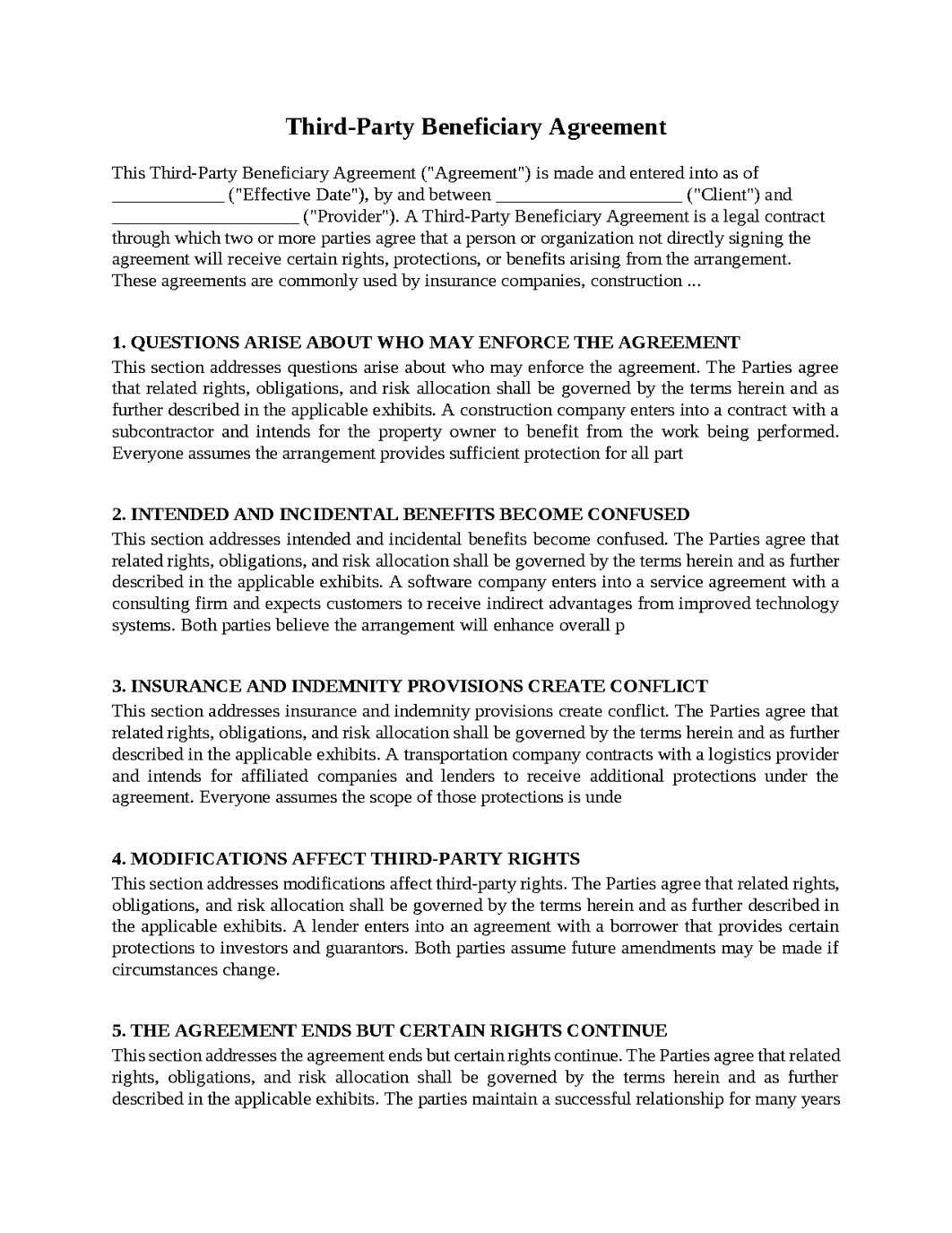
Third-Party Beneficiary Agreement
A Third-Party Beneficiary Agreement is a legal contract through which two or more parties agree that a person or organization not directly signing the agreement will receive certain rights, protections, or benefits arising from the arrangement. These agreements are commonly used by insurance companies, construction firms, lenders, employers, software providers, and commercial businesses seeking to extend specific contractual benefits to individuals or entities outside the primary relationship. A Third-Party Beneficiary Agreement typically addresses the rights being granted, limitations on enforcement, responsibilities of the contracting parties, dispute resolution procedures, and provisions governing termination. Because individuals who are not direct participants may claim rights under the agreement, disputes can arise when expectations regarding those rights are not documented clearly. A carefully drafted Third-Party Beneficiary Agreement helps establish certainty and protect the interests of all parties involved.
Questions Arise About Who May Enforce the Agreement
A construction company enters into a contract with a subcontractor and intends for the property owner to benefit from the work being performed. Everyone assumes the arrangement provides sufficient protection for all parties involved.
Initially, the project progresses smoothly and expectations remain aligned. Over time, however, defects and delays occur, and questions arise regarding whether the property owner may pursue claims directly against the subcontractor.
The property owner believes protections should exist because the work was intended to benefit the completed project. The subcontractor believes obligations are owed only to the general contractor and argues that the owner should not possess independent enforcement rights. As losses increase, tensions emerge regarding who may assert claims.
To help avoid this problem, a Third-Party Beneficiary Agreement should clearly establish the rights granted to third parties and define the circumstances under which those rights may be enforced.
Intended and Incidental Benefits Become Confused
A software company enters into a service agreement with a consulting firm and expects customers to receive indirect advantages from improved technology systems. Both parties believe the arrangement will enhance overall performance.
As service interruptions occur, customers claim they should receive compensation because they benefited from the relationship. Questions arise regarding whether those customers were intended beneficiaries under the agreement.
The customers believe they should have rights because the services were designed to improve their experience. The contracting parties believe any benefits received by customers were incidental and argue that no direct contractual rights were intended. As complaints increase, disagreements emerge regarding the distinction between intended and incidental beneficiaries.
To help prevent these issues, a Third-Party Beneficiary Agreement should clearly establish who qualifies as a beneficiary and define any limitations applicable to enforcement rights.
Insurance and Indemnity Provisions Create Conflict
A transportation company contracts with a logistics provider and intends for affiliated companies and lenders to receive additional protections under the agreement. Everyone assumes the scope of those protections is understood.
Following a major accident, questions arise regarding whether affiliated entities qualify for indemnification and insurance coverage. Different interpretations create uncertainty regarding financial responsibility.
The affiliated companies believe they should receive protection because the agreement contemplated their involvement in the business relationship. The service provider believes the protections should be interpreted narrowly and argues that liability should not extend beyond the primary contracting parties. As claims increase, tensions develop regarding indemnity rights.
To help avoid these problems, a Third-Party Beneficiary Agreement should clearly establish indemnification provisions and define the parties entitled to protection.
Modifications Affect Third-Party Rights
A lender enters into an agreement with a borrower that provides certain protections to investors and guarantors. Both parties assume future amendments may be made if circumstances change.
As market conditions evolve, the lender and borrower modify the agreement without consulting the beneficiaries. Questions arise regarding whether those changes improperly affect rights previously granted to others.
The beneficiaries believe their interests should remain protected because important financial decisions were made in reliance upon the agreement. The contracting parties believe flexibility is necessary and argue that amendments are essential to adapting to changing circumstances. As financial issues emerge, disagreements arise regarding modification rights.
To help prevent these issues, a Third-Party Beneficiary Agreement should clearly establish amendment procedures and define when beneficiary consent is required.
The Agreement Ends but Certain Rights Continue
The parties maintain a successful relationship for many years and assume the arrangement will continue indefinitely. Future planning and expectations are built around that assumption.
Eventually, changing priorities lead one side to terminate the agreement. Questions arise regarding claims that arose before termination and whether beneficiaries retain any rights after the relationship ends.
The beneficiaries believe previously granted protections should survive because they relied upon those rights in making important decisions. The contracting parties believe future obligations should end with the agreement and expect finality. As unresolved issues remain, disagreements emerge regarding the rights and responsibilities that survive termination.
To help avoid this problem, a Third-Party Beneficiary Agreement should clearly establish termination procedures and identify the rights and obligations that continue after the agreement ends.
Third-Party Beneficiary Agreements are valuable tools that allow contracting parties to extend protections and benefits to others while maintaining clear legal relationships. However, issues involving enforcement rights, intended beneficiaries, indemnification provisions, amendment procedures, and post-termination obligations can become significant sources of conflict when expectations are not documented clearly. A carefully drafted Third-Party Beneficiary Agreement provides a structured framework for allocating responsibilities and protecting the interests of both the contracting parties and designated beneficiaries. When prepared thoughtfully, it can reduce uncertainty, strengthen commercial relationships, facilitate complex transactions, and provide the foundation necessary for effective long-term arrangements.

Get started with Upsign today!
Easily send, sign and track your documents