

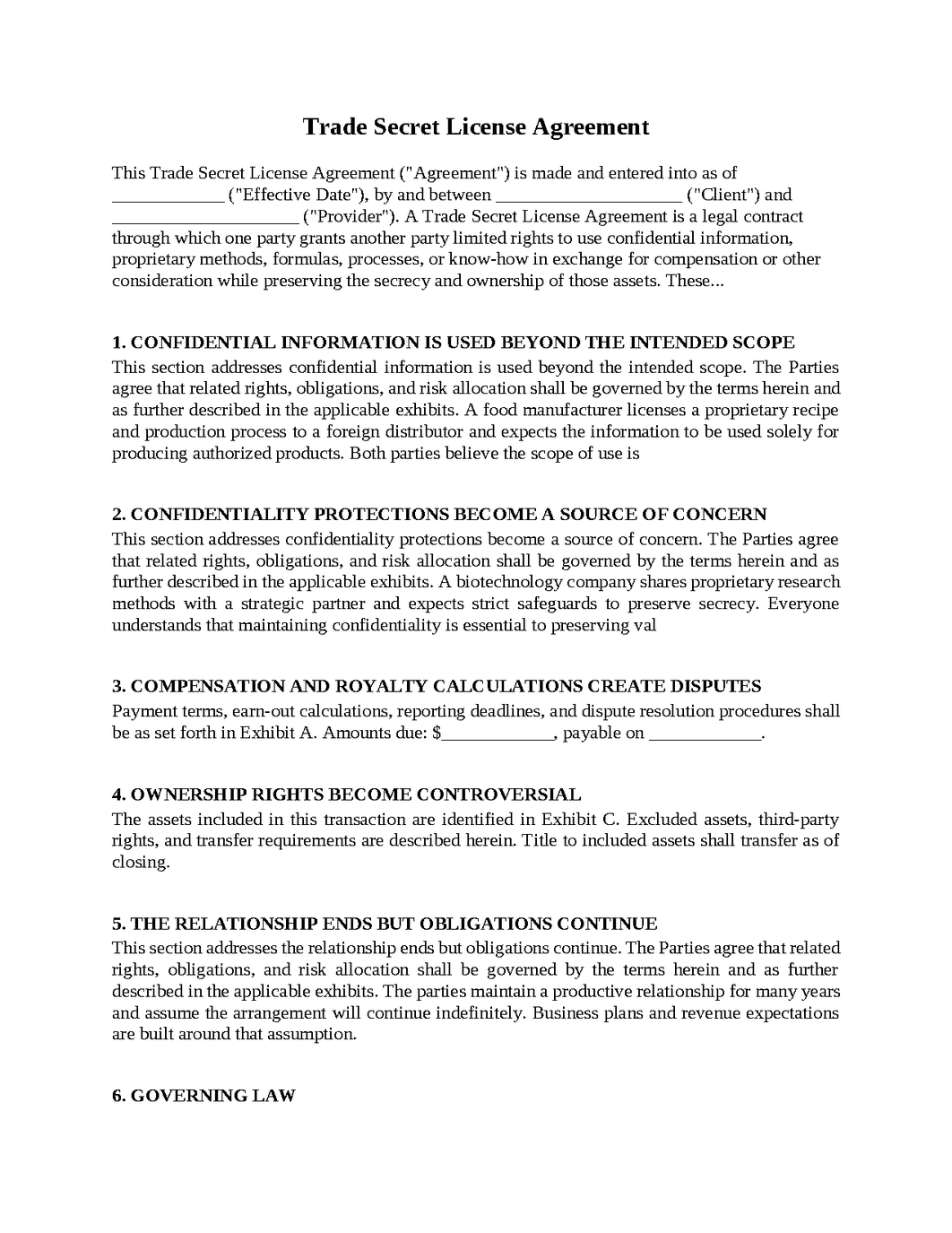
Trade Secret License Agreement
A Trade Secret License Agreement is a legal contract through which one party grants another party limited rights to use confidential information, proprietary methods, formulas, processes, or know-how in exchange for compensation or other consideration while preserving the secrecy and ownership of those assets. These agreements are commonly used by manufacturers, software companies, biotechnology firms, food producers, engineering businesses, and research organizations seeking to commercialize valuable knowledge without surrendering ownership. A Trade Secret License Agreement typically addresses permitted uses, confidentiality requirements, compensation arrangements, ownership rights, security obligations, and procedures governing disputes and termination. Because trade secrets derive much of their value from remaining confidential, disputes can arise when expectations regarding protection and use are not documented clearly. A carefully drafted Trade Secret License Agreement helps establish certainty and protect the interests of both licensors and licensees.
Confidential Information Is Used Beyond the Intended Scope
A food manufacturer licenses a proprietary recipe and production process to a foreign distributor and expects the information to be used solely for producing authorized products. Both parties believe the scope of use is clearly understood.
Initially, operations proceed successfully and product demand increases. Over time, however, questions arise regarding whether the distributor has begun applying the proprietary methods to additional products and markets.
The trade secret owner believes the expanded use exceeds the intended scope because the information represents years of investment and competitive advantage. The distributor believes adapting the process to related products is a natural extension of the relationship and argues that flexibility is necessary for growth. As new opportunities emerge, tensions develop regarding permitted uses.
To help avoid this problem, a Trade Secret License Agreement should clearly establish the authorized uses of confidential information and define any limitations applicable to additional products or markets.
Confidentiality Protections Become a Source of Concern
A biotechnology company shares proprietary research methods with a strategic partner and expects strict safeguards to preserve secrecy. Everyone understands that maintaining confidentiality is essential to preserving value.
As additional employees and contractors gain access to the information, concerns arise regarding unauthorized disclosures and security procedures. Questions emerge regarding whether adequate protections are being maintained.
The biotechnology company believes strict safeguards are essential because the trade secrets provide a significant competitive advantage. The partner believes reasonable procedures are already in place and argues that some information sharing is necessary to support operations. As concerns increase, disagreements emerge regarding confidentiality obligations.
To help prevent these issues, a Trade Secret License Agreement should clearly establish confidentiality requirements and define the procedures governing access, security, and disclosure.
Compensation and Royalty Calculations Create Disputes
An engineering company licenses proprietary manufacturing techniques and expects royalties to provide ongoing income. Both parties assume the compensation structure is transparent and straightforward.
As production increases, questions arise regarding output measurements, deductions, and whether certain products should be included when calculating royalties. Different interpretations create uncertainty regarding payments.
The trade secret owner believes royalties should reflect the full value generated because the licensed know-how made production possible. The licensee believes certain expenses and products should be excluded and argues that industry practices support those adjustments. As revenues increase, tensions develop regarding compensation.
To help avoid these problems, a Trade Secret License Agreement should clearly establish royalty formulas and define the methods used to calculate compensation.
Ownership Rights Become Controversial
A software company licenses proprietary algorithms to another business and expects ownership rights to remain intact. Both parties assume that improvements and modifications will benefit the relationship.
As the licensee develops enhancements and additional applications, questions arise regarding who owns those improvements and derivative technologies. Different expectations create uncertainty regarding intellectual property rights.
The software company believes ownership should remain with the original creator because the underlying technology made the enhancements possible. The licensee believes its independent efforts justify ownership of newly developed features and argues that innovation should be rewarded. As the value of the technology increases, disagreements emerge regarding ownership.
To help prevent these issues, a Trade Secret License Agreement should clearly establish ownership rights and define the treatment of improvements and derivative works.
The Relationship Ends but Obligations Continue
The parties maintain a productive relationship for many years and assume the arrangement will continue indefinitely. Business plans and revenue expectations are built around that assumption.
Eventually, changing priorities lead one side to terminate the relationship. Questions arise regarding the return of confidential information, ongoing royalty obligations, and restrictions involving knowledge previously shared.
The trade secret owner believes continuing protections are essential because the value of confidential information survives long after the agreement ends. The licensee believes future obligations should be limited according to the contract and expects finality. As the relationship concludes, disagreements emerge regarding the rights and responsibilities that survive termination.
To help avoid this problem, a Trade Secret License Agreement should clearly establish termination procedures and identify the obligations that continue after the relationship ends.
Trade Secret License Agreements are valuable tools that allow businesses to commercialize proprietary knowledge while preserving ownership and competitive advantages. However, issues involving unauthorized use, confidentiality protections, royalty calculations, ownership rights, and post-termination responsibilities can become significant sources of conflict when expectations are not documented clearly. A carefully drafted Trade Secret License Agreement provides a structured framework for allocating responsibilities and protecting the interests of both licensors and licensees. When prepared thoughtfully, it can reduce uncertainty, encourage innovation, strengthen business relationships, and provide the foundation necessary for successful commercialization of valuable confidential information.

Get started with Upsign today!
Easily send, sign and track your documents