

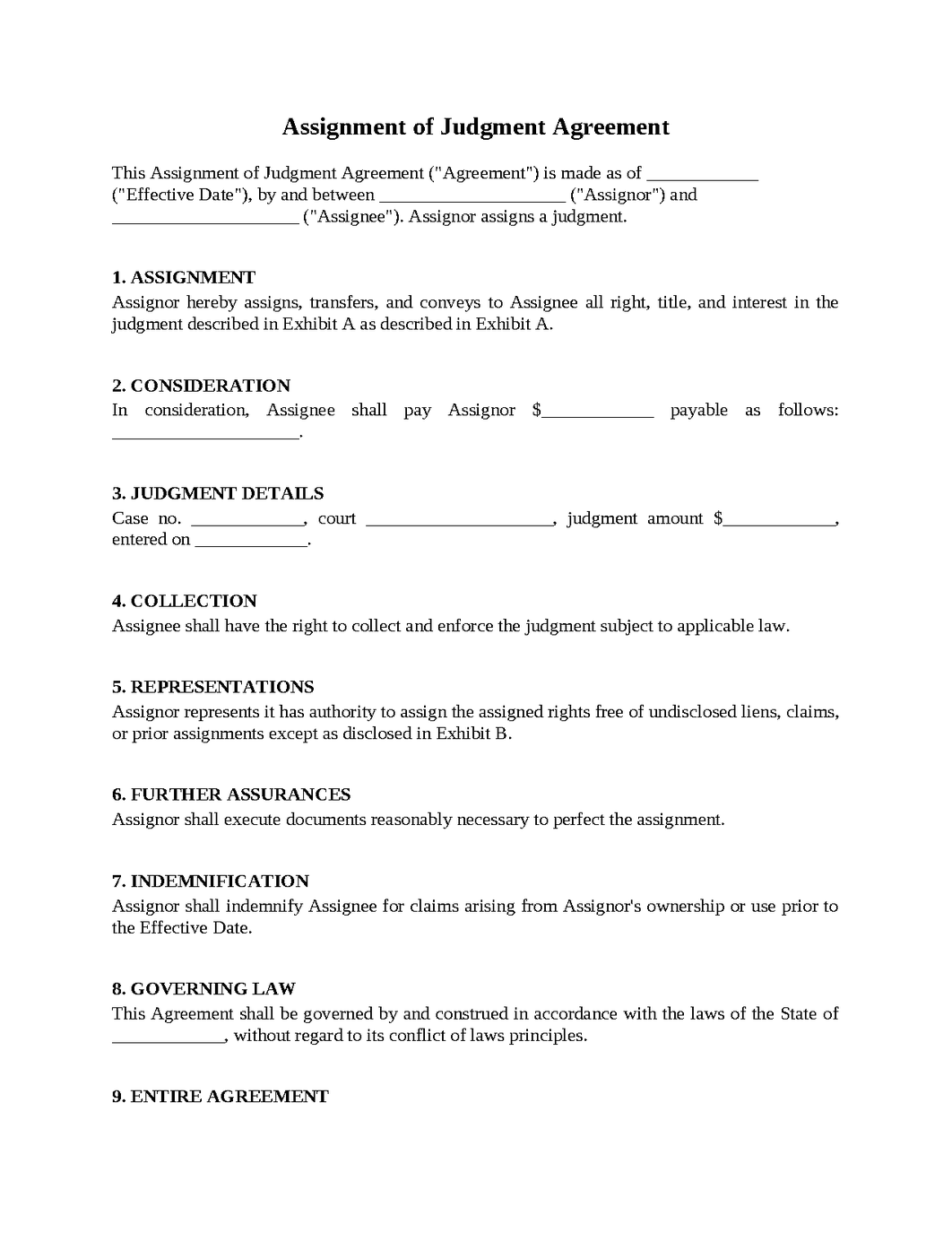
Assignment of Judgment Agreement
An Assignment of Judgment Agreement is a legal contract used when the owner of a court judgment transfers the right to collect that judgment to another person or entity. The party transferring the judgment is known as the assignor, while the recipient is known as the assignee. Judgments commonly arise after lawsuits involving unpaid debts, breach of contract claims, personal injury matters, business disputes, landlord-tenant conflicts, and other legal proceedings. Because judgments often represent valuable financial assets, they are frequently bought, sold, transferred, pledged as collateral, or assigned as part of business transactions. However, collecting a judgment can be far more complicated than simply obtaining a court order. Questions often arise regarding ownership, collection rights, enforcement authority, settlement authority, and collection costs. An Assignment of Judgment Agreement helps document the transfer and establish clear expectations regarding who owns and controls the judgment going forward.
The Judgment Debtor Continues Negotiating with the Wrong Party
A construction company wins a lawsuit against a former customer and obtains a judgment for more than $400,000. After several unsuccessful collection attempts, the company decides to sell the judgment to a professional judgment recovery firm.
The transaction closes, and ownership of the judgment transfers to the recovery firm.
Several weeks later, the judgment debtor contacts the construction company and offers to discuss a settlement. The debtor is unaware that the judgment has been assigned.
A company employee, wanting to be helpful, engages in discussions and even suggests a possible settlement amount.
Meanwhile, the recovery firm is pursuing its own collection efforts and has no idea these conversations are taking place.
The debtor soon receives conflicting communications from both parties and becomes uncertain about who actually owns the judgment.
Settlement discussions collapse, frustration increases, and collection efforts are delayed.
This problem is surprisingly common because judgment debtors often continue communicating with the party they originally litigated against rather than the new judgment owner.
To avoid this issue, an Assignment of Judgment Agreement should require prompt notice to the judgment debtor, clearly establish the effective date of the transfer, and specify that all future settlement discussions and collection communications must be directed to the assignee. The agreement should also address how accidental communications received by the assignor will be handled after the assignment.
The Assignee Discovers the Judgment Is Difficult to Collect
A private investor purchases several judgments from a law firm that routinely represents commercial creditors. One judgment appears particularly attractive because the debtor owes nearly $750,000.
The investor assumes collection will be relatively straightforward.
After acquiring the judgment, however, the investor begins investigating the debtor's financial condition and discovers several problems.
The debtor no longer owns significant assets. Real estate that once appeared valuable has been refinanced. Business operations have declined substantially. Other creditors have already filed claims against many of the debtor's remaining assets.
The investor quickly realizes that obtaining a judgment and collecting a judgment are two very different things.
Although the judgment remains legally valid, the practical likelihood of recovery is far lower than anticipated.
The investor becomes frustrated and argues that the value of the judgment was overstated during negotiations.
Collection risk is one of the most significant issues affecting judgment assignments. A judgment may appear valuable based on its face amount while being extremely difficult to enforce in practice.
To reduce misunderstandings, an Assignment of Judgment Agreement should clearly address whether any representations are being made regarding collectability, identify known collection challenges, and specify the extent to which the assignee is relying on its own investigation when evaluating the judgment.
Multiple Parties Claim an Interest in the Judgment
A business obtains a substantial judgment against a former supplier. Over time, the judgment becomes involved in several different transactions.
At one point, the judgment is pledged as collateral for a loan. Later, management negotiates a separate transaction involving the same judgment.
Years pass before anyone notices a problem.
The issue surfaces when the judgment debtor attempts to negotiate a payoff. Two separate parties claim ownership rights and each insists it is entitled to receive payment.
The debtor refuses to proceed until ownership is clarified.
Attorneys begin reviewing years of loan documents, assignment agreements, security arrangements, and court filings. The dispute becomes increasingly expensive as everyone attempts to establish priority.
Meanwhile, the debtor's financial condition continues deteriorating.
What could have been a successful collection opportunity becomes a battle between competing claimants.
To help prevent these disputes, an Assignment of Judgment Agreement should contain representations regarding ownership, prior assignments, security interests, and competing claims. The agreement should require disclosure of any existing encumbrances and provide remedies if ownership representations prove inaccurate.
The Assignee Wants to Settle but the Assignor Objects
A software company obtains a judgment against a former business partner following years of litigation. Eventually, the company assigns the judgment to a collection firm in exchange for an upfront payment.
Several months later, the collection firm receives a settlement offer from the judgment debtor.
The collection firm believes the offer is reasonable and wants to resolve the matter quickly. From its perspective, accepting a discounted payment now is preferable to spending years pursuing uncertain collection efforts.
The original judgment creditor disagrees.
Although the company no longer owns the judgment, executives remain emotionally invested in the dispute. They believe the debtor should pay the full amount and are frustrated that a settlement is even being considered.
Tensions emerge between the parties regarding who controls future decisions.
While the collection firm insists ownership includes settlement authority, the assignor argues that certain expectations existed when the assignment occurred.
Situations like this frequently arise when litigation has been personal, emotional, or highly contentious.
To avoid future disagreements, an Assignment of Judgment Agreement should expressly address settlement authority. The agreement should state whether the assignee has unrestricted discretion to compromise the judgment, whether consultation is required before settlement, and whether any minimum settlement thresholds apply.
A Collection Lawsuit Reveals Missing Documentation
A judgment recovery company purchases a portfolio of judgments from a financial institution. The judgments are several years old but still legally enforceable.
One of the debtors owns valuable real estate, making collection appear promising.
The recovery company initiates enforcement proceedings and begins preparing the necessary court filings.
During the process, attorneys discover that portions of the underlying judgment file are missing. Copies of key court orders cannot be located. Certain post-judgment filings are incomplete. Historical records regarding accrued interest are inconsistent.
The missing documentation creates delays and additional legal expenses.
Although the judgment itself remains valid, proving the exact amount owed and establishing a complete enforcement history becomes more difficult than expected.
The recovery company questions whether the file should have been reviewed more carefully before the assignment occurred.
Documentation issues are particularly important with judgments because enforcement often depends on historical court records that may span many years.
To reduce these risks, an Assignment of Judgment Agreement should require delivery of all available judgment records, identify any missing documents before closing, and obligate the assignor to cooperate if additional information is needed for future enforcement efforts.
Judgments are valuable legal assets that are frequently transferred, sold, financed, and assigned for a variety of business and financial reasons. However, judgment ownership can create significant challenges involving collection rights, settlement authority, ownership disputes, debtor communications, and enforcement documentation. An Assignment of Judgment Agreement provides a structured framework for documenting these transfers and clarifying the rights and obligations of everyone involved. When drafted carefully, it can help reduce disputes, improve collection efforts, and provide assignors, assignees, debtors, and courts with confidence regarding who owns and controls the judgment.
:::

Get started with Upsign today!
Easily send, sign and track your documents