

Assignment of Lease Agreement
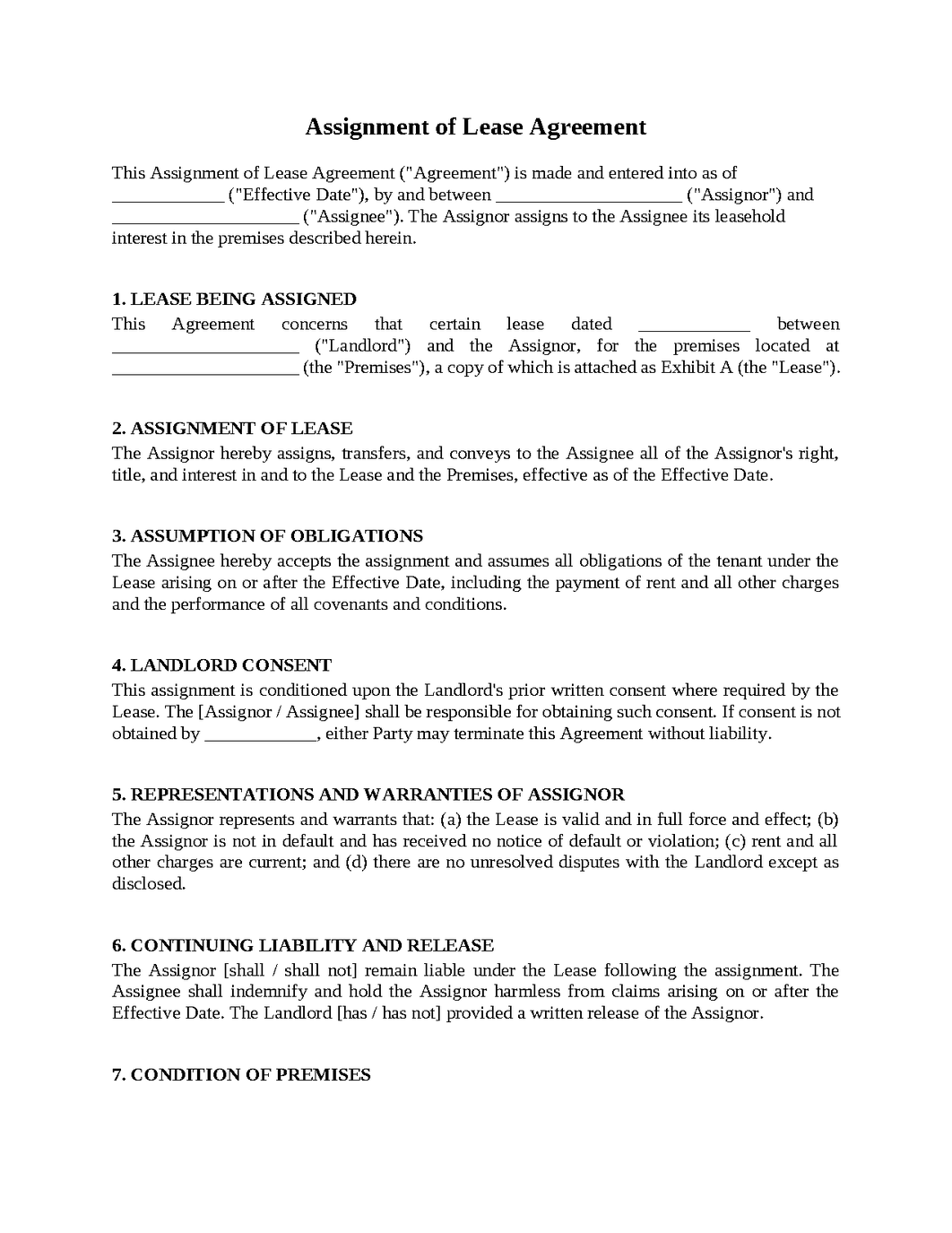
An Assignment of Lease Agreement is a legal contract used when a tenant transfers its rights and interests under a lease to another person or business. The tenant transferring the lease is known as the assignor, while the party receiving the lease rights is known as the assignee. Lease assignments are common in commercial real estate transactions, business acquisitions, franchise sales, restaurant transfers, office relocations, retail operations, and corporate restructurings. Unlike a sublease, where the original tenant remains in possession and rents the space to another occupant, an assignment generally transfers the tenant's entire leasehold interest to the assignee. Because leases often contain consent requirements, ongoing obligations, use restrictions, and liability provisions, assigning a lease can create significant legal and financial risks if not handled properly. An Assignment of Lease Agreement helps establish which rights are being transferred, what obligations are assumed by the assignee, and how future responsibilities will be allocated among the tenant, assignee, and landlord.
The Tenant Assigns the Lease Without Obtaining Landlord Consent
A restaurant owner decides to sell a successful local restaurant to an entrepreneur eager to enter the industry. The business sale includes equipment, inventory, goodwill, customer relationships, and the right to operate from a highly desirable leased location.
The buyer views the location as one of the most valuable assets involved in the transaction. The restaurant occupies a busy corner in a growing commercial district, and finding a comparable location would be difficult and expensive. Because both parties are focused on closing the business sale quickly, they assume the lease can simply be transferred as part of the transaction.
Several weeks after the sale closes, the landlord discovers that ownership of the restaurant has changed. After reviewing the lease, the landlord points to a provision requiring prior written consent before any assignment may occur. No request for approval was ever submitted, and no consent was granted.
The landlord immediately notifies both parties that the assignment constitutes a lease default. The buyer has already invested substantial capital into inventory purchases, employee hiring, marketing campaigns, and facility improvements. The possibility of losing the location threatens the viability of the entire acquisition.
What began as a promising business purchase becomes a crisis. Attorneys become involved, negotiations with the landlord grow tense, and the buyer faces uncertainty regarding whether operations can continue at the location.
To help avoid this problem, an Assignment of Lease Agreement should specifically identify any consent requirements contained in the lease and make landlord approval a condition of closing when required. The agreement should also establish which party is responsible for obtaining consent, what happens if consent is denied, and whether the transaction may be terminated if landlord approval cannot be secured.
The Assignee Inherits a Lease Already in Trouble
A medical practice acquires another healthcare provider and receives an assignment of a long-term office lease located in a professional medical complex. The location appears attractive because it offers favorable rental rates and several years of remaining lease term.
During negotiations, the seller emphasizes the advantages of the lease and highlights the stability of the landlord relationship. The buyer reviews rent schedules and occupancy costs but spends relatively little time investigating the property's compliance history.
Shortly after the assignment closes, the landlord delivers a formal notice of default. The notice identifies multiple issues that existed before the assignment occurred, including unpaid common area maintenance charges, unresolved maintenance obligations, and repeated violations of parking and signage provisions.
The buyer is caught completely off guard. Rather than inheriting a healthy lease relationship, the buyer has acquired a lease already burdened by disputes and compliance problems. The landlord becomes increasingly aggressive and begins discussing remedies available under the lease.
The buyer now faces unexpected expenses, legal costs, and operational distractions that were never factored into the acquisition decision. What initially appeared to be a valuable asset now presents significant financial risk.
To reduce these risks, an Assignment of Lease Agreement should contain detailed representations regarding the status of the lease. The assignor should confirm whether any defaults exist, whether notices of violation have been received, whether rent and other charges are current, and whether disputes with the landlord remain unresolved. The agreement should also provide indemnification if undisclosed lease problems emerge after closing.
The Assignor Learns It Is Still Liable Years Later
A manufacturing company relocates operations to a larger facility and assigns its existing warehouse lease to a growing logistics business. Management believes the assignment will eliminate future obligations associated with the property.
The transaction closes successfully, and the assignee takes possession of the warehouse. For several years, everything appears to work as expected. The assignor moves forward with its expansion plans and rarely thinks about the old facility.
Five years later, the assignee experiences financial difficulties and abruptly stops paying rent. The landlord quickly begins pursuing available remedies and contacts the original tenant regarding the growing lease deficiency.
The assignor is shocked to learn that the landlord still considers it responsible for the lease. Although the lease was assigned years earlier, the landlord never executed a release of liability. Under the lease terms, the original tenant remains responsible if the assignee defaults.
The assignor suddenly faces substantial financial exposure for a property it has not occupied in years. Significant legal fees are incurred while the parties argue about responsibility for unpaid rent, property damage, and other lease obligations.
This situation occurs frequently because many tenants incorrectly assume that assigning a lease automatically eliminates future liability. In many commercial leases, the original tenant remains responsible unless the landlord expressly agrees otherwise.
To avoid these problems, an Assignment of Lease Agreement should clearly address continuing liability. The agreement should state whether the assignor remains obligated under the lease, require the assignee to indemnify the assignor against future claims, and identify whether the landlord has provided a written release. These provisions can dramatically reduce the risk of unpleasant surprises years after the assignment occurs.
The Parties Disagree About the Condition of the Premises
A retail business assigns its lease to another retailer as part of a store sale. Both parties inspect the property briefly before closing and assume the transition will be straightforward.
Shortly after taking possession, the assignee begins discovering problems. HVAC systems perform inconsistently, portions of the flooring require replacement, electrical systems need repairs, and several fixtures do not function properly.
The assignee believes these issues existed before the assignment and argues that the assignor should bear responsibility. The assignor responds that the property was accepted in its existing condition and that the buyer had every opportunity to inspect the premises before closing.
The landlord becomes involved because certain repairs may be tenant responsibilities under the lease. Confusion develops regarding who must pay for corrective work, whether conditions violate lease obligations, and whether maintenance issues should have been disclosed earlier.
The disagreement delays operations and damages the relationship between the parties. Instead of focusing on growing the business, management spends time negotiating repair obligations and addressing legal concerns.
To reduce the likelihood of these disputes, an Assignment of Lease Agreement should document the condition of the premises carefully. The agreement should identify known maintenance issues, allocate responsibility for existing defects, permit inspections before closing, and specify which party bears the cost of repairs discovered after the assignment becomes effective.
The Assignee Cannot Use the Property as Intended
A retailer assigns its shopping center lease to an entrepreneur who plans to open a specialty fitness studio. The assignee believes the location is ideal because of its visibility, parking availability, and established customer traffic.
After closing, the assignee begins preparing renovation plans and applying for business licenses. Significant resources are committed to launching the new concept.
During the approval process, the landlord objects. The lease contains a narrowly defined permitted-use clause allowing only certain retail activities. The proposed fitness studio falls outside the approved uses described in the lease.
The assignee is surprised because no one identified the restriction during negotiations. Although the property appears physically suitable for the business, the lease itself prohibits the intended operation.
Expansion plans are delayed while the parties explore possible amendments and negotiate with the landlord. Construction schedules slip, financing arrangements become uncertain, and the anticipated opening date is pushed back significantly.
What seemed like a valuable lease assignment now threatens the viability of the entire business plan.
To help avoid these problems, an Assignment of Lease Agreement should require disclosure of all use restrictions, exclusivity provisions, zoning limitations, operating requirements, and landlord approval conditions that may affect the assignee's intended business. The agreement should also confirm that the assignee has reviewed the lease and understands any limitations affecting future operations.

Get started with Upsign today!
Easily send, sign and track your documents