

Assignment of Warehouse Space Agreement
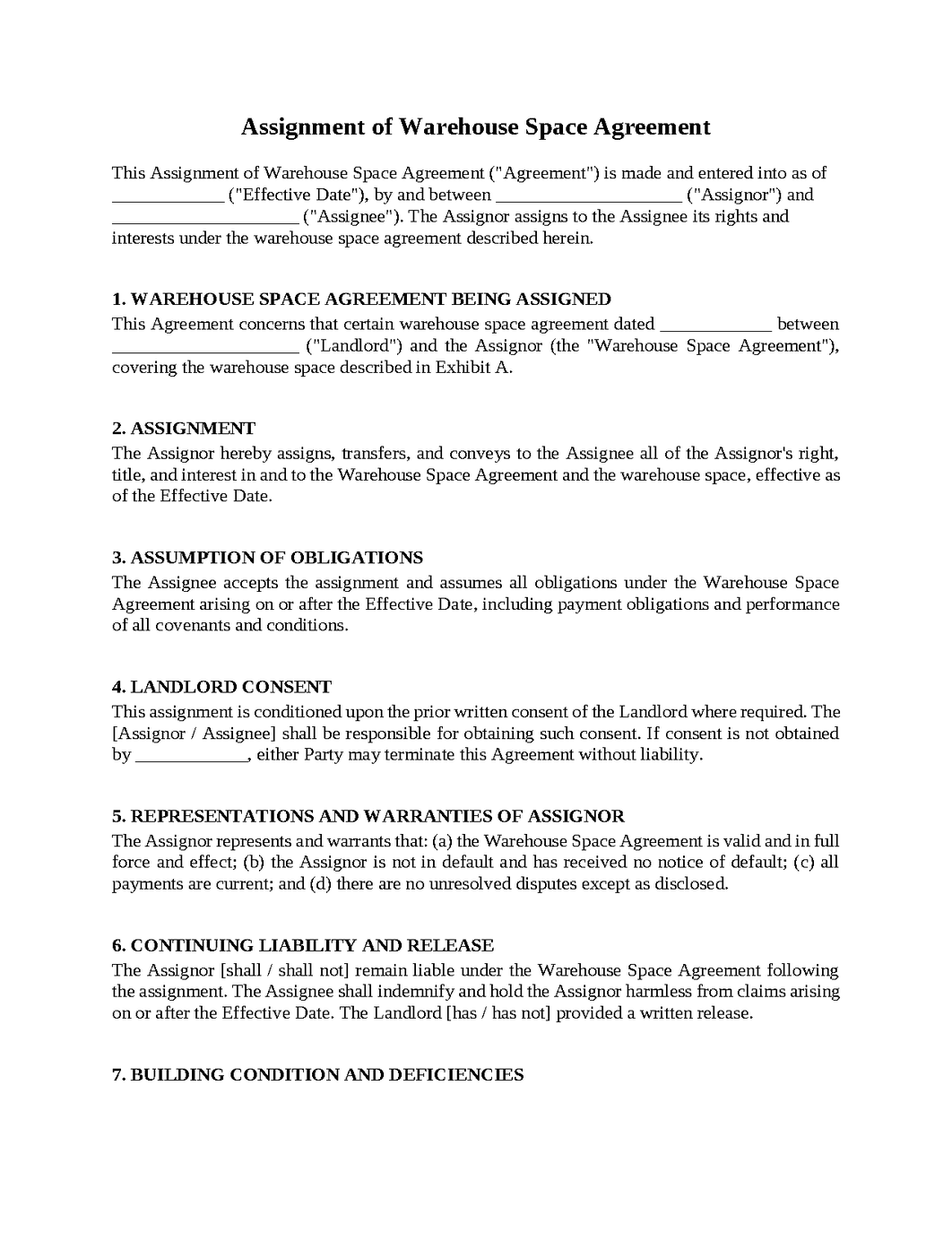
An Assignment of Warehouse Space Agreement is a legal contract used when a tenant transfers its rights and obligations under a warehouse space agreement to another person or business. The party transferring the warehouse rights is known as the assignor, while the party receiving those rights is known as the assignee. Warehouse space assignments commonly occur during business sales, logistics reorganizations, supply chain changes, inventory relocations, corporate restructurings, and company expansions or downsizing efforts. Because warehouse facilities often involve significant square footage, specialized infrastructure, loading capabilities, storage systems, and operational requirements, disputes can arise regarding property condition, permitted uses, landlord approvals, environmental concerns, and future liability. An Assignment of Warehouse Space Agreement helps establish who assumes responsibility for the warehouse space and how future obligations will be allocated among the parties.
The Tenant Transfers the Warehouse Without Landlord Approval
A distribution company leases a large warehouse facility located near a major transportation corridor. The location provides excellent access to highways, rail connections, and shipping facilities, making it a valuable operational asset.
After consolidating operations into a newer facility, management decides the warehouse is no longer needed. Rather than continue paying rent on unused space, the company identifies another business willing to assume the warehouse agreement.
The parties negotiate quickly because both see immediate benefits. The assignor wants relief from lease expenses, while the assignee wants rapid access to warehouse space in a competitive market.
The assignee moves inventory into the building and begins operations. Forklifts are delivered, employees are hired, and customer shipments begin flowing through the facility.
Several weeks later, the landlord discovers the occupancy change during a property inspection. Upon reviewing the lease, the landlord identifies a provision requiring written approval before any assignment can occur.
No approval was requested.
The landlord immediately notifies both parties that the assignment violates the lease. Questions arise regarding insurance coverage, financial qualifications, and whether the assignee satisfies the landlord's operational requirements.
The assignee now faces uncertainty regarding continued access to a facility that has already become central to business operations.
To help avoid this problem, an Assignment of Warehouse Space Agreement should identify all landlord consent requirements and make approval a condition of the assignment. The agreement should also establish responsibility for obtaining consent and provide remedies if approval cannot be secured.
The Assignee Inherits Serious Building Deficiencies
A logistics company assumes rights under a warehouse agreement because the facility appears well suited for inventory storage and regional distribution.
The building looks functional during initial inspections. The roof appears intact, loading docks seem operational, and warehouse operations begin shortly after the assignment closes.
Several months later, significant problems emerge.
Heavy rain reveals multiple roof leaks. Sections of the concrete floor begin deteriorating under normal warehouse traffic. Several loading dock systems malfunction, creating delays in shipping operations.
As maintenance contractors investigate, they discover that many of these issues existed before the assignment occurred. Internal emails reveal that the assignor had previously discussed some of the deficiencies with the landlord.
The assignee becomes frustrated.
Instead of obtaining a fully functional warehouse, the company inherits substantial repair costs, operational disruptions, and customer service challenges. Shipping delays increase, inventory is damaged, and unexpected expenses affect profitability.
The assignor argues that the building was available for inspection and that no guarantees were provided regarding condition.
To reduce these risks, an Assignment of Warehouse Space Agreement should require disclosure of known defects, maintenance issues, landlord notices, repair histories, and property-condition concerns. The agreement should also allocate responsibility for pre-existing deficiencies discovered after the transfer.
The Original Tenant Remains Liable for Years
A manufacturing company assigns warehouse rights after relocating production operations to another state.
The assignee takes possession of the facility and successfully operates from the location for several years. Rent is paid regularly, and the assignor assumes all obligations ended when the assignment occurred.
Eventually, however, the assignee experiences financial difficulties and stops making rent payments.
The landlord initiates collection efforts and immediately contacts the original tenant.
Management is shocked.
Although the warehouse has not been used by the assignor for years, the lease provides that the original tenant remains liable unless formally released by the landlord. No release was obtained during the assignment process.
The assignor now faces potential responsibility for unpaid rent, maintenance obligations, property damage, and legal expenses.
The financial exposure is substantial because warehouse leases often involve large facilities and significant monthly rental commitments.
The assignor becomes frustrated because it has no control over how the facility is being managed yet remains exposed to future liability.
To avoid these problems, an Assignment of Warehouse Space Agreement should address continuing liability directly. The agreement should require the assignee to indemnify the assignor against future claims and should identify whether the landlord has formally released the assignor from future obligations.
Environmental Issues Surface After the Assignment
A chemical distribution company assigns warehouse rights to another industrial operator.
The assignee focuses heavily on location, storage capacity, and lease economics. The warehouse appears suitable for operations, and the assignment proceeds smoothly.
Several months later, an environmental inspection identifies contamination concerns.
Investigators discover evidence of historical spills, improper storage practices, and environmental compliance issues that may have originated before the assignment occurred. Regulatory agencies begin asking questions regarding prior operations conducted within the facility.
The assignee becomes concerned because environmental liabilities can be extremely expensive.
Cleanup costs, regulatory compliance obligations, legal expenses, and operational interruptions begin affecting the business. Customers raise concerns, and financing partners request additional information regarding potential exposure.
The assignor argues that no formal environmental claims existed when the assignment occurred. The assignee believes material environmental risks should have been disclosed before closing.
This type of dispute is particularly common in warehouse facilities that previously housed industrial products, chemicals, fuels, or other regulated materials.
To reduce these risks, an Assignment of Warehouse Space Agreement should require disclosure of environmental reports, known contamination issues, regulatory inquiries, hazardous material storage activities, and compliance concerns affecting the property.
The Warehouse Cannot Be Used for the Assignee's Intended Operations
A growing e-commerce company assumes rights under a warehouse agreement because the facility appears ideal for expanding fulfillment operations.
Management plans to install automated storage systems, increase staffing levels, extend operating hours, and significantly increase shipping volume.
After taking possession, the company discovers several restrictions embedded within the lease and local property requirements.
The lease limits certain operational activities. Local zoning restrictions affect truck traffic. Noise limitations restrict overnight loading operations. Parking requirements limit staffing expansion.
The assignee is surprised because these restrictions materially affect the business plan that justified the assignment.
Projected growth targets become difficult to achieve. Additional facilities must be leased, and operational costs increase substantially.
The dispute centers on whether these limitations should have been disclosed during negotiations.
To help avoid these problems, an Assignment of Warehouse Space Agreement should require disclosure of operational restrictions, zoning limitations, truck-access requirements, permitted-use provisions, parking restrictions, and other limitations that could affect the assignee's intended business activities.
Warehouse facilities are critical assets for manufacturers, distributors, retailers, logistics providers, and many other businesses. However, assigning warehouse rights can create significant challenges involving landlord approvals, property condition, continuing liability, environmental risks, and operational restrictions. An Assignment of Warehouse Space Agreement provides a structured framework for documenting these transfers and clarifying expectations regarding future rights and obligations. When drafted carefully, it can help reduce disputes, protect business operations, and provide confidence regarding the successful transfer of warehouse space rights and responsibilities.

Get started with Upsign today!
Easily send, sign and track your documents