

Assignment of Rental Agreement
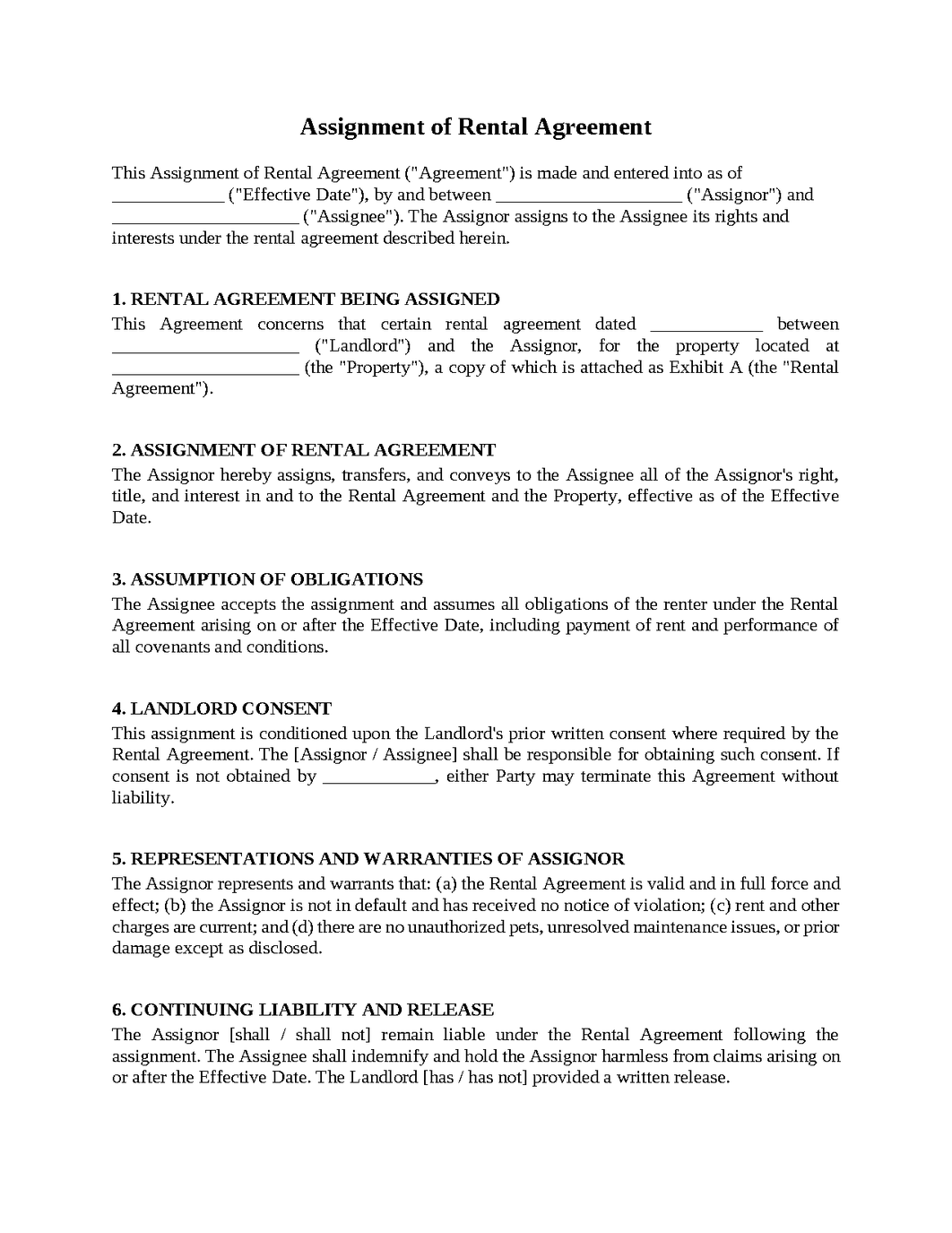
An Assignment of Rental Agreement is a legal contract used when a tenant transfers its rights and interests under a rental agreement to another person or business. The party transferring the rental rights is known as the assignor, while the recipient is known as the assignee. Rental agreement assignments commonly occur in residential housing, apartment leases, vacation rentals, equipment rentals, vehicle rentals, storage facilities, and short-term commercial occupancy arrangements. Unlike a subrental arrangement, where the original renter remains responsible while allowing another person to use the property, an assignment generally transfers the renter's interest to a new party. Because rental agreements often involve landlord approval requirements, payment obligations, security deposits, maintenance responsibilities, and occupancy restrictions, disputes can arise if the assignment is not documented carefully. An Assignment of Rental Agreement helps establish who assumes the rental rights and what obligations transfer as part of the arrangement.
The Tenant Transfers the Rental Without Permission
A tenant signs a one-year rental agreement for a desirable apartment near a university campus. Six months later, the tenant receives a job offer in another state and decides to move before the rental term expires.
Rather than paying rent on an apartment that will sit empty, the tenant finds another individual willing to take over the remaining months of the rental agreement. Both parties are eager to complete the transition quickly, and they exchange basic paperwork documenting the arrangement.
The new occupant moves into the apartment and begins paying rent. For several weeks, everything appears to be working smoothly.
The situation changes when the property manager discovers that a different person is living in the apartment. Upon reviewing the rental agreement, the landlord identifies a provision requiring written approval before any assignment can occur. No approval was requested and no consent was granted.
The landlord immediately notifies both parties that the assignment violates the rental agreement. The incoming occupant now faces uncertainty regarding continued occupancy, while the original tenant risks default claims for violating the lease terms.
What began as a practical solution for both parties becomes a legal problem involving eviction risks, unpaid fees, and potential damage to rental histories.
To help avoid this issue, an Assignment of Rental Agreement should clearly identify any consent requirements contained in the original rental agreement. The assignment should be conditioned upon landlord approval whenever required, and responsibility for obtaining that approval should be clearly allocated before occupancy changes hands.
The Assignee Discovers Hidden Rental Violations
A young professional assumes a rental agreement from another tenant who needs to relocate unexpectedly. The apartment is attractive because it offers below-market rent and several months remain on the existing agreement.
The incoming tenant reviews the monthly payment obligations and believes the arrangement is straightforward. Because the transfer is occurring quickly, little attention is given to the history of the tenancy.
Several weeks after moving in, the landlord delivers a formal notice regarding multiple lease violations.
According to the landlord, unauthorized pets have occupied the apartment for months, maintenance requests were ignored, and damage caused by prior occupants remains unresolved. The landlord expects these issues to be corrected immediately and threatens further action if they are not addressed.
The assignee is surprised and frustrated. From their perspective, they agreed to take over a rental agreement, not inherit a collection of unresolved disputes.
The unexpected expenses and complications create tension between the assignor and assignee and damage what initially seemed like a beneficial arrangement.
To reduce these risks, an Assignment of Rental Agreement should include representations regarding the status of the rental agreement, known violations, outstanding fees, property damage, and communications from the landlord. The assignor should disclose any issues that could materially affect the assignee's decision to assume the agreement.
The Original Tenant Remains Responsible After the Assignment
A renter receives military orders requiring relocation before the expiration of a residential rental agreement. To avoid early termination penalties, the renter assigns the agreement to another individual who appears financially responsible.
The transfer is completed, the new occupant moves in, and the original tenant assumes the matter is resolved permanently.
Nearly a year later, the assignee loses employment and stops paying rent. The landlord begins collection efforts and quickly contacts the original tenant regarding the unpaid balance.
The original tenant is confused. Having moved across the country, they believed all responsibilities ended when the assignment occurred.
The landlord points to provisions in the rental agreement stating that the original tenant remains liable unless expressly released. No release was ever obtained.
The original tenant suddenly faces collection demands, potential credit consequences, and legal expenses arising from a property they no longer occupy.
This issue occurs frequently because many tenants assume an assignment automatically eliminates future liability when that is often not the case.
To avoid these problems, an Assignment of Rental Agreement should clearly address continuing liability. The agreement should specify whether the assignor remains responsible after the transfer and should require the assignee to indemnify the assignor for future losses whenever appropriate. If possible, the parties should also seek a written release from the landlord.
The Security Deposit Becomes a Source of Conflict
A tenant assigns a rental agreement to a new occupant approximately halfway through the lease term. Both parties focus on rent obligations and move-in logistics while giving little attention to the security deposit.
The original tenant previously paid a substantial deposit when the rental agreement began. The assignee agrees to reimburse a portion of that amount as part of the assignment transaction.
Months later, the rental agreement ends and the landlord conducts a final inspection.
Damage is discovered throughout the property. Some issues existed before the assignment, while others appear to have occurred afterward. The landlord applies most of the security deposit toward repairs.
The assignor argues that much of the damage was caused by the assignee. The assignee responds that certain conditions already existed before taking possession.
The disagreement quickly becomes personal because both parties believe they are being unfairly charged.
Without clear documentation regarding property condition and deposit allocation, determining responsibility becomes difficult.
To reduce these disputes, an Assignment of Rental Agreement should address security deposit ownership, reimbursement arrangements, and final allocation procedures. The parties should document the property's condition carefully before the assignment becomes effective and specify how future deductions will be handled.
The Assignee Cannot Use the Property as Intended
A tenant assigns a rental agreement for a residential property to an individual who operates a small online business from home. The assignee assumes the property will meet both personal and professional needs.
After moving in, the assignee begins receiving deliveries, meeting with occasional clients, and installing equipment needed for business operations.
The landlord objects.
The rental agreement prohibits commercial activities on the premises and limits occupancy to residential purposes only. The landlord warns that continued business use may constitute a lease violation.
The assignee is surprised because the property appears physically suitable for the intended use.
What seemed like an ideal arrangement now threatens both housing stability and business operations. Additional expenses arise as the assignee explores alternative locations and attempts to negotiate accommodations with the landlord.
The issue could have been identified much earlier through a careful review of the rental agreement.
To help prevent these problems, an Assignment of Rental Agreement should require disclosure of use restrictions, occupancy limitations, pet policies, parking rules, and other provisions that could affect the assignee's intended use of the property. The agreement should confirm that the assignee has reviewed and accepted those restrictions before the transfer occurs.
Rental agreements are among the most commonly assigned contracts in both residential and commercial settings. However, assigning a rental agreement can create significant challenges involving landlord consent, hidden defaults, continuing liability, security deposits, and property-use restrictions. An Assignment of Rental Agreement provides a structured framework for documenting these transfers and clarifying the rights and obligations of everyone involved. When drafted carefully, it can help reduce disputes, protect both assignors and assignees, and ensure a smoother transition of rental rights and responsibilities.

Get started with Upsign today!
Easily send, sign and track your documents