

Assignment of Parking Space Agreement
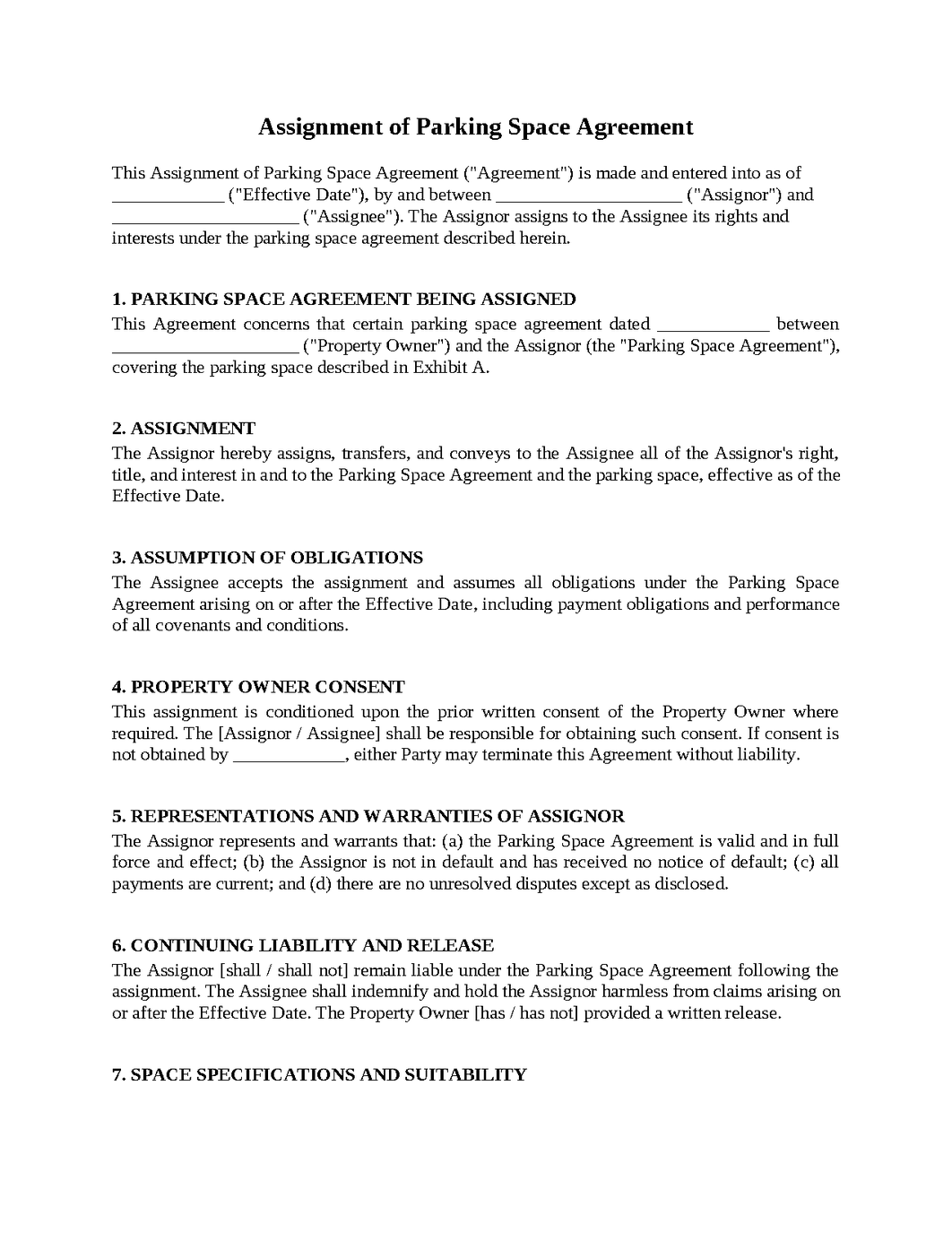
An Assignment of Parking Space Agreement is a legal contract used when a person or business transfers its rights and obligations under a parking space agreement to another party. The party transferring the parking rights is known as the assignor, while the party receiving those rights is known as the assignee. Parking space assignments commonly occur in office buildings, apartment complexes, mixed-use developments, commercial centers, condominium projects, airports, marinas, and urban areas where parking is limited and highly valuable. Because assigned parking spaces often provide convenience, security, and access advantages that are difficult to replace, disputes can arise regarding ownership rights, approval requirements, space restrictions, fees, and liability for vehicle-related damage. An Assignment of Parking Space Agreement helps establish who assumes the parking rights and what obligations transfer as part of the assignment.
The Parking Space Is Assigned Without Property Owner Approval
A condominium owner leases an underground parking space in a downtown residential tower. The building is located in an area where street parking is scarce, making reserved parking particularly valuable.
After selling a vehicle and moving closer to work, the owner decides the parking space is no longer necessary. A neighbor immediately expresses interest in taking over the space because the building maintains a lengthy waiting list for parking assignments.
The parties agree on terms and begin using the arrangement immediately. The assignee parks in the space daily, and for several months everything appears to function normally.
Eventually, property management notices that the vehicle registered to the parking space no longer matches building records. A review of the parking agreement reveals that assignments require prior written approval from the property owner or management company.
No approval was obtained.
Property management notifies both parties that the transfer violates building policies. Questions arise regarding insurance coverage, vehicle registration requirements, and compliance with parking regulations.
The assignee now faces the possibility of losing access to a parking space that was one of the primary reasons for entering the arrangement.
To help avoid this problem, an Assignment of Parking Space Agreement should clearly identify all approval requirements and make property owner consent a condition of the assignment. The agreement should also specify which party is responsible for obtaining approval and what happens if approval is denied.
The Assignee Learns the Space Has Unexpected Restrictions
An employee working in a busy downtown office district assumes rights to a reserved parking space from a departing coworker.
The location appears ideal because it is close to the building entrance and significantly less expensive than nearby public parking options.
The assignee assumes the parking arrangement will fully satisfy commuting needs and pays little attention to the underlying parking agreement.
After beginning to use the space, however, the assignee discovers several restrictions.
The parking agreement prohibits overnight parking. Certain vehicle types are not permitted. Visitor access rules are strict, and the space may not be used for commercial vehicles. Additional restrictions apply during special events and building maintenance periods.
These limitations create practical problems because the assignee frequently travels for business and occasionally uses a company vehicle.
The value of the parking assignment becomes much lower than anticipated.
The assignee argues that these restrictions should have been disclosed during negotiations. The assignor responds that the rules were available for review before the assignment occurred.
To reduce these risks, an Assignment of Parking Space Agreement should require disclosure of all material restrictions affecting use of the space, including vehicle limitations, access hours, guest policies, towing rules, and operational requirements.
The Original Space Holder Remains Responsible for Future Charges
A business tenant assigns rights to several reserved parking spaces after downsizing office operations.
The assignee takes over the spaces and begins using them immediately. The assignor assumes all responsibilities ended when the assignment was completed.
Several years later, the assignee stops paying parking fees and ignores invoices issued by the property manager.
Unpaid charges accumulate.
The property owner begins collection efforts and contacts the original parking space holder.
The assignor is surprised to learn that the parking agreement still identifies the original party as responsible for payment obligations unless a formal release is granted. No release was ever obtained.
The assignor now faces unexpected financial exposure for parking spaces that have not been used personally for years.
The situation becomes particularly frustrating because the assignor has no control over how the assignee manages the spaces.
This issue arises frequently because many people assume that assigning a parking agreement automatically eliminates future liability.
To avoid these problems, an Assignment of Parking Space Agreement should address continuing liability directly. The agreement should require the assignee to indemnify the assignor against future claims and should identify whether the property owner has released the assignor from ongoing obligations.
The Assigned Space Does Not Meet the Assignee's Needs
A resident of a luxury apartment building assumes rights to a parking space after purchasing a larger vehicle.
The space appears adequate during an initial walkthrough, and both parties believe the arrangement will work without issue.
After moving into the space, however, problems become apparent.
The vehicle barely fits within the designated boundaries. Maneuvering is difficult because of support columns and adjacent vehicles. Opening doors safely becomes challenging, and visibility is limited when entering and exiting.
The assignee quickly realizes that the space was originally designed for smaller vehicles.
Using the space daily becomes inconvenient and increases the risk of accidental damage.
The assignee becomes frustrated because relocating to another space within the building is difficult and additional spaces are unavailable.
To help prevent these disputes, an Assignment of Parking Space Agreement should identify space dimensions, vehicle restrictions, access limitations, and any physical characteristics that may affect usability. The agreement should also confirm that the assignee has inspected the space and determined that it meets operational needs.
Vehicle Damage Leads to a Liability Dispute
A commuter assumes rights to a reserved parking space within a commercial parking structure.
For several months, the arrangement works smoothly. The vehicle is parked regularly, fees are paid on time, and no concerns arise.
One evening, a structural component in the parking facility fails and debris falls onto several vehicles, including the assignee's car.
Insurance claims are submitted immediately.
As investigations begin, questions emerge regarding prior maintenance issues, inspection reports, and whether property management was aware of potential hazards before the assignment occurred.
The assignee argues that the parking facility had known maintenance deficiencies. The assignor insists that the parking space was transferred in acceptable condition and that responsibility shifted entirely to the assignee.
Property managers, insurers, and attorneys become involved.
What began as a simple parking space assignment evolves into a complicated dispute regarding liability, maintenance responsibilities, and insurance coverage.
To reduce these risks, an Assignment of Parking Space Agreement should address responsibility for property conditions, insurance requirements, liability allocation, and known maintenance concerns affecting the parking facility. The agreement should also require disclosure of any known issues that could materially affect the safety or usability of the space.
Parking spaces can be valuable assets, particularly in urban environments where parking availability is limited and demand is high. However, assigning parking rights can create significant challenges involving approval requirements, usage restrictions, continuing liability, physical limitations, and damage-related claims. An Assignment of Parking Space Agreement provides a structured framework for documenting these transfers and clarifying expectations regarding future rights and responsibilities. When drafted carefully, it can help reduce disputes, preserve access to valuable parking resources, and provide confidence regarding the successful transfer of parking space rights and obligations.

Get started with Upsign today!
Easily send, sign and track your documents