

Assignment of Sublease Agreement
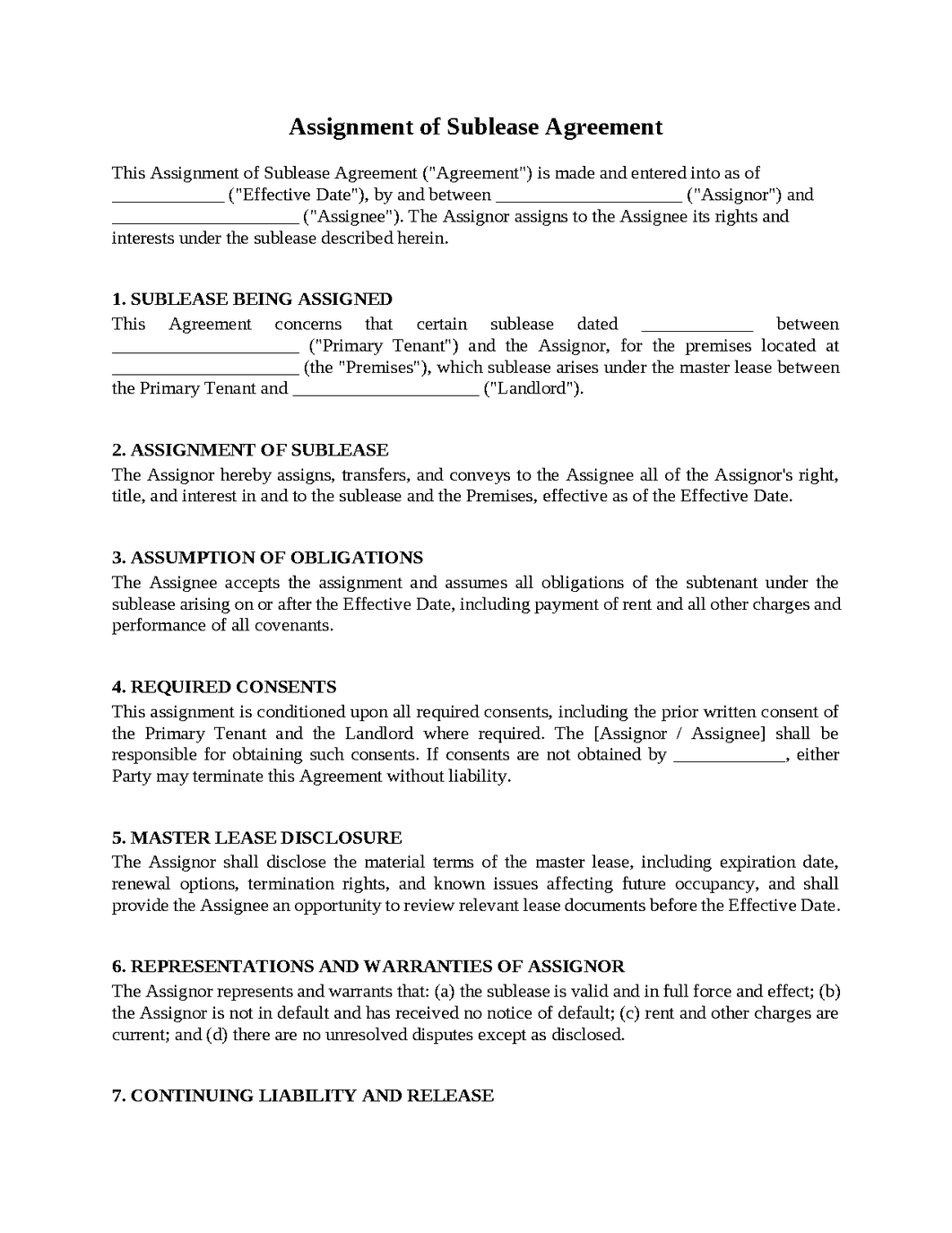
An Assignment of Sublease Agreement is a legal contract used when a subtenant transfers its rights and interests under an existing sublease to another person or business. The party transferring the sublease rights is known as the assignor, while the party receiving those rights is known as the assignee. Assignment of Sublease Agreements commonly arise in commercial office space, retail properties, industrial facilities, coworking environments, and business acquisitions. Unlike a traditional lease assignment, which transfers rights directly under a lease with the landlord, a sublease assignment involves a secondary occupancy arrangement where the subtenant's rights originate from another tenant's leasehold interest. Because multiple parties are involved—including the landlord, original tenant, subtenant, and assignee—sublease assignments often create unique legal and operational challenges. An Assignment of Sublease Agreement helps establish what rights are being transferred, what approvals are required, and how future obligations will be allocated among the parties.
The Subtenant Assigns the Space Without Required Approvals
A technology startup leases a portion of a larger office suite through a sublease agreement with the primary tenant. After experiencing rapid growth, the startup relocates to a larger facility and decides to transfer its sublease rights to another emerging business.
The parties negotiate quickly because both are eager to complete the transaction. The startup wants to eliminate ongoing occupancy costs, while the incoming company wants immediate access to a furnished office in a desirable location.
Several weeks after the new occupant moves in, the primary tenant discovers the transfer. Upon reviewing the sublease documents, it becomes clear that both the primary tenant and the landlord were required to approve any assignment of the sublease.
No approvals were ever obtained.
The primary tenant immediately objects and argues that the transfer violates both the sublease and the underlying lease. The landlord becomes involved as well, raising concerns about occupancy, insurance coverage, and compliance with building requirements.
What seemed like a straightforward office transition becomes a legal dispute involving multiple parties. The incoming company faces uncertainty regarding its ability to remain in the space, while the outgoing subtenant risks liability for violating contractual obligations.
To help avoid this problem, an Assignment of Sublease Agreement should clearly identify all required approvals and make those approvals a condition of the assignment becoming effective. The agreement should specify who is responsible for obtaining consent and what happens if required approvals cannot be secured before closing.
The Assignee Discovers the Master Lease Is About to Expire
A marketing agency acquires the rights to occupy office space through an assignment of an existing sublease. The location appears attractive because it is centrally located and significantly below current market rental rates.
During negotiations, the parties focus heavily on the sublease terms. Rent, security deposits, and occupancy dates receive careful attention.
What the assignee fails to investigate thoroughly is the underlying lease.
Several months after taking possession, the assignee learns that the master lease between the landlord and primary tenant is scheduled to expire much sooner than expected. The primary tenant has not yet negotiated a renewal and is uncertain whether one will even be offered.
The assignee suddenly realizes that its right to occupy the premises depends entirely on the continued existence of the master lease.
The office space that seemed secure may disappear within months.
The assignee now faces unexpected relocation costs, operational disruptions, and uncertainty regarding future business planning. Had this information been known earlier, the assignee may have negotiated different terms or selected a different property altogether.
To reduce these risks, an Assignment of Sublease Agreement should require disclosure of key terms contained in the master lease, including expiration dates, renewal options, termination rights, and known issues affecting future occupancy. The assignee should also be given an opportunity to review relevant lease documents before the assignment is finalized.
The Original Subtenant Remains Liable for Future Problems
A consulting company assigns its sublease rights to another professional services firm after relocating to a new city.
Management assumes that once the assignment is complete, all obligations associated with the office space transfer to the new occupant.
For several years, no issues arise.
Eventually, however, the assignee encounters financial difficulties and stops making rent payments. The primary tenant begins pursuing remedies under the sublease and contacts the original subtenant regarding unpaid obligations.
The original subtenant is surprised.
Although it no longer occupies the space, the assignment documents never released it from future liability. The primary tenant argues that the assignor remains responsible if the assignee defaults.
What began as a completed transaction years earlier suddenly creates significant financial exposure.
The assignor must now devote time and resources to addressing obligations it believed had ended long ago.
This issue is common because parties often assume an assignment automatically eliminates future liability. In reality, liability frequently depends on the specific language of the sublease, assignment agreement, and any consent documents.
To avoid these problems, an Assignment of Sublease Agreement should clearly address continuing liability. The agreement should identify whether the assignor remains responsible after the transfer and should require the assignee to indemnify the assignor against future claims whenever appropriate.
The Assignee Learns the Space Cannot Be Used as Intended
A retailer acquires rights under a sublease assignment because the location appears perfect for a specialty boutique concept.
The assignee reviews the sublease briefly and confirms that the space itself appears suitable for operations.
After investing in signage, inventory, and renovation plans, the assignee discovers a significant problem.
The master lease contains strict use restrictions that limit the types of businesses permitted within the shopping center. Certain product categories are reserved exclusively for other tenants, and the proposed boutique conflicts with those restrictions.
The assignee is shocked.
The location remains physically attractive, but the intended business model may not be permitted under the governing lease documents.
Expansion plans stall while attorneys, landlords, and tenants attempt to determine whether exceptions can be negotiated.
The assignee incurs delays, additional expenses, and uncertainty that could have been avoided through more thorough due diligence.
To help prevent these disputes, an Assignment of Sublease Agreement should require disclosure of use restrictions, exclusivity provisions, operating requirements, and landlord rules affecting occupancy. The agreement should also confirm that the assignee has reviewed the governing lease documents and understands any limitations on future use.
A Property Damage Dispute Emerges After the Transfer
A design firm assigns its sublease rights to another creative agency as part of a relocation effort.
Before vacating the premises, the assignor performs only a limited walkthrough. Both parties are focused on completing the transition quickly.
Several months after occupancy changes hands, the primary tenant identifies substantial damage to portions of the office space. Questions arise regarding damaged flooring, alterations made to conference rooms, and repairs needed to building systems.
The assignee insists the damage existed before taking possession.
The assignor argues that the space was delivered in acceptable condition and that any new problems occurred after the transfer.
The primary tenant becomes frustrated because responsibility remains unclear.
The disagreement escalates into a costly dispute involving repair estimates, inspection reports, and competing claims regarding property condition at the time of assignment.
This type of conflict is common whenever possession changes without adequate documentation.
To reduce these risks, an Assignment of Sublease Agreement should include a detailed description of the premises' condition, permit pre-closing inspections, allocate responsibility for known defects, and require documentation such as photographs or condition reports. Clear records can prevent significant disagreements later.
Sublease interests can provide valuable occupancy opportunities for businesses seeking flexibility, favorable rental terms, or access to desirable locations. However, assigning a sublease creates unique challenges because multiple contractual relationships often govern the arrangement. An Assignment of Sublease Agreement provides a structured framework for documenting the transfer and clarifying expectations regarding approvals, liability, occupancy rights, property condition, and future obligations. When drafted carefully, it can help reduce disputes, protect business operations, and provide confidence regarding the successful transfer of sublease rights.

Get started with Upsign today!
Easily send, sign and track your documents