

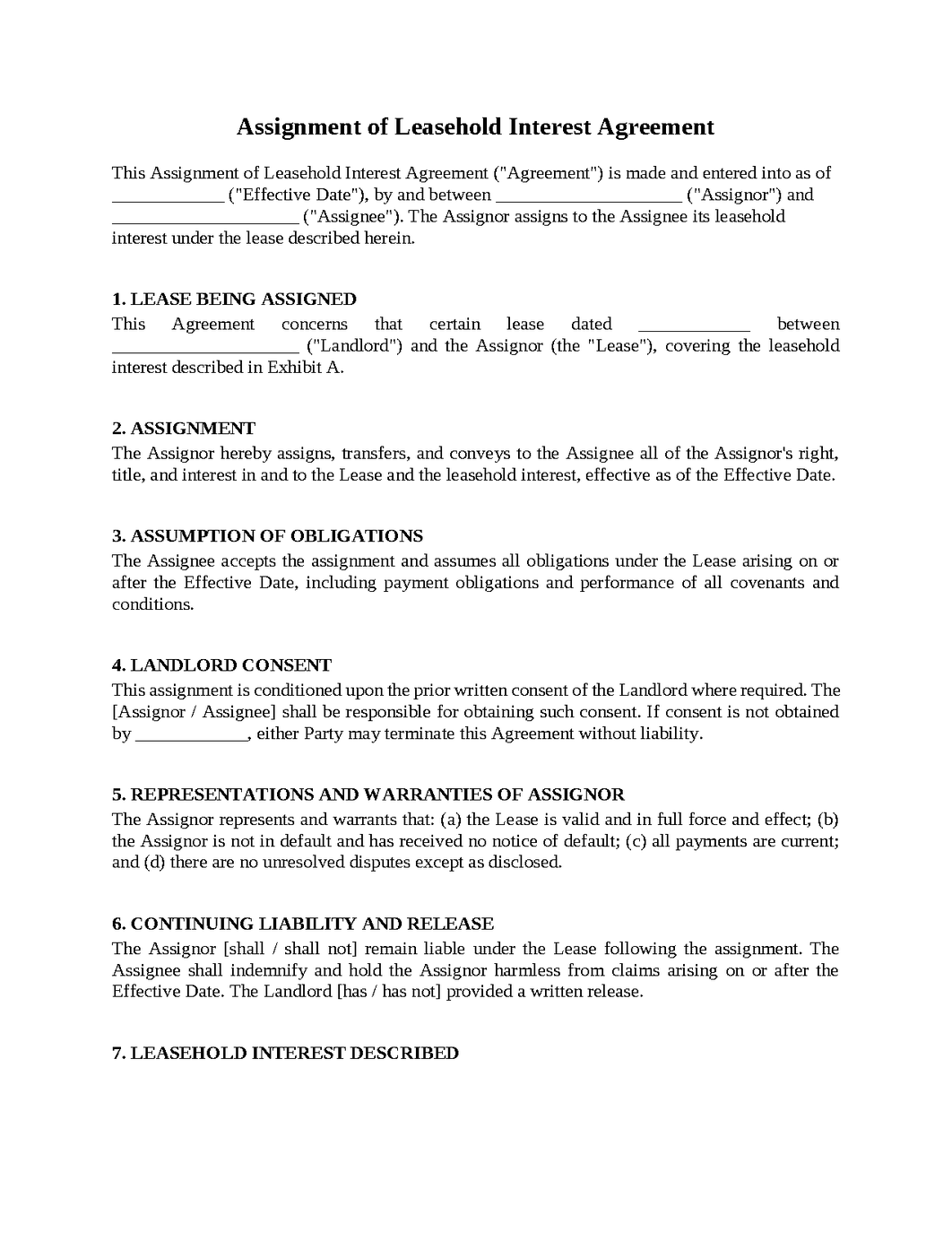
Assignment of Leasehold Interest Agreement
An Assignment of Leasehold Interest Agreement is a legal contract used when a tenant transfers its interest in a leased property to another party. The original tenant, known as the assignor, transfers some or all of its rights under the lease to a new tenant, known as the assignee. Leasehold interest assignments are common in commercial real estate, retail businesses, office leasing, industrial properties, franchise operations, and business acquisitions. In many cases, the lease itself is one of the most valuable assets a business owns because of its location, favorable rental terms, or remaining lease term. While assigning a leasehold interest can create flexibility and facilitate business transactions, it can also lead to disputes involving landlord approval, ongoing liability, lease obligations, property condition issues, and business operations. An Assignment of Leasehold Interest Agreement helps document the transfer and establish clear expectations regarding the rights and responsibilities of all parties involved.
A Business Sale Falls Apart Because the Lease Cannot Be Assigned
A successful restaurant owner decides to sell the business after twenty years of operation. A buyer is found quickly, a purchase price is negotiated, and both parties are eager to close the transaction.
One of the most valuable assets involved in the sale is the restaurant's location. The lease has favorable rental terms and several years remaining, making it critical to the buyer's plans.
During due diligence, however, the buyer's attorney discovers a problem.
The lease contains a provision requiring the landlord's written consent before any assignment can occur. The seller assumed approval would be routine. The buyer assumed the same thing.
The landlord is not convinced.
After reviewing the buyer's financial information and restaurant experience, the landlord requests additional guarantees and proposes several new lease conditions. Negotiations drag on for months.
The buyer begins to question whether the transaction is worth pursuing. Without certainty regarding the location, the business becomes significantly less attractive.
What started as a straightforward business sale now faces the possibility of collapse.
To reduce this risk, an Assignment of Leasehold Interest Agreement should be drafted to address landlord consent requirements directly. The agreement should clearly state whether landlord approval is a condition of closing, identify responsibility for obtaining approvals, and establish what happens if consent is denied or delayed.
The Original Tenant Assumes Liability Ends After the Assignment
A technology company leases office space under a ten-year commercial lease. After several years, the company relocates to a larger facility and assigns its leasehold interest to another business.
Management believes the assignment completely ends its relationship with the property.
For several years, everything appears to go smoothly.
Then the replacement tenant experiences financial trouble and stops paying rent. The landlord immediately contacts the original tenant and demands payment of the outstanding lease obligations.
The original tenant is shocked.
Executives believed that assigning the lease transferred all future responsibility to the new occupant. The landlord points to both the lease and assignment documents, which do not contain any release of liability.
Attorneys become involved, and the former tenant learns that assignment and release are not necessarily the same thing.
This misunderstanding occurs frequently in commercial leasing. Many landlords agree to assignments while still requiring the original tenant to remain secondarily liable if the assignee defaults.
To help avoid this situation, an Assignment of Leasehold Interest Agreement should expressly address ongoing liability. The agreement should state whether the assignor remains responsible for future obligations, whether the landlord is granting a release, and whether the assignee will indemnify the assignor if future claims arise.
The New Tenant Discovers Expensive Lease Obligations
A manufacturing company acquires another business and agrees to assume its warehouse lease through an assignment transaction.
The acquiring company reviews the monthly rent and remaining lease term and concludes that the lease appears attractive.
After taking possession of the property, however, management discovers numerous obligations that were overlooked during the review process.
The lease requires the tenant to maintain specialized fire suppression systems, repair portions of the roof, contribute to common area expenses, and carry substantial insurance coverage. There are also environmental compliance obligations relating to prior uses of the property.
The costs quickly exceed expectations.
The new tenant begins questioning whether the lease was properly disclosed and whether the assignment accurately reflected the obligations being assumed.
Disputes arise regarding what information should have been provided before the assignment occurred.
Commercial leases often contain extensive obligations beyond rent. Maintenance responsibilities, taxes, insurance costs, repair obligations, and compliance requirements can significantly affect the value of a leasehold interest.
To minimize these risks, an Assignment of Leasehold Interest Agreement should identify the underlying lease, acknowledge the assignee's review of lease obligations, disclose known issues affecting the property, and clarify exactly which obligations are being assumed as part of the transfer.
The Assignee Changes the Business in Violation of the Lease
A retail clothing store assigns its leasehold interest to a specialty food retailer. The parties complete the assignment and assume the transition will be seamless.
Shortly after taking over the space, the new tenant begins remodeling.
Food preparation equipment is installed. Seating areas are added. Customer traffic increases substantially.
The landlord soon objects.
According to the lease, the premises may only be used for certain retail purposes. The landlord argues that the new business model violates permitted-use restrictions and negatively affects neighboring tenants.
The assignee disagrees and argues that both businesses operate in retail environments.
The dispute escalates. The landlord threatens default proceedings, while the assignee argues that the assignment should have granted flexibility regarding operations.
This type of problem is common in shopping centers, office complexes, and mixed-use developments where landlords carefully manage tenant mix and property usage.
To avoid these conflicts, an Assignment of Leasehold Interest Agreement should identify the assignee's intended use of the property, confirm compliance with lease restrictions, and require any necessary landlord approvals before operational changes are implemented.
A Dispute Arises Over Property Damage Existing Before the Assignment
A distribution company assigns its leasehold interest in a warehouse to another business after relocating operations.
Several months later, the landlord conducts an inspection and discovers substantial damage to loading areas, interior walls, and portions of the building's electrical system.
The landlord claims the damage existed before the assignment and seeks compensation from the original tenant.
The assignee argues that the condition problems were present before it took possession and should not be its responsibility.
The assignor insists that much of the damage occurred after the transfer.
The disagreement becomes a costly battle over timing, responsibility, and evidence.
Without clear documentation, determining who caused the damage becomes difficult. Witness memories differ, photographs are incomplete, and inspection records are inconsistent.
Property condition disputes are common when leased premises change hands because responsibility for repairs often depends on when the damage occurred.
To help prevent these issues, an Assignment of Leasehold Interest Agreement should include detailed property condition acknowledgments, inspection procedures, photographs where appropriate, and provisions allocating responsibility for known and unknown conditions existing before the transfer date.
Leasehold interests are often among the most valuable assets a business owns, particularly when favorable rental terms or strategic locations are involved. However, transferring those interests can create significant challenges involving landlord approvals, continuing liability, lease obligations, permitted uses, and property condition disputes. An Assignment of Leasehold Interest Agreement provides a structured framework for documenting these transfers and establishing expectations for landlords, assignors, and assignees. When drafted carefully, it can help reduce disputes, facilitate business transactions, and provide all parties with confidence regarding their rights and obligations following the assignment.
:::

Get started with Upsign today!
Easily send, sign and track your documents