

Assignment of Limited Liability Company Interest Agreement
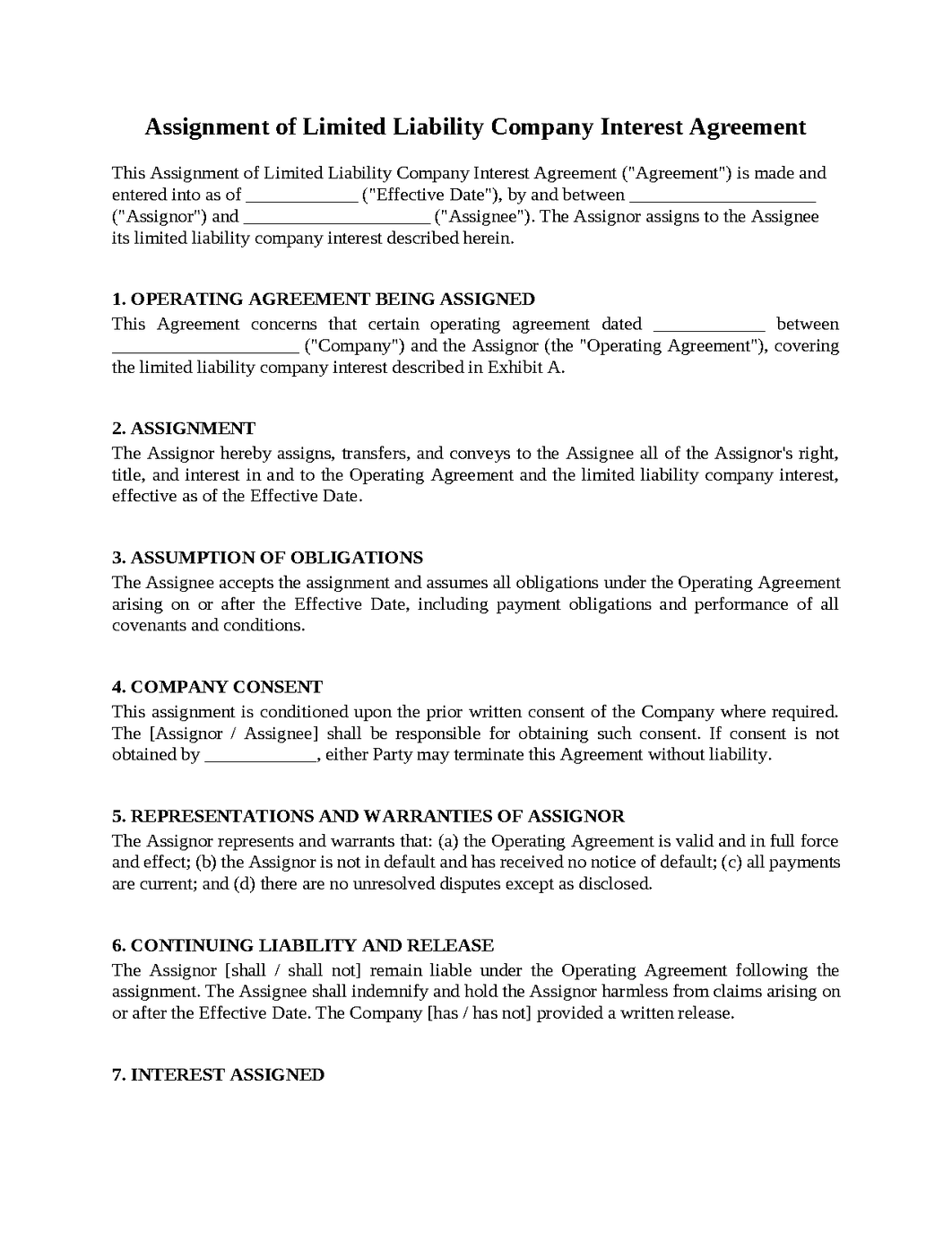
An Assignment of Limited Liability Company Interest Agreement is a legal contract used when an owner of a limited liability company (LLC) transfers some or all of their ownership interest to another person or entity. The transferring owner is commonly referred to as the assignor, while the recipient is known as the assignee. LLC interests can include rights to profits, losses, distributions, capital accounts, and, in some situations, voting and management authority. These agreements are frequently used in business sales, retirement planning, estate planning, succession planning, divorce settlements, investor transactions, and ownership restructurings. Because LLCs are often governed by detailed operating agreements that restrict ownership transfers, assigning an LLC interest can create significant legal and operational issues. An Assignment of Limited Liability Company Interest Agreement helps define what is being transferred, what approvals are required, and what rights the recipient will receive after the transaction is completed.
A Member Tries to Transfer Ownership Without Following the Operating Agreement
A member of a successful digital marketing agency decides to retire and sell their ownership interest to a former colleague. The buyer has industry experience, sufficient financial resources, and appears capable of contributing to the business.
The parties quickly agree on a purchase price and begin preparing transfer documents.
Before closing, however, another member reviews the LLC's operating agreement and discovers that ownership transfers require approval from at least seventy-five percent of the membership interests. Several members object to the proposed buyer and refuse to provide consent.
The seller is frustrated. From their perspective, they own a portion of the company and should be free to sell it. The remaining members disagree and point out that the operating agreement was specifically designed to prevent unwanted ownership changes.
The transaction stalls, relationships become strained, and the buyer begins looking at other opportunities.
To help avoid this problem, an Assignment of Limited Liability Company Interest Agreement should reference the applicable operating agreement and clearly state any approval requirements that must be satisfied before the transfer becomes effective. The agreement should also address what happens if required approvals are denied, including whether deposits are refunded and whether alternative buyout procedures apply.
The Assignee Believes Ownership Automatically Includes Voting Rights
A family-owned LLC owns several commercial office buildings. As part of an estate planning strategy, one member transfers their ownership interest to an adult son.
After the transfer is completed, the son begins attending management meetings, requesting financial records, and offering opinions regarding future acquisitions. He assumes that because he now owns an interest in the company, he automatically has the right to participate in company decisions.
The other members disagree.
They explain that while he now owns the economic interest associated with the transferred units, admission as a voting member requires approval under the operating agreement. Until that approval occurs, he may receive distributions but cannot vote on management matters.
The son feels excluded from a company he partially owns. The existing members believe they are simply following the company's governing documents.
The disagreement quickly spreads beyond the business. Family relationships become strained, and meetings become increasingly uncomfortable.
This situation is extremely common in LLCs because ownership rights and management rights are often treated separately. Many operating agreements permit the transfer of economic interests while restricting voting authority and management participation.
To avoid this problem, an Assignment of Limited Liability Company Interest Agreement should clearly identify which rights are being transferred. The agreement should specify whether the assignee is receiving only economic rights or whether voting, management, inspection, and membership rights are included. If separate approval is required to become a full member, the agreement should state that explicitly.
The Parties Cannot Agree on What the LLC Interest Is Worth
Three partners own an LLC that provides specialized engineering services. After twenty years in business, one member decides to retire and sell their ownership interest.
Initially, everyone expects the transaction to proceed smoothly.
The problem emerges when the parties attempt to determine value.
The retiring member believes the company should be valued based on future growth opportunities, customer relationships, and long-term contracts. The remaining owners focus on current earnings and argue that future opportunities involve significant uncertainty.
To resolve the disagreement, the parties hire valuation experts.
One expert concludes the ownership interest is worth $3 million. Another values the same interest at $1.9 million. Both provide detailed reports supporting their conclusions.
The gap is far larger than anyone expected.
Negotiations stall. The retiring member believes the business is being undervalued. The remaining members worry that overpaying could harm the company's financial stability.
Employees begin hearing rumors about ownership disputes. Customers start asking questions about the future of the firm.
Valuation disagreements are among the most common reasons LLC ownership transfers fail. Unlike publicly traded securities, LLC interests often have no readily available market value.
To reduce the likelihood of these disputes, an Assignment of Limited Liability Company Interest Agreement should incorporate a valuation methodology whenever possible. The agreement may reference appraisals, formulas, buy-sell provisions, or operating agreement procedures so that disagreements can be resolved objectively rather than emotionally.
A Divorce Creates an Unexpected Ownership Crisis
A member of a successful construction LLC becomes involved in a contentious divorce. During settlement discussions, the member's ownership interest quickly becomes one of the most valuable assets under consideration.
The spouse argues that a portion of the LLC interest should be transferred as part of the marital property division.
The remaining members are alarmed.
They never anticipated becoming business partners with the member's former spouse. Concerns arise regarding access to confidential information, voting authority, and future involvement in company affairs.
The divorcing member finds themselves caught between competing obligations. The court expects compliance with the divorce settlement, while the operating agreement contains strict restrictions on ownership transfers.
The uncertainty affects the entire company. Other members begin discussing buyout rights and contingency plans in case the transfer proceeds.
Divorce-related ownership disputes occur frequently in closely held businesses because LLC interests often represent a significant portion of a member's net worth.
Without clear planning, a personal legal dispute can create major business disruptions.
To help avoid these issues, an Assignment of Limited Liability Company Interest Agreement should work alongside operating agreement provisions addressing divorce-related transfers. The agreement should clearly define what rights are being transferred, whether buyout rights apply, and whether the transferee receives full membership status or only economic rights.
A Former Member Faces Liability Years After Leaving the Company
A member of an environmental consulting LLC sells their ownership interest and relocates to another state. The transaction is completed successfully, and the former member assumes their involvement with the company has ended.
Five years later, a lawsuit is filed involving an environmental assessment completed while the former member was actively involved in the business.
The plaintiff alleges errors in the assessment caused substantial financial damages and names both the company and several individuals associated with the project.
To the former member's surprise, they are included in the lawsuit.
They argue that they no longer own any interest in the company and have not been involved in operations for years.
Their attorney explains that ownership transfers do not necessarily eliminate liability relating to events that occurred before the transfer. Depending on the facts, former members may still face claims arising from historical activities.
The legal costs alone become significant.
Many owners focus exclusively on purchase price and transfer mechanics while overlooking liability allocation.
To reduce these risks, an Assignment of Limited Liability Company Interest Agreement should contain indemnification provisions, survival clauses, and clear language allocating responsibility for claims arising before and after the transfer date. These provisions can provide valuable protection if disputes emerge long after the ownership change is complete.
LLC interests often represent valuable ownership rights and substantial financial assets. Whether ownership is being transferred because of retirement, succession planning, investment activity, divorce, or business restructuring, significant legal and practical issues can arise if expectations are not documented carefully. An Assignment of Limited Liability Company Interest Agreement provides a structured framework for documenting these transfers and clarifying the rights and obligations of everyone involved. When drafted properly and coordinated with the LLC's operating agreement, it can help reduce disputes, facilitate smooth ownership transitions, and protect the interests of the assignor, the assignee, the remaining members, and the company itself.
:::

Get started with Upsign today!
Easily send, sign and track your documents