

Assignment of Loan Agreement
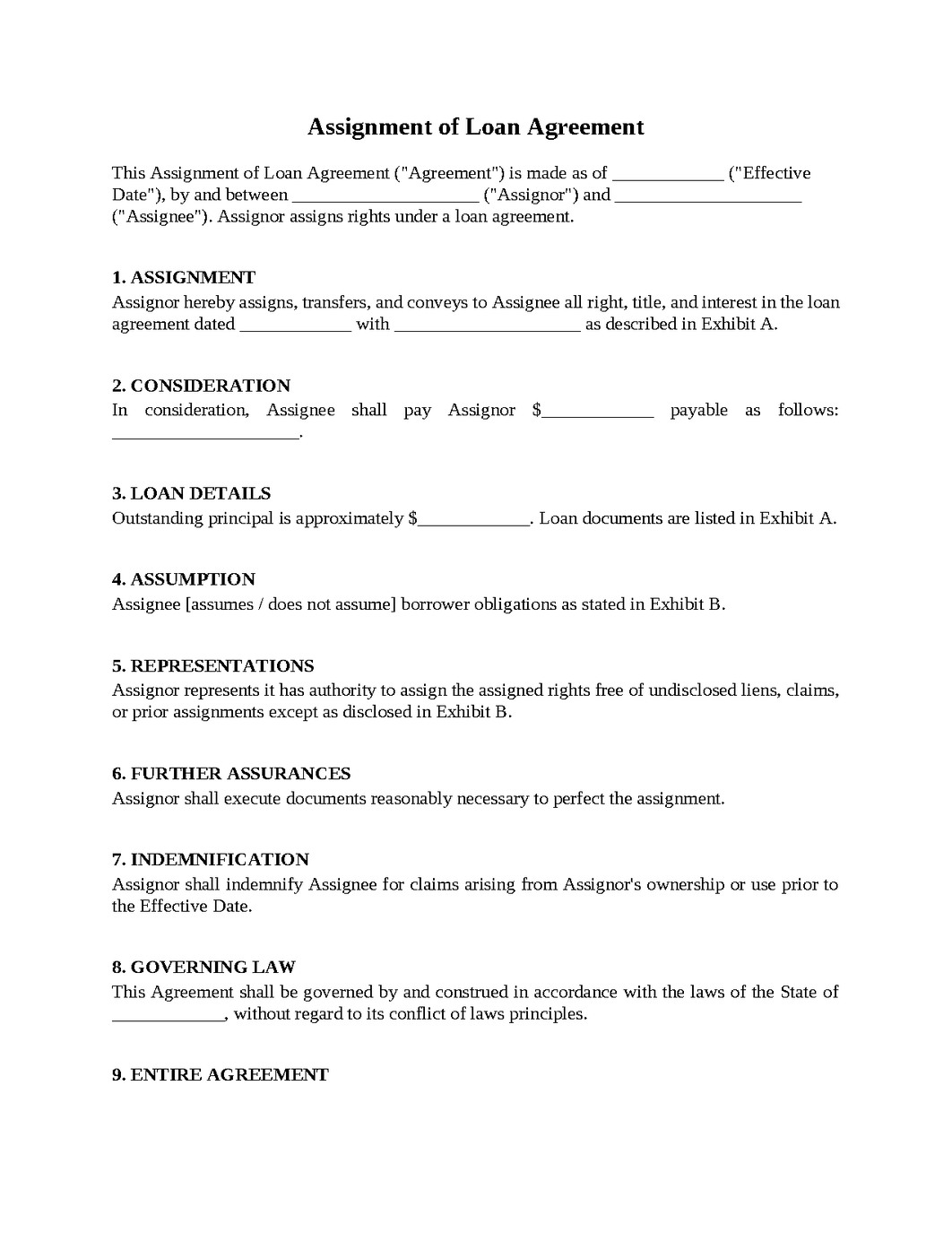
An Assignment of Loan Agreement is a legal contract used when a lender transfers some or all of its rights in a loan to another person or entity. The party transferring the loan rights is known as the assignor, while the recipient is known as the assignee. Loan assignments are common in commercial lending, real estate finance, private lending transactions, business acquisitions, loan portfolio sales, syndications, and secondary market transactions. Banks, credit funds, private investors, and finance companies frequently buy and sell loans as part of their business operations. While the borrower often continues making payments according to the original loan terms, a loan assignment can create significant questions regarding ownership, payment rights, servicing responsibilities, enforcement authority, and borrower communications. An Assignment of Loan Agreement helps establish who owns the loan and what rights are transferred as part of the transaction.
The Borrower Keeps Sending Payments to the Original Lender
A regional commercial lender decides to sell a portfolio of small business loans to an investment fund. The transaction closes successfully, and ownership of the loans transfers to the buyer.
The investment fund expects loan payments to begin arriving immediately.
Unfortunately, several borrowers are never properly informed about the transfer. As monthly payments become due, they continue sending checks to the original lender because that is the institution they have always dealt with.
The borrowers are unaware that anything has changed.
The investment fund quickly notices missing payments and contacts the lender. The lender acknowledges that payments were received but explains that borrowers simply continued following their normal procedures.
What should have been a routine transfer becomes an administrative challenge. Payment histories must be reconciled, funds must be forwarded, and borrowers become confused when they receive notices from multiple entities.
The situation damages goodwill and creates unnecessary work for everyone involved.
To help avoid this problem, an Assignment of Loan Agreement should clearly identify the assigned loans, establish the effective date of the transfer, require borrower notification procedures, and specify how payments mistakenly sent to the assignor will be handled after closing. The agreement should also address cooperation obligations if borrower communication issues arise.
The Buyer Discovers the Borrower Was Already in Trouble
A private credit fund purchases a portfolio of commercial loans from a finance company seeking additional liquidity. The loans appear healthy based on the information provided during negotiations.
One particular loan stands out as especially attractive.
The borrower owns several successful businesses, has historically made payments on time, and appears financially stable. The buyer places significant value on the loan when determining the purchase price.
Several months after closing, however, the borrower misses a payment.
As the buyer investigates, it discovers that the borrower had been experiencing financial difficulties long before the assignment occurred. Internal communications at the original lender referenced declining revenue, covenant violations, and concerns regarding liquidity.
None of that information was disclosed during negotiations.
The buyer becomes frustrated and argues that it paid a premium price for a loan that carried far more risk than expected. The seller responds that the buyer had an opportunity to conduct due diligence and that future performance can never be guaranteed.
Disputes like this are common in loan assignments because the assignor often possesses information about the borrower that is not obvious from payment histories alone.
To reduce these risks, an Assignment of Loan Agreement should include detailed representations regarding borrower defaults, covenant violations, delinquency history, pending restructurings, and other material facts affecting the loan. The agreement should also specify what remedies are available if significant information was withheld.
Multiple Parties Claim Ownership of the Same Loan
A specialty finance company experiences financial pressure and begins using several funding arrangements to raise capital.
In one transaction, the company assigns a group of loans to a lender as collateral. Later, management enters into another financing arrangement involving some of the same loans.
Initially, no one realizes a problem exists.
The issue surfaces when a borrower requests a payoff statement. Two different parties claim ownership of the loan and each insists that repayment funds should be sent to them.
The borrower is understandably confused.
Attorneys become involved, transaction records are reviewed, and the finance company faces allegations that it improperly transferred overlapping interests in the same loan.
The dispute becomes expensive very quickly. Collections are delayed, relationships deteriorate, and significant legal fees are incurred while ownership is determined.
Competing claims can be particularly damaging because borrowers lose confidence when multiple parties assert rights to the same obligation.
To help prevent these situations, an Assignment of Loan Agreement should contain representations confirming ownership of the loan, disclose existing liens or participation interests, identify prior assignments, and require the assignor to indemnify the assignee against competing ownership claims.
The Assignee Assumes It Can Change the Loan Terms
A community bank assigns several commercial loans to a private investment group. The investor's primary goal is to generate income from future loan payments.
After acquiring the loans, the investor reviews the portfolio and decides that certain terms should be modified.
The investor believes interest rates should be increased on some loans, maturity dates should be shortened on others, and additional collateral should be requested from selected borrowers.
The borrowers object immediately.
They point out that the original loan agreements remain in effect regardless of who owns the loans. The investment group is surprised to learn that acquiring a loan does not automatically grant unlimited authority to rewrite its terms.
The misunderstanding creates frustration for everyone involved.
Many investors new to loan acquisitions assume ownership provides broad discretion to modify contractual obligations. In reality, loan assignments generally transfer rights under the existing loan rather than authority to disregard its terms.
To help avoid confusion, an Assignment of Loan Agreement should clearly identify what rights are being transferred and whether any servicing, modification, restructuring, or consent authority accompanies the assignment. The agreement should also clarify which actions remain governed by the original loan documents.
A Loan Sale Delays a Major Acquisition
A regional bank agrees to acquire a smaller lender whose primary assets consist of commercial and real estate loans. The acquisition appears attractive because the target institution has a strong loan portfolio and loyal customer base.
As part of due diligence, attorneys begin reviewing ownership records for the loans.
Several issues quickly emerge.
Certain loans contain incomplete assignment records. Others involve prior participations that were never documented clearly. A few loans appear to have been transferred between affiliated entities without formal assignment agreements.
The acquiring bank becomes concerned.
Without clear documentation, enforcing some of the loans could become more difficult. Ownership questions could create problems during future collections, restructurings, or foreclosure proceedings.
The acquisition timeline begins slipping as attorneys attempt to reconstruct years of loan history.
What started as a straightforward transaction becomes increasingly complicated because documentation was not maintained properly.
To reduce the likelihood of these problems, an Assignment of Loan Agreement should clearly identify the loan being transferred, include supporting schedules and loan information, establish a reliable chain of ownership, and require delivery of all relevant loan documents at closing. Proper documentation today can prevent costly disputes years later.
Loans are valuable financial assets that are routinely bought, sold, financed, and transferred throughout the lending industry. However, ownership changes frequently create questions involving borrower communications, credit quality, competing ownership claims, loan administration, and transaction documentation. An Assignment of Loan Agreement provides a structured framework for documenting these transfers and clarifying the rights and responsibilities of everyone involved. When drafted carefully, it can help reduce disputes, facilitate transactions, and provide lenders, investors, borrowers, and future purchasers with confidence regarding ownership and enforcement rights associated with the loan.
:::

Get started with Upsign today!
Easily send, sign and track your documents