

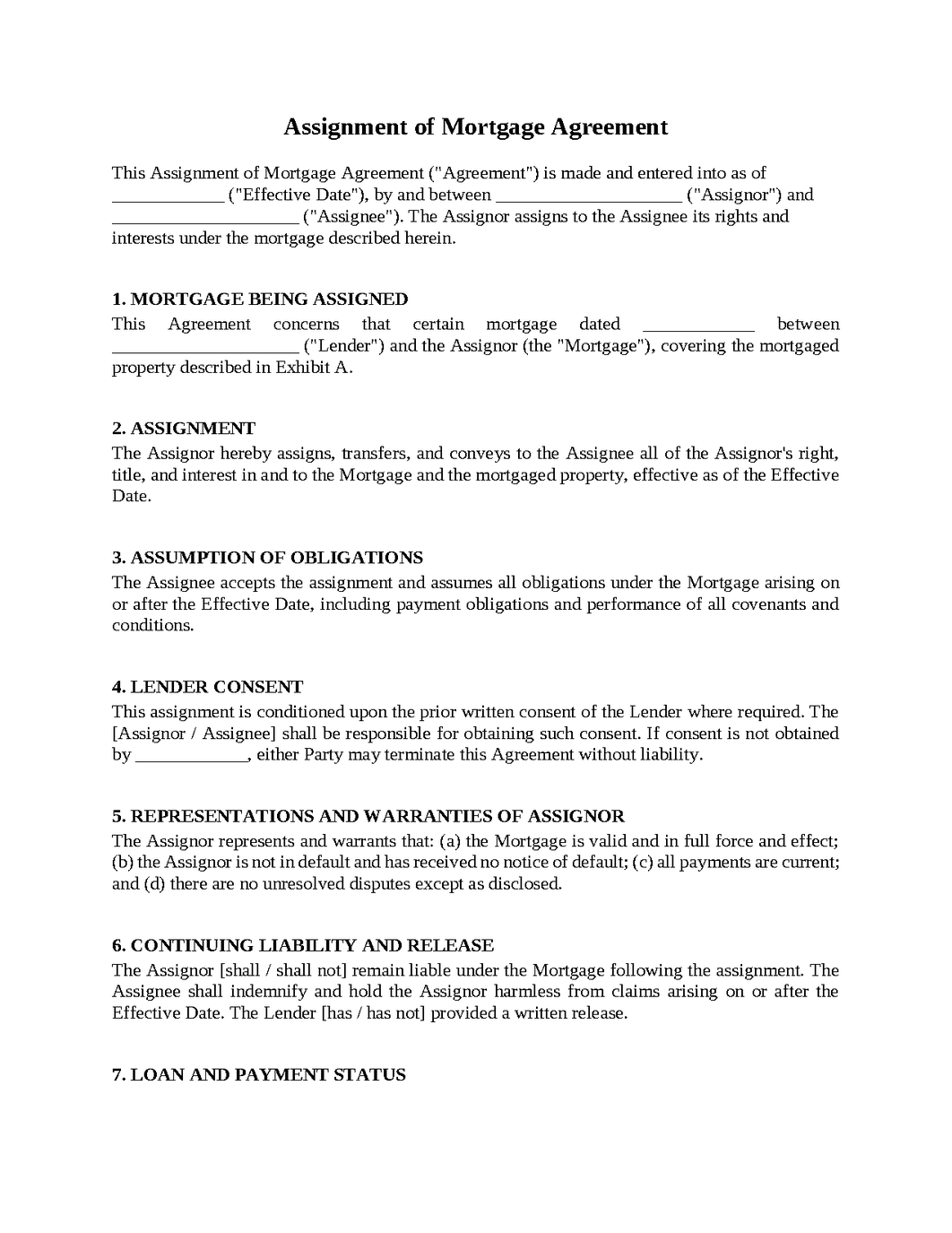
Assignment of Mortgage Agreement
An Assignment of Mortgage Agreement is a legal contract that transfers a lender's ownership interest in a mortgage loan from one party to another. The party transferring the mortgage is known as the assignor, while the party receiving the mortgage rights is known as the assignee. Mortgage assignments are common in residential lending, commercial real estate financing, private lending arrangements, loan portfolio sales, bank mergers, and secondary mortgage market transactions. While borrowers often continue making the same monthly payments regardless of who owns the loan, the legal ownership of mortgages frequently changes throughout the life of a loan. An Assignment of Mortgage Agreement establishes who owns the mortgage, who has the right to receive payments, who can enforce the loan terms, and who may exercise remedies if the borrower defaults. Proper documentation helps protect lenders, investors, borrowers, and courts by creating a clear chain of ownership. Without accurate assignment records, disputes regarding payment rights, foreclosure authority, and loan ownership can become expensive and difficult to resolve.
The Borrower Does Not Know Who Owns the Loan
A homeowner obtains a mortgage from a local bank and faithfully makes payments for several years. One day, the borrower receives a notice stating that ownership of the loan has been transferred to another institution. Shortly afterward, a second notice announces that loan servicing is also changing. The borrower becomes confused about where payments should be sent, who actually owns the mortgage, and who has authority to make decisions regarding the loan. Situations like this occur every day because mortgage loans are frequently sold and transferred between financial institutions. An Assignment of Mortgage Agreement helps document those transfers and establishes the legal ownership of the mortgage so that borrowers and lenders understand who holds the rights associated with the loan.
A Foreclosure Is Delayed Because Ownership Records Are Incomplete
A commercial property owner falls behind on mortgage payments after several major tenants leave a shopping center. The lender begins foreclosure proceedings in an effort to recover the property and reduce losses.
The borrower responds by challenging the lender's authority to foreclose. According to the borrower, the institution pursuing foreclosure has not proven that it actually owns the mortgage.
At first, the lender believes this challenge will be easy to defeat. However, after reviewing the file, attorneys discover that the mortgage has changed hands several times over the years. One assignment was recorded late. Another references an outdated corporate name following a merger. A third assignment appears to be missing from the file entirely.
The borrower argues that these documentation problems create uncertainty regarding who owns the loan. The court requests additional evidence before allowing the foreclosure to proceed.
What should have been a relatively straightforward enforcement action suddenly becomes much more complicated. Attorneys spend months gathering historical records. Former lenders are contacted to provide supporting documentation. Additional legal fees accumulate while the parties debate ownership rather than addressing the underlying payment default.
These situations are surprisingly common. Mortgage loans are often transferred multiple times, especially when they are sold into investment portfolios or securitized transactions. Even small recordkeeping mistakes can create significant problems years later when ownership must be proven in court.
An Assignment of Mortgage Agreement helps preserve a clear chain of title by documenting each transfer properly. When every assignment is executed accurately and retained with the loan file, lenders are generally in a much stronger position to prove ownership and enforce their rights.
A Loan Portfolio Sale Reveals Serious Documentation Issues
A regional bank decides to sell a portfolio containing hundreds of residential mortgage loans to an institutional investor. The transaction is expected to improve liquidity and free capital for additional lending activities.
Before completing the purchase, the investor conducts an extensive due diligence review. Attorneys, accountants, and loan specialists examine payment histories, collateral documentation, promissory notes, and mortgage assignments.
Several problems emerge.
A number of mortgages contain incomplete assignment records. Some transfers were never recorded. Certain legal descriptions do not match the underlying property records. A few assignments reference entities that ceased to exist years earlier following acquisitions and mergers.
The investor immediately becomes concerned. If ownership of the mortgages cannot be proven clearly, future collection efforts could become more difficult. Foreclosure actions might face legal challenges. Borrowers could dispute payment obligations. The value of the portfolio may not be as high as originally expected.
As a result, the investor begins negotiating a lower purchase price to compensate for the additional risk.
The bank argues that the documentation issues are minor administrative matters that can be corrected later. The investor disagrees and points out that documentation quality directly affects the marketability and enforceability of the loans.
What began as a routine transaction evolves into a lengthy negotiation over ownership records and assignment documentation.
An Assignment of Mortgage Agreement helps prevent these problems by creating a formal record of each ownership transfer. Accurate assignments increase investor confidence, facilitate due diligence reviews, and improve the overall value of mortgage assets being sold.
Mortgage Payments Continue Going to the Wrong Institution
A homeowner receives a letter explaining that their mortgage has been assigned to a new lender. Unfortunately, the notice arrives during a busy period and receives little attention.
For the next several months, the borrower continues sending payments to the previous lender.
The borrower assumes everything is fine because the payments are being withdrawn from their account. Eventually, however, the homeowner receives a delinquency notice from the new lender claiming that no payments have been received.
The borrower is understandably frustrated. From their perspective, every payment was made on time.
The new lender acknowledges that payments were made but explains that the funds were sent to the wrong institution. Meanwhile, the prior lender must determine how to transfer the payments and update its records appropriately.
Although these situations are usually resolved eventually, they often create significant administrative headaches. Borrowers may spend hours on the phone with customer service representatives. Credit reporting issues may need to be corrected. Account histories must be reconciled. Escrow balances may require adjustment.
The problem becomes even more complicated when automatic payment systems are involved. Borrowers may continue sending payments to the wrong entity for months before discovering the error.
An Assignment of Mortgage Agreement establishes the effective date of the ownership transfer and provides documentation supporting the change. Combined with proper borrower notification procedures, the agreement helps reduce confusion regarding payment responsibilities and loan ownership.
Investors Later Dispute Ownership of a Valuable Mortgage
A private investment firm purchases a large portfolio of commercial real estate loans from another lender. Among the assets is a mortgage secured by a warehouse property located in a rapidly growing industrial market.
Over time, the property increases dramatically in value. The borrower remains current on payments, and the loan becomes one of the most valuable assets in the portfolio.
Several years later, the borrower seeks to refinance the property. During the payoff process, another financial institution claims that it—not the investment firm—actually owns the mortgage.
Both parties believe they have legitimate ownership rights.
The investment firm points to its acquisition documents. The competing institution argues that the mortgage was excluded from the original transaction and never transferred properly.
Attorneys begin reviewing transaction schedules, assignment records, correspondence, and historical closing files. What initially appears to be a simple ownership question turns into a major dispute involving millions of dollars.
The financial consequences are significant. Whoever owns the mortgage is entitled to receive the payoff proceeds and future interest income. If ownership cannot be established clearly, litigation may be necessary.
These disputes are rare but can be extremely expensive when they occur. They often result from vague transaction documents, incomplete schedules, or poorly maintained assignment records.
An Assignment of Mortgage Agreement helps eliminate uncertainty by identifying exactly which mortgage is being transferred and documenting the parties involved. Detailed assignment records can prevent costly ownership disputes years after a transaction closes.
Mortgage assignments play a critical role in modern lending and real estate finance. Loans are routinely transferred between lenders, investors, servicers, and financial institutions throughout their lifespan. While these transactions are common, they can create significant problems when ownership records are incomplete or unclear. Questions regarding foreclosure authority, payment rights, portfolio sales, borrower communications, and loan ownership frequently arise when mortgages change hands. An Assignment of Mortgage Agreement provides a reliable framework for documenting these transfers and preserving a clear chain of ownership. When prepared carefully and maintained properly, the agreement helps reduce disputes, facilitate transactions, protect enforcement rights, and provide borrowers, lenders, investors, and courts with greater confidence regarding who owns and controls the mortgage.
:::

Get started with Upsign today!
Easily send, sign and track your documents