

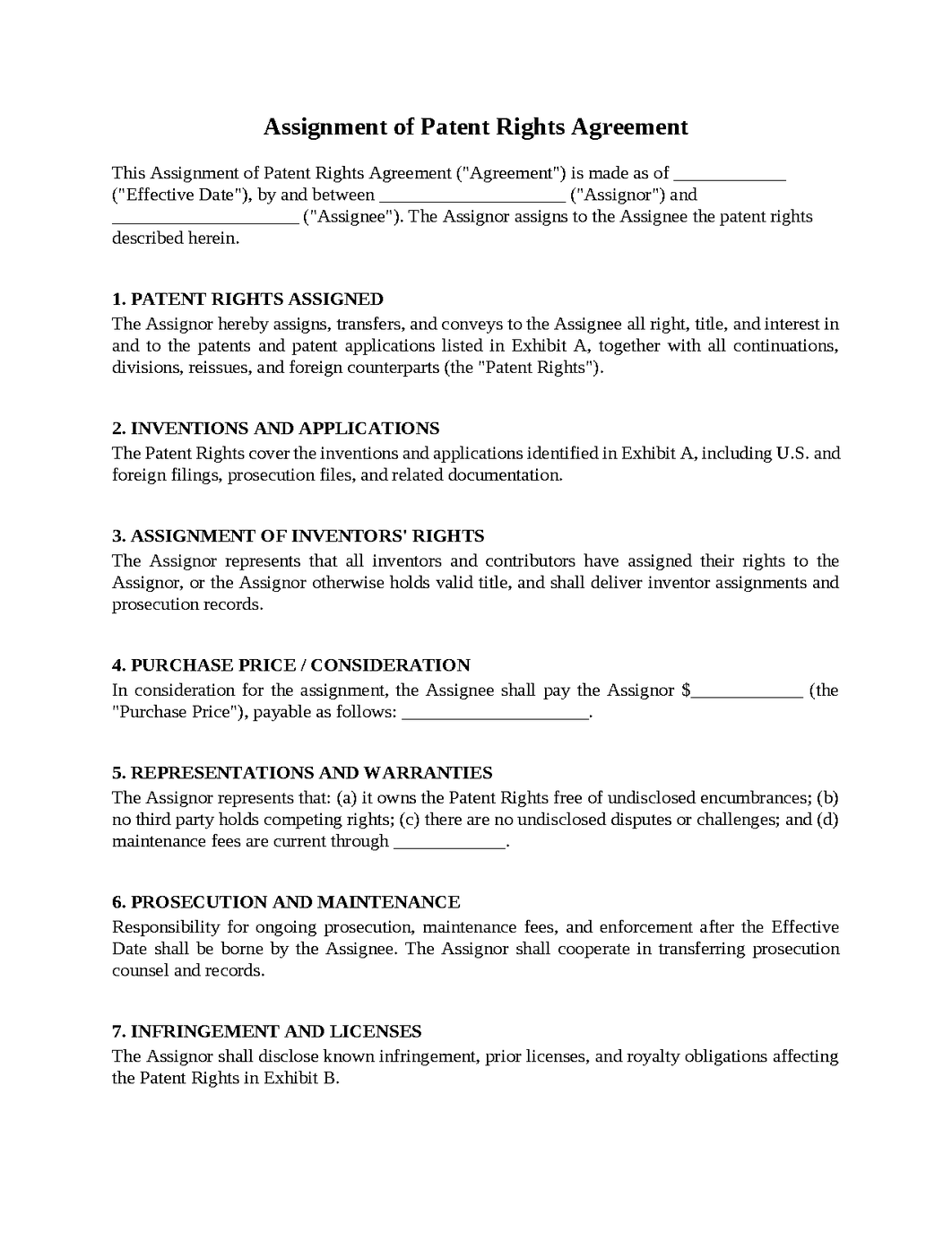
Assignment of Patent Rights Agreement
An Assignment of Patent Rights Agreement is a legal contract used when a patent owner transfers ownership of a patent or patent-related rights to another person or entity. The party transferring the rights is known as the assignor, while the recipient is known as the assignee. Patent assignments are common in technology transactions, startup acquisitions, research collaborations, employee invention programs, university licensing arrangements, corporate restructurings, and mergers and acquisitions. Because patents often protect valuable inventions and may generate substantial licensing revenue, ownership disputes can have significant financial consequences. An Assignment of Patent Rights Agreement helps establish who owns the patent, what rights are being transferred, and what obligations remain after the assignment occurs.
An Inventor Leaves the Company Without Assigning the Patent
A medical device company spends years developing a new surgical instrument that significantly improves patient outcomes. Much of the development work is led by a talented engineer who eventually leaves the company to pursue another opportunity.
Management assumes ownership of the invention belongs to the company.
After all, the engineer worked for the company, used company resources, and developed the invention while employed.
Several years later, the company begins acquisition discussions with a large healthcare manufacturer.
During due diligence, the buyer requests documentation proving ownership of the patents covering the technology.
To everyone's surprise, attorneys discover that although the engineer is listed as an inventor on the patent application, no properly executed assignment transferred ownership of the patent rights to the company.
The former employee still retains ownership interests that were never formally conveyed.
The acquisition stalls immediately.
The company must locate the former employee, negotiate corrective documents, and address concerns raised by the buyer regarding ownership certainty.
What seemed like a routine transaction becomes a costly legal issue.
To help avoid this problem, an Assignment of Patent Rights Agreement should clearly transfer all ownership interests from inventors to the company, identify all relevant patent applications and patents, and require cooperation with future filings, prosecution activities, and ownership confirmations. The agreement should be executed as early as possible rather than years after development is completed.
Multiple Inventors Disagree About Ownership
A technology startup develops an artificial intelligence platform involving contributions from software engineers, researchers, and data scientists.
The project progresses rapidly and eventually produces several patentable inventions.
When investors begin reviewing the company's intellectual property portfolio, questions emerge regarding ownership.
One inventor believes a particular patent belongs primarily to them because they originated the core concept. Another argues that critical technical improvements made the invention commercially viable. A third contributor claims portions of the invention were developed before joining the company.
The disagreement creates uncertainty regarding who owns what.
Potential investors become concerned because competing ownership claims can weaken the value of a patent portfolio and create future litigation risks.
Management realizes that assumptions about ownership were never documented properly.
Patent ownership disputes involving multiple inventors are common because innovation often occurs through collaborative efforts rather than individual work.
To reduce these risks, an Assignment of Patent Rights Agreement should identify all inventors, clearly define the patents and applications being assigned, require representations regarding ownership, and address any prior inventions or excluded intellectual property. Proper documentation helps ensure that ownership remains clear even when multiple contributors are involved.
The Buyer Assumes Future Patent Applications Are Included
A manufacturing company sells a patented production technology to a larger competitor.
The assignment agreement transfers ownership of several issued patents and pending patent applications related to the technology.
Months after closing, the buyer learns that additional patent applications covering improvements to the technology were filed shortly before the transaction but were not specifically referenced in the assignment documents.
The seller argues that only the patents expressly identified in the agreement were transferred.
The buyer disagrees.
From the buyer's perspective, the entire technology platform was purchased and all related patent rights should have been included.
The disagreement becomes increasingly expensive because the newly filed applications may be worth millions of dollars.
The parties find themselves litigating issues that could have been addressed clearly during the transaction.
This problem occurs frequently because patent portfolios often evolve continuously through continuation applications, divisional filings, improvements, and related inventions.
To avoid these disputes, an Assignment of Patent Rights Agreement should carefully define the scope of transferred rights. The agreement should specify whether future patent applications, continuations, divisionals, continuations-in-part, foreign filings, improvements, and related inventions are included in the assignment.
The Assignor Continues Using the Patented Technology
A startup develops a patented industrial process and later sells the patent rights to a strategic buyer as part of a business sale.
The buyer expects to become the exclusive owner of the patented technology.
Several months after closing, however, the former owners launch a new company.
Although they make certain modifications, they continue using technology that appears substantially similar to the patented process that was sold.
The buyer becomes alarmed.
Customers begin questioning who owns the technology. Competitors notice the overlap. Attorneys are hired to determine whether the former owners have retained rights they were never supposed to keep.
The former owners argue that they are simply applying their experience and expertise.
The buyer believes the conduct undermines the value of the patent rights that were purchased.
Disputes like this often arise when parties fail to address post-closing usage rights clearly.
To reduce these risks, an Assignment of Patent Rights Agreement should specify whether the assignor retains any license rights, define prohibited uses, address future improvements, and establish restrictions designed to protect the value of the transferred patent rights.
A Patent Infringement Lawsuit Raises Questions About Past Claims
A pharmaceutical company acquires ownership of several patents through an assignment transaction.
Two years later, the company discovers that a competitor may have been infringing one of the patents both before and after the assignment occurred.
The company immediately begins evaluating litigation options.
A key question emerges.
Who owns the right to sue for infringement that occurred before the assignment?
The assignor argues that historical claims remain with the original patent owner unless transferred explicitly. The assignee believes ownership of the patent automatically includes all infringement claims.
The disagreement complicates litigation planning and creates uncertainty regarding potential damages.
Attorneys spend months reviewing assignment language and applicable legal authority.
The value of the potential lawsuit depends heavily on the answer.
This issue arises regularly because patent ownership and patent enforcement rights are not always identical. Historical claims, future claims, settlements, and litigation proceeds may require specific treatment.
To avoid these disputes, an Assignment of Patent Rights Agreement should expressly address enforcement rights, including past infringement claims, future infringement claims, litigation authority, settlement rights, and ownership of any resulting recoveries.
Patents often represent some of the most valuable assets a business owns. Whether patent rights are transferred through employment relationships, acquisitions, technology transactions, or strategic business arrangements, ownership must be documented carefully. An Assignment of Patent Rights Agreement provides a structured framework for transferring patent ownership and clarifying expectations regarding inventorship, future applications, enforcement rights, and post-transfer obligations. When drafted properly, it can help reduce disputes, strengthen intellectual property portfolios, and provide confidence regarding ownership and control of valuable patented technology.
:::

Get started with Upsign today!
Easily send, sign and track your documents