

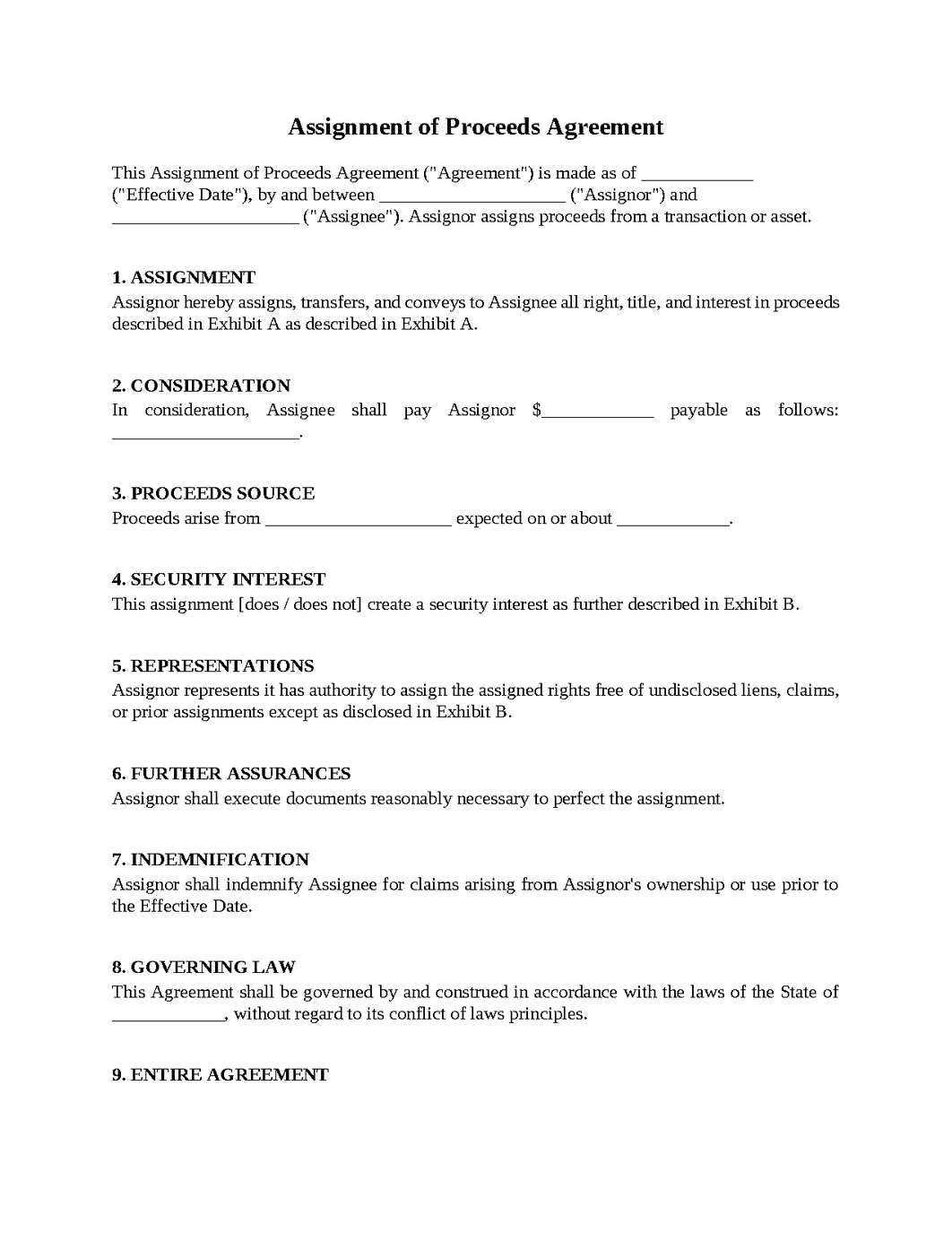
Assignment of Proceeds Agreement
An Assignment of Proceeds Agreement is a legal contract used when a person or business transfers the right to receive future payments, proceeds, or other financial benefits from a particular asset, contract, transaction, or event to another party. The party transferring the rights is known as the assignor, while the recipient is known as the assignee. Assignment of Proceeds Agreements are commonly used in construction projects, financing transactions, business sales, litigation settlements, insurance claims, government contracts, licensing arrangements, and commercial agreements. Because proceeds often represent future payments that have not yet been received, disputes can arise regarding ownership, timing, competing claims, payment administration, and the scope of the assigned rights. An Assignment of Proceeds Agreement helps establish who is entitled to receive the proceeds and under what circumstances the assignment applies.
The Payor Sends the Money to the Wrong Party
A commercial contractor is awarded a large municipal construction project that will generate several milestone payments over the next eighteen months. To obtain working capital, the contractor assigns the future project proceeds to a financing company.
The financing company advances funds based on the expectation that future payments will be directed to it when the project milestones are completed.
The arrangement appears simple.
Several months later, the city approves a major payment and issues funds directly to the contractor because the contractor remains the party listed in the original project documents.
The financing company is surprised when the expected payment never arrives.
The contractor insists the payment was received by mistake and promises to forward the funds. Meanwhile, accounting departments on both sides spend weeks reconciling records, and the city becomes frustrated by requests to correct payment instructions.
What should have been a routine financing transaction turns into an administrative dispute.
To help avoid this problem, an Assignment of Proceeds Agreement should clearly identify the proceeds being assigned, establish the effective date of the assignment, require notice to the payor, and specify what happens if funds are mistakenly sent to the assignor after the assignment takes effect. The agreement should also require the assignor to promptly deliver any proceeds received in error.
The Assignee Discovers the Proceeds Are Already Promised to Someone Else
A manufacturing company assigns future proceeds from a long-term supply contract to a lender in exchange for financing needed to expand operations.
The lender reviews the contract and believes the proceeds provide strong repayment support.
Several months after closing, however, the lender discovers that another creditor claims an interest in the same proceeds. Years earlier, the manufacturer pledged substantially all contract receivables as collateral under a separate financing arrangement.
The competing creditor asserts priority rights.
The lender is shocked.
From its perspective, it purchased or secured a valuable payment stream. Instead, it finds itself competing with another party that may have superior legal rights.
The disagreement quickly escalates into a priority dispute involving attorneys, lenders, and the manufacturer.
Collection efforts become delayed, relationships deteriorate, and transaction costs increase.
This problem occurs frequently because businesses often use the same assets and payment streams in multiple financing arrangements without fully understanding the consequences.
To reduce this risk, an Assignment of Proceeds Agreement should contain representations regarding prior assignments, security interests, liens, and competing claims. The agreement should require disclosure of existing encumbrances and provide remedies if the assignor's ownership representations prove inaccurate.
The Assigned Proceeds Never Materialize
A technology company develops software and negotiates a lucrative licensing arrangement expected to generate substantial future royalties. To obtain immediate capital, the company assigns a portion of the anticipated proceeds to an investor.
Both parties are optimistic.
The investor reviews projections showing significant future revenue. The company receives the cash it needs to fund growth.
Unfortunately, market conditions change.
The software fails to gain traction with customers. Licensing revenue falls dramatically below expectations. The proceeds that seemed virtually certain during negotiations never materialize.
The investor becomes frustrated and argues that the company's projections were unrealistic.
The company responds that business forecasts are inherently uncertain and that no guarantees were made regarding future performance.
The disagreement centers on expectations rather than wrongdoing.
This issue is common because assignments of proceeds often involve future events that neither party fully controls. Sales volumes, market demand, contract performance, regulatory approvals, and economic conditions can all affect whether proceeds are ultimately generated.
To avoid misunderstandings, an Assignment of Proceeds Agreement should clearly describe the source of the proceeds, disclose material risks affecting future payments, and specify whether any minimum recovery amounts are guaranteed. The agreement should make clear whether the assignee is assuming the risk that proceeds may never be received.
The Parties Disagree About What Counts as "Proceeds"
A business owner sells a product line and assigns the future proceeds associated with a key customer agreement to an investor.
Initially, both parties believe they understand the transaction.
Months later, the customer relationship expands.
In addition to making direct payments under the original agreement, the customer purchases additional services, enters into related contracts, and receives rebates that affect the overall economics of the relationship.
A dispute emerges.
The investor argues that all revenue generated by the customer should qualify as assigned proceeds. The business owner contends that only payments arising under the original agreement were included.
Neither side can point to language that clearly resolves the disagreement.
The ambiguity creates tension and increases the likelihood of litigation.
This problem occurs frequently because parties often assume terms like "proceeds," "revenue," "payments," or "receipts" are self-explanatory when they are not. Business relationships frequently evolve in ways that were not anticipated when the assignment was signed.
To prevent these disputes, an Assignment of Proceeds Agreement should define assigned proceeds with precision. The agreement should identify exactly which payments are included, whether related agreements are covered, how rebates and offsets are treated, and what happens if the underlying transaction changes over time.
The Assignor Settles for Less Without Telling the Assignee
A company assigns future proceeds from a commercial dispute to an investor that helped finance the underlying litigation.
The investor expects to receive a percentage of any future recovery.
As settlement negotiations progress, the company receives an offer from the opposing party.
Management believes the offer is reasonable and wants to resolve the dispute quickly. Without consulting the investor, the company accepts a settlement that is substantially lower than the amount originally expected.
The investor learns about the settlement after the agreement has already been signed.
From the investor's perspective, the company's decision significantly reduced the value of the assigned proceeds.
The company argues that it retained authority to settle the dispute and believed the agreement represented the best available outcome.
The disagreement quickly evolves into a dispute over control and decision-making authority.
Situations like this arise whenever assigned proceeds depend on negotiations, litigation outcomes, insurance claims, or other discretionary decisions.
To help avoid these conflicts, an Assignment of Proceeds Agreement should address settlement authority directly. The agreement should specify whether the assignor may compromise the underlying claim, whether assignee consent is required for certain decisions, and how reductions in anticipated proceeds will affect the parties' rights.
Future proceeds often represent valuable financial assets that can be assigned, financed, pledged, or sold for a variety of business purposes. However, because proceeds frequently depend on future events and involve multiple interested parties, ownership and payment disputes can arise unexpectedly. An Assignment of Proceeds Agreement provides a structured framework for documenting these transfers and clarifying expectations regarding ownership, payment rights, risk allocation, and decision-making authority. When drafted carefully, it can help reduce disputes, facilitate financing transactions, and provide confidence regarding who is entitled to receive future proceeds when they are eventually paid.
:::

Get started with Upsign today!
Easily send, sign and track your documents