

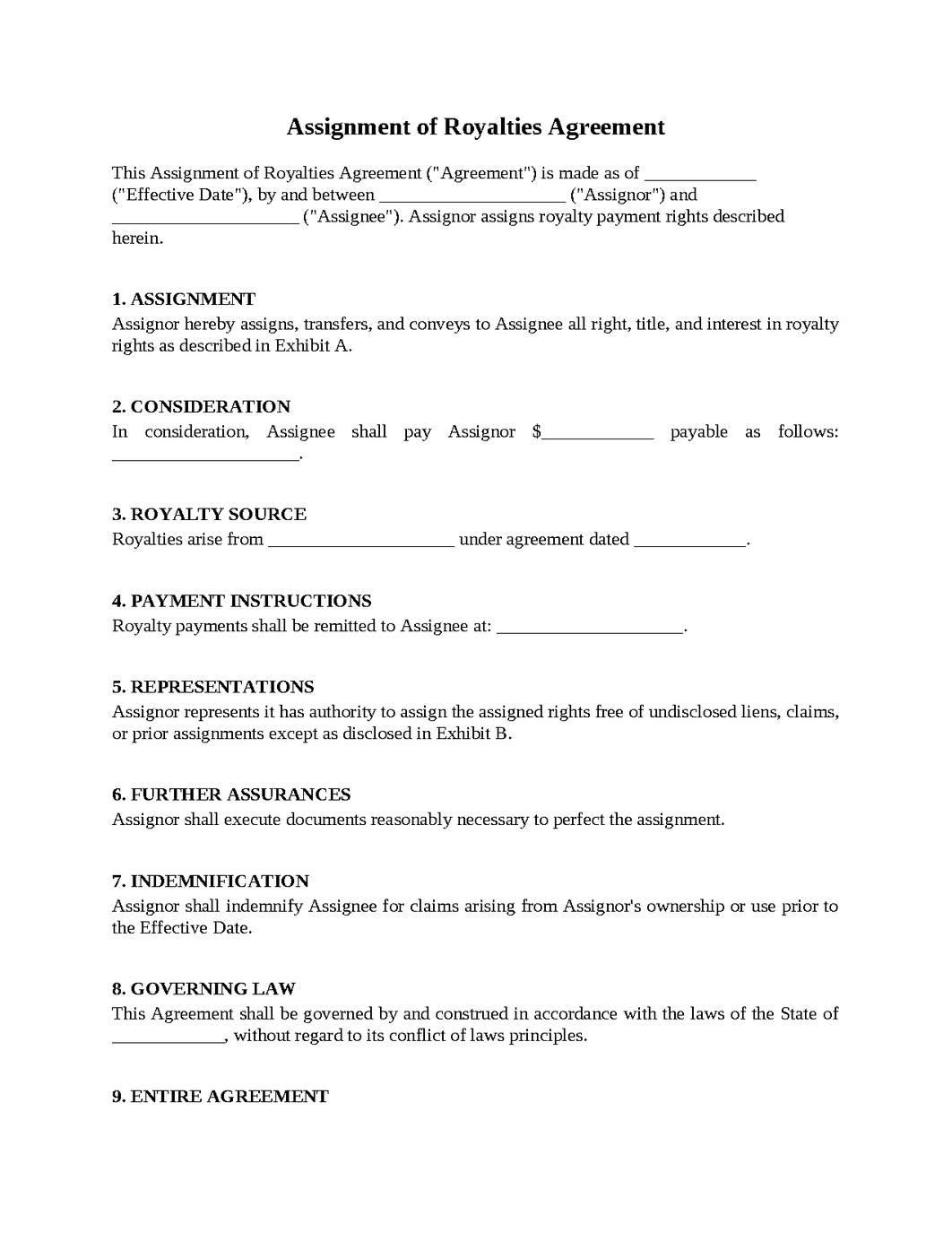
Assignment of Royalties Agreement
An Assignment of Royalties Agreement is a legal contract used to transfer the right to receive royalty payments from one party to another. The party transferring the royalty rights is known as the assignor, while the recipient is known as the assignee. Royalties can arise from a wide variety of assets, including patents, copyrights, trademarks, books, music, mineral rights, oil and gas interests, franchise arrangements, software licenses, and intellectual property licensing agreements. Businesses, investors, creators, authors, musicians, inventors, and property owners frequently use Assignment of Royalties Agreements to monetize future income streams, settle debts, facilitate estate planning, or transfer financial interests. Because royalty payments often continue for many years and may fluctuate significantly over time, disputes frequently arise regarding ownership, payment rights, valuation, and future obligations. An Assignment of Royalties Agreement helps establish who is entitled to receive royalty income and under what terms those rights have been transferred.
An Author Sells Future Royalties and Later Regrets the Decision
A business author publishes a niche industry book that generates modest royalty income during its first few years. While the book has a loyal audience, annual royalty payments remain relatively small.
When an investor approaches the author with an offer to purchase the future royalty stream, the proposal appears attractive. The investor offers a lump-sum payment that exceeds several years of anticipated royalties.
The author accepts.
At the time, the decision seems wise. The immediate cash can be used to pay off debt and fund other projects. The book appears unlikely to become a major commercial success.
Several years later, however, the book experiences an unexpected surge in popularity. Industry influencers begin recommending it, corporate training programs adopt it, and international licensing opportunities emerge.
Royalty payments increase dramatically.
The author realizes that the investor is now receiving income far exceeding the original purchase price. While the author remains proud of the work, the royalty stream no longer belongs to them.
Situations like this occur frequently because future royalty income is difficult to predict. What appears to be a modest asset today may become significantly more valuable later. An Assignment of Royalties Agreement helps ensure that both parties understand exactly what royalty rights are being transferred and whether any future participation rights remain with the original owner.
Two Parties Claim the Same Royalty Payments
A software developer licenses a proprietary application to several large customers. The licensing agreements generate recurring royalty payments that provide a steady source of income.
Several years later, the developer assigns the royalty rights to an investment group in exchange for a lump-sum payment.
Initially, everything proceeds smoothly.
Then one of the customers receives conflicting payment instructions. The developer continues communicating with the customer as if ownership of the royalty stream never changed, while the investment group insists that all future payments belong to them.
The customer becomes caught in the middle.
Unsure who is entitled to receive payment, the customer delays remitting royalties until ownership can be confirmed. Both sides become frustrated, and legal counsel is eventually involved.
Ownership disputes involving royalty streams often arise when assignments are poorly documented or when third parties are not notified of the transfer. Unlike physical assets, royalty rights may exist entirely on paper, making clear documentation especially important.
The consequences can be significant. Payments may be delayed, business relationships may suffer, and litigation costs can quickly exceed the value of the disputed royalties.
An Assignment of Royalties Agreement helps create a clear record of ownership and provides evidence that can be presented to licensees, payors, and courts if questions arise regarding who is entitled to receive future payments.
A Family Estate Contains Valuable Royalty Rights
A songwriter spends decades building a successful catalog of music. While none of the songs become global hits, they generate steady royalty income from streaming platforms, radio play, licensing agreements, and performance rights organizations.
When the songwriter passes away, ownership of the royalty interests becomes part of the estate.
The family quickly discovers that dividing royalty rights is far more complicated than dividing traditional assets.
Some heirs want to continue receiving future royalty income. Others would prefer to sell their interests immediately and receive cash. Questions emerge regarding ownership percentages, administration responsibilities, and who has authority to negotiate future licensing opportunities.
The situation becomes even more complex because royalties arrive from multiple sources and continue indefinitely.
Family members begin disagreeing about valuation, management decisions, and future strategy. What was intended to be a straightforward estate administration turns into an ongoing dispute.
Royalty interests frequently create challenges in estate planning because they represent continuing income streams rather than static assets. Their future value can be difficult to estimate, and multiple beneficiaries may have different financial goals.
An Assignment of Royalties Agreement can help facilitate transfers among heirs and establish clear ownership rights when royalty interests pass through estates or family succession plans.
A Lender Accepts Royalties as Collateral
A technology company owns several patented inventions that generate licensing royalties from manufacturers around the world. Seeking additional capital, the company approaches a lender for financing.
The lender agrees to provide funding but requires security for the loan.
Rather than pledging physical assets, the company offers a portion of its royalty stream as collateral. The parties structure an arrangement in which royalty payments will be assigned to the lender if certain conditions occur.
Initially, the transaction appears straightforward.
As the business grows, however, questions arise regarding which royalties are covered by the assignment, what happens if licensing agreements are modified, and whether future royalty streams are included in the arrangement.
The lender wants broad protection. The company wants flexibility to continue operating and expanding its licensing program.
Disagreements emerge regarding the scope of the assigned rights.
Royalty assignments are increasingly common in financing transactions because intellectual property often represents a company's most valuable asset. However, future royalty streams can be difficult to define and monitor.
An Assignment of Royalties Agreement helps clarify exactly what income has been assigned, under what circumstances, and how future royalties will be treated throughout the life of the transaction.
The Value of the Royalty Stream Changes Dramatically
A mineral rights owner receives royalty payments from oil and gas production on property owned by the family for generations. The payments fluctuate but generally provide predictable supplemental income.
An investment company approaches the owner and offers to purchase the royalty rights.
After reviewing historical production figures, both sides negotiate a price and complete the assignment.
For several years, the transaction appears fair.
Then market conditions change dramatically. New extraction technologies increase production, energy prices rise, and the property becomes significantly more productive than anyone anticipated.
The royalty stream grows substantially.
The original owner begins questioning whether the sale was wise, while the investor celebrates an unexpectedly successful acquisition.
In other situations, the opposite occurs. Production declines, prices fall, and royalty income becomes far less valuable than expected.
These outcomes highlight one of the most challenging aspects of royalty transactions: predicting future value. Royalties are often tied to uncertain factors such as market demand, technological developments, production levels, consumer behavior, and licensing opportunities.
An Assignment of Royalties Agreement cannot eliminate uncertainty, but it can clearly define the rights being transferred and help ensure that both parties understand the risks associated with future royalty performance.
Royalty streams can represent valuable and long-lasting sources of income, making them attractive assets for investors, creators, businesses, and property owners alike. Whether royalty rights arise from intellectual property, natural resources, licensing arrangements, or creative works, ownership transfers frequently raise questions regarding valuation, payment rights, estate planning, financing, and future income. An Assignment of Royalties Agreement provides a structured framework for documenting these transfers and establishing who is entitled to receive royalty payments going forward. When prepared carefully, it can help reduce disputes, facilitate transactions, and provide confidence regarding ownership of valuable royalty interests.
:::

Get started with Upsign today!
Easily send, sign and track your documents