

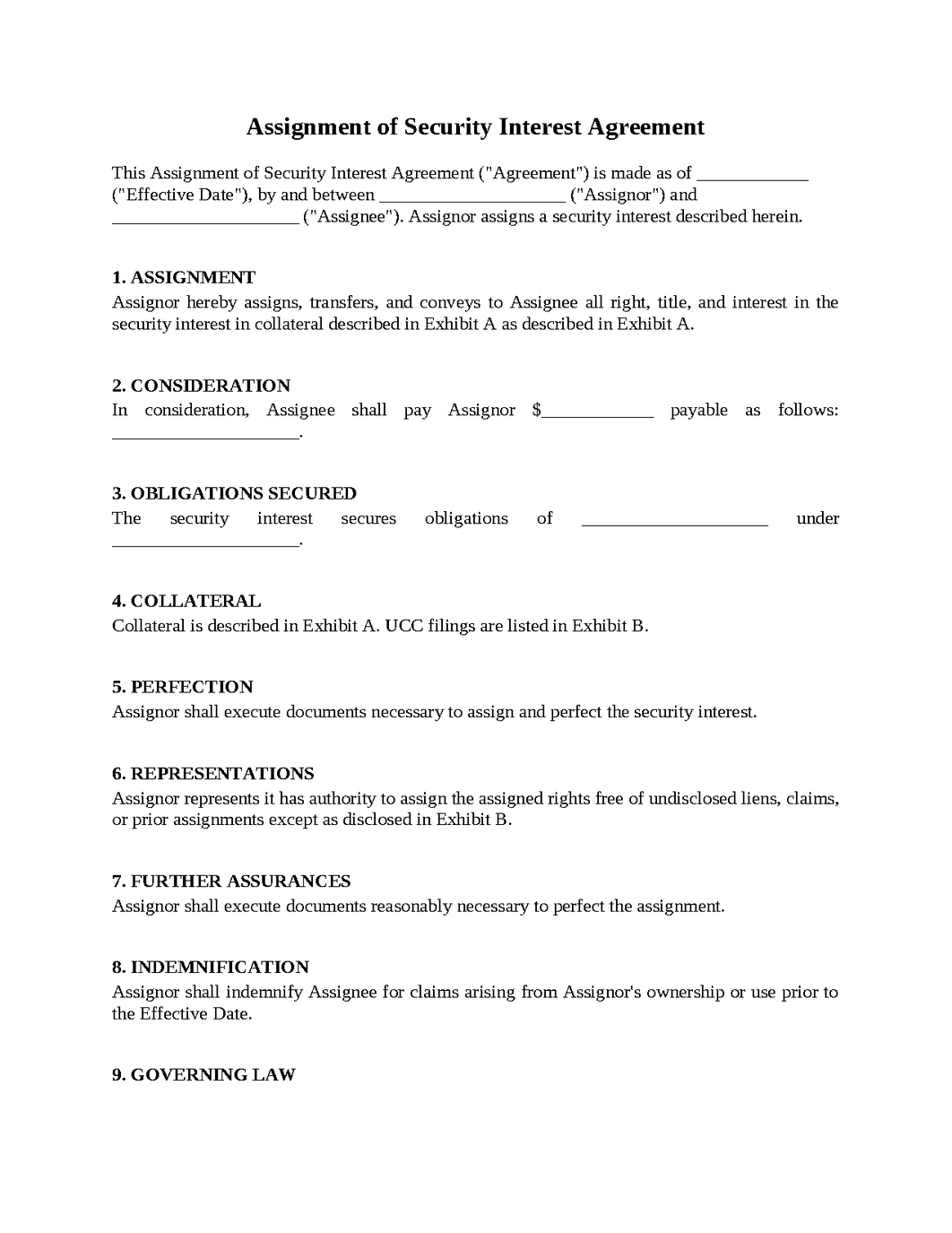
Assignment of Security Interest Agreement
An Assignment of Security Interest Agreement is a legal contract used when a party transfers its rights in a security interest to another person or entity. The party transferring the security interest is known as the assignor, while the recipient is known as the assignee. Security interests are commonly created when a borrower pledges collateral to secure repayment of a loan or other obligation. The collateral may include equipment, inventory, accounts receivable, vehicles, real estate, intellectual property, investment accounts, or other assets. Lenders, banks, finance companies, investors, and commercial businesses frequently assign security interests as part of loan sales, portfolio transactions, financing arrangements, restructurings, and acquisitions. Because the value of a security interest often depends on the ability to enforce rights against collateral, assignments can create significant legal and practical challenges if they are not documented properly.
The Loan Is Sold but the Security Interest Is Not Properly Assigned
A commercial lender originates a loan to a manufacturing company secured by all of the company's equipment and inventory. Several years later, the lender decides to sell the loan to an investment fund as part of a portfolio transaction.
Both parties focus heavily on the loan documents and purchase price.
The transaction closes, payments begin flowing to the new owner, and everyone assumes the transfer was completed successfully.
Two years later, the borrower defaults.
When the investment fund begins preparing to seize and liquidate collateral, its attorneys discover a serious issue. While the loan itself was assigned properly, the documents transferring the security interest are incomplete. Questions arise regarding whether the fund actually possesses enforceable rights against the collateral.
The investor is shocked.
From its perspective, purchasing the loan should have included all collateral rights automatically. Unfortunately, gaps in the transfer documentation create uncertainty at exactly the moment those rights become most important.
The resulting legal dispute delays enforcement efforts and increases collection costs.
To help avoid this problem, an Assignment of Security Interest Agreement should clearly identify both the underlying obligation and the collateral securing it. The agreement should reference applicable security agreements, financing statements, and related documents so that the assignee receives not only the debt but also the enforcement rights associated with the collateral.
A UCC Filing Is Never Updated
A regional finance company holds a security interest in a trucking company's fleet of vehicles. The security interest was properly perfected through Uniform Commercial Code (UCC) filings when the loan was originated.
Several years later, the finance company assigns the security interest to another lender.
The parties sign transfer documents and move on without much discussion regarding public filings.
Everything appears fine until the borrower experiences financial difficulties and files for bankruptcy protection. During the proceedings, attorneys review the public record and discover that the financing statements still identify the original lender.
Questions immediately arise regarding perfection and priority.
Other creditors begin arguing that the assignee failed to preserve its rights properly. The assignee insists ownership transferred years ago, but ownership and perfection are not always the same issue.
What should have been a strong secured position becomes vulnerable to challenge.
The assignee spends significant time and money defending rights that could have been protected more easily.
To reduce this risk, an Assignment of Security Interest Agreement should address post-closing filing obligations. The agreement should specify which party is responsible for filing amendments, assignments, continuation statements, or other documents necessary to preserve perfection and priority after the transfer.
Two Lenders Claim the Same Collateral
A construction company uses its heavy equipment as collateral for a series of financing arrangements.
At one point, a lender assigns its security interest to an investment group. Several months later, a separate transaction involving the same collateral creates confusion regarding ownership rights.
The issue remains unnoticed until the construction company defaults.
Suddenly, multiple parties claim rights to the same equipment. Each insists it has priority. Each believes it can seize and liquidate the assets.
The borrower is caught in the middle.
Auction plans are delayed while attorneys review security agreements, UCC filings, assignment documents, and payment histories. The value of the equipment begins declining while the dispute remains unresolved.
What should have been a straightforward enforcement process becomes a complex priority battle.
Competing claims frequently arise when security interests are transferred without adequate due diligence. Existing liens, subordinate interests, participation agreements, and prior assignments can all create unexpected complications.
To help prevent these disputes, an Assignment of Security Interest Agreement should contain representations regarding ownership, priority, existing liens, prior assignments, and competing claims. The agreement should also require disclosure of any known encumbrances affecting the collateral.
The Assignee Learns the Collateral Is Worth Far Less Than Expected
A lender assigns a security interest in a borrower's manufacturing equipment to an investment fund. The collateral schedule indicates that the equipment has a value of approximately $3 million.
The investment fund relies heavily on that valuation when negotiating the purchase price.
Several months later, the borrower defaults.
When the assignee begins evaluating the collateral, reality proves disappointing. Much of the equipment is outdated. Some assets no longer function properly. Several items listed in the collateral schedule have been replaced or disposed of entirely.
The actual liquidation value is a fraction of what was expected.
The assignee becomes frustrated and argues that the collateral information provided during the transaction was inaccurate. The assignor responds that values change over time and that the assignee had an opportunity to conduct its own inspection.
The disagreement quickly becomes contentious.
This issue is common because collateral values often fluctuate significantly between origination and enforcement. Market conditions, depreciation, damage, obsolescence, and borrower conduct can all affect value.
To reduce misunderstandings, an Assignment of Security Interest Agreement should clearly address representations regarding collateral condition, valuation assumptions, inspection rights, and the extent to which the assignee is relying on information provided by the assignor.
The Assignee Assumes It Has Immediate Enforcement Authority
A private lender assigns a security interest in a company's accounts receivable to an investment group. The borrower remains current on all obligations at the time of the assignment.
Shortly after acquiring the security interest, the investment group begins contacting the borrower's customers directly.
The borrower is alarmed.
Management argues that no default has occurred and that the assignee has no business interfering with customer relationships. The assignee believes ownership of the security interest grants broad authority over the collateral.
The disagreement escalates quickly.
Customers become confused when they receive communications from a third party claiming rights in the receivables. Business relationships begin to suffer, and tensions between the borrower and assignee increase.
The problem stems from a misunderstanding regarding enforcement rights.
Owning a security interest does not necessarily mean the secured party can exercise all remedies immediately. Those rights are often governed by the underlying loan documents and may depend on the occurrence of a default.
To avoid this situation, an Assignment of Security Interest Agreement should clearly define what enforcement rights are being transferred, when those rights may be exercised, and whether any conditions must be satisfied before the assignee can take action against the collateral.
Security interests are critical tools for protecting lenders and other creditors when extending credit or entering into commercial transactions. However, transferring those rights can create significant challenges involving perfection, priority, collateral value, competing claims, and enforcement authority. An Assignment of Security Interest Agreement provides a structured framework for documenting these transfers and preserving the rights associated with secured collateral. When drafted carefully, it can help reduce disputes, maintain priority positions, and provide assignors, assignees, borrowers, and future creditors with confidence regarding the ownership and enforceability of the security interest.
:::

Get started with Upsign today!
Easily send, sign and track your documents