

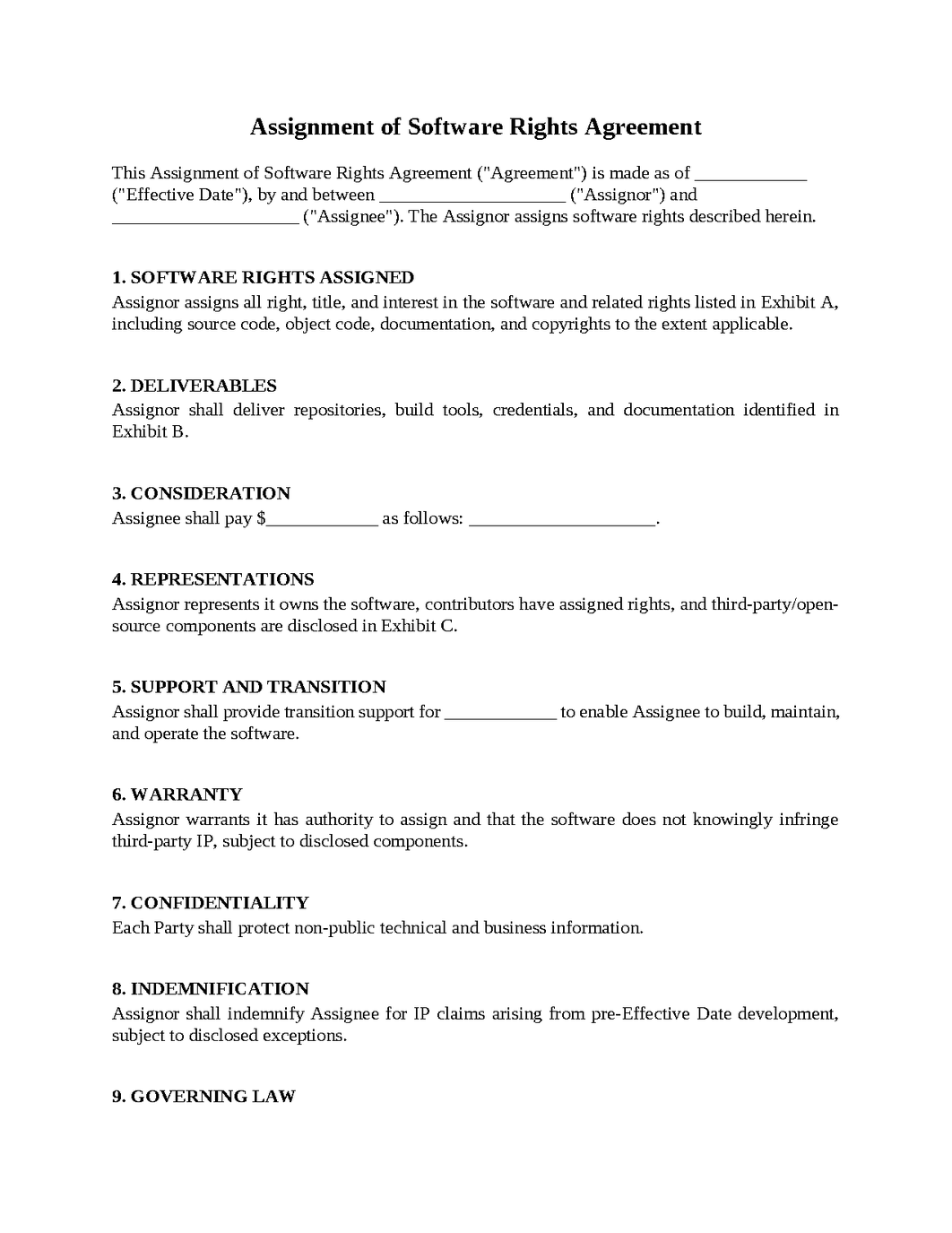
Assignment of Software Rights Agreement
An Assignment of Software Rights Agreement is a legal contract used when ownership rights in software are transferred from one person or business to another. The party transferring the software rights is known as the assignor, while the recipient is known as the assignee. Software rights can include source code, object code, copyrights, proprietary algorithms, databases, application programming interfaces (APIs), documentation, development tools, user interfaces, and related intellectual property. Assignment of Software Rights Agreements are commonly used in software development projects, startup acquisitions, contractor relationships, mergers and acquisitions, technology licensing transactions, business sales, and intellectual property transfers. Because software often represents one of the most valuable assets a company owns, disputes regarding ownership can significantly affect valuations, financing opportunities, acquisitions, and future business operations. An Assignment of Software Rights Agreement helps establish who owns the software and what rights are transferred as part of the transaction.
A Company Pays for Software Development but Never Receives Ownership
A logistics company hires an independent software developer to build a custom inventory management platform. The project takes nearly eighteen months to complete and costs hundreds of thousands of dollars.
The company pays every invoice promptly and assumes ownership of the software belongs to the business.
For several years, the platform becomes a critical part of daily operations.
Eventually, a larger competitor expresses interest in acquiring the company. During due diligence, attorneys request documentation proving ownership of all proprietary software.
Management confidently provides contracts, invoices, and payment records.
The buyer's attorneys identify a significant issue.
Although the company paid for the software, none of the agreements explicitly transferred ownership of the source code or associated intellectual property. Under applicable law, the developer may still own the software despite being fully compensated.
The acquisition immediately slows.
The company must locate the developer, negotiate additional documentation, and address concerns raised by the buyer regarding ownership certainty.
What seemed like a routine contractor relationship becomes a major transaction risk.
To help avoid this problem, an Assignment of Software Rights Agreement should clearly transfer ownership of all software-related intellectual property, including source code, object code, documentation, databases, interfaces, and related materials. The agreement should also require future cooperation if ownership verification becomes necessary.
Multiple Developers Claim Ownership of Critical Components
A technology startup develops a software platform using employees, contractors, offshore developers, and specialized consultants.
The project evolves rapidly over several years and eventually attracts significant investor interest.
During a financing round, investors conduct intellectual property due diligence.
Questions immediately arise regarding ownership.
One contractor claims ownership of a key module. An offshore development team argues that portions of the code were licensed rather than assigned. A consultant insists that certain algorithms were developed independently before becoming involved with the company.
Management is surprised.
The company assumed ownership was straightforward because all contributors were paid for their work.
Instead, attorneys must review years of contracts, development records, and intellectual property provisions to determine who owns what.
The uncertainty concerns investors and threatens the financing transaction.
Ownership disputes frequently arise when software is developed through multiple contributors working under different contractual arrangements.
To reduce these risks, an Assignment of Software Rights Agreement should identify the software being assigned, require ownership representations, address pre-existing code, and confirm that all necessary rights have been transferred from contributors. The agreement should also disclose any third-party ownership interests that could affect future use.
The Buyer Assumes the Source Code Is Included
A manufacturing company acquires a proprietary scheduling application from a software vendor.
The application performs well, and the buyer intends to customize it for future operational needs.
After closing, the buyer requests access to the source code.
The seller refuses.
According to the seller, the transaction transferred only executable software and certain usage rights. The source code itself was never included in the transfer.
The buyer is shocked.
From management's perspective, purchasing the software meant acquiring complete control over the technology. Without source code access, modifications become expensive and dependent on the seller's cooperation.
The disagreement creates operational challenges and delays future development plans.
This problem occurs frequently because software transactions often involve multiple layers of rights. Ownership of software may not automatically include source code, development tools, technical documentation, or proprietary libraries.
To prevent these disputes, an Assignment of Software Rights Agreement should specifically identify all assets included in the transfer. The agreement should address source code, object code, development environments, documentation, databases, APIs, technical specifications, and any other materials necessary to maintain or enhance the software.
The Seller Continues Using the Software After the Transfer
A software company sells a specialized business application to a larger competitor as part of an asset sale.
The buyer expects exclusive ownership of the software and related intellectual property.
Several months later, the seller launches a new business.
Although the software has been modified slightly, many of the core functions, interfaces, and workflows appear substantially similar to the platform that was sold.
Customers begin asking questions.
Some assume the businesses remain connected. Others are unsure who actually owns the technology.
The buyer becomes concerned that the value of the acquired software is being diluted.
The seller argues that it is simply applying experience gained during years of development.
The disagreement escalates into a significant legal dispute.
Software ownership transfers often create conflict when post-closing usage rights are not addressed clearly.
To reduce these risks, an Assignment of Software Rights Agreement should specify whether the assignor retains any rights to use the software after closing. The agreement should address derivative works, future development activities, license-back arrangements, and restrictions on creating substantially similar products that could undermine the value of the transferred software.
A Cybersecurity Incident Reveals Hidden Third-Party Dependencies
A private equity firm acquires a software company whose primary asset is a proprietary cloud-based platform.
The software appears highly valuable and generates recurring revenue from hundreds of customers.
Several months after closing, a cybersecurity review uncovers a problem.
Critical portions of the software rely on open-source components, third-party libraries, and external development tools. Some components are subject to restrictive licenses that were never disclosed during the transaction.
The buyer becomes concerned.
Future commercialization plans may be affected. Certain licensing obligations could require disclosure of source code or limit how portions of the software are used.
The value of the platform becomes less certain than originally expected.
Software frequently depends on third-party technologies that can affect ownership rights and future business opportunities.
To help avoid these issues, an Assignment of Software Rights Agreement should require disclosure of open-source software, third-party code, external dependencies, and licensing obligations. The agreement should also contain representations regarding the assignor's ownership rights and the absence of undisclosed restrictions affecting the software.
Software often represents one of the most important and valuable assets within a modern business. Whether software rights are transferred through acquisitions, contractor relationships, technology transactions, or intellectual property restructurings, ownership must be documented carefully. An Assignment of Software Rights Agreement provides a structured framework for transferring software ownership and clarifying expectations regarding source code, contributor rights, future development, licensing obligations, and post-transfer use. When drafted properly, it can help reduce disputes, strengthen intellectual property portfolios, and provide confidence regarding ownership and control of valuable software assets.
:::

Get started with Upsign today!
Easily send, sign and track your documents