

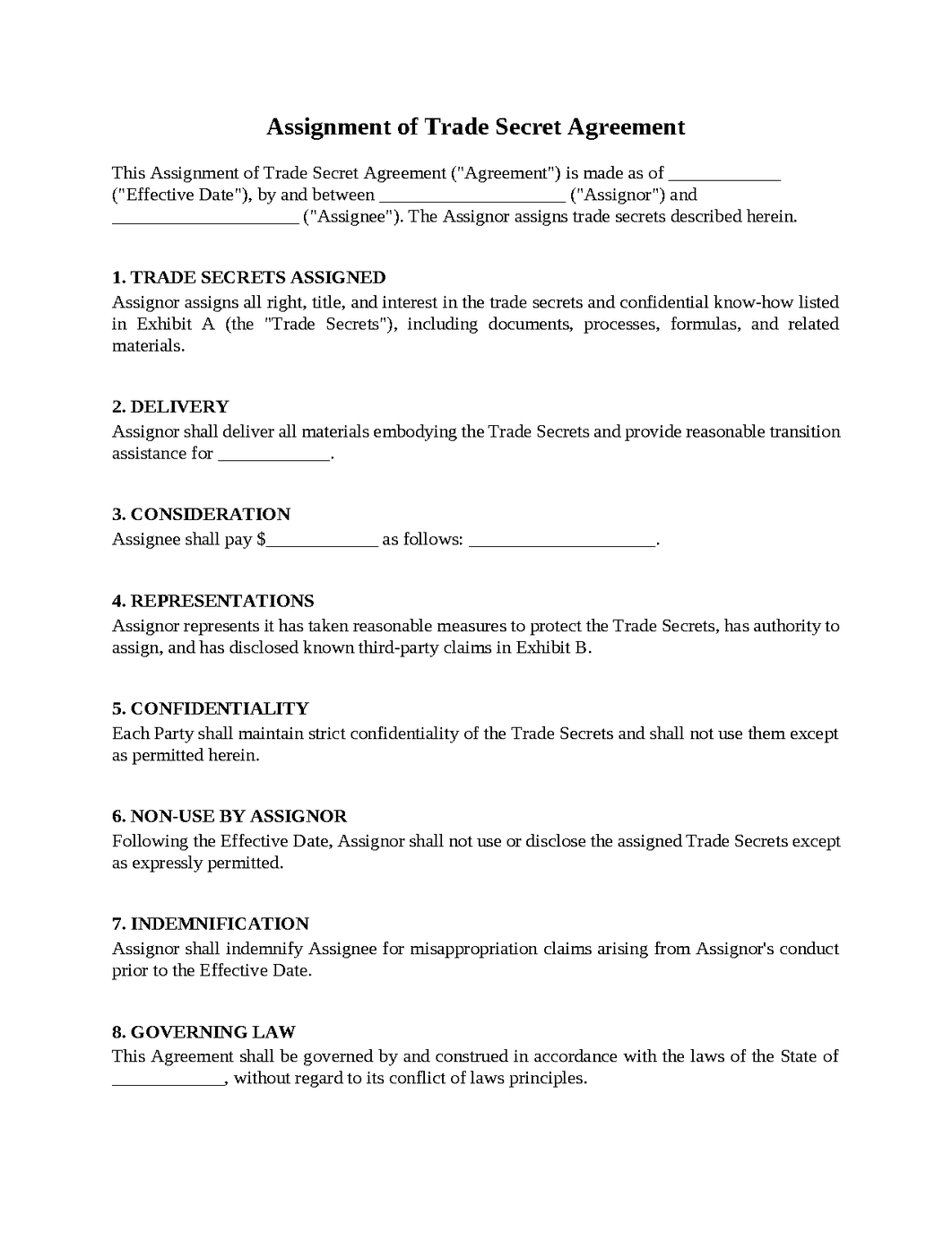
Assignment of Trade Secret Agreement
An Assignment of Trade Secret Agreement is a legal contract used when the owner of a trade secret transfers ownership rights in confidential business information to another person or entity. The party transferring the trade secret is known as the assignor, while the recipient is known as the assignee. Trade secrets can include proprietary formulas, manufacturing processes, customer lists, pricing strategies, source code, algorithms, business methods, research data, supplier relationships, product specifications, marketing techniques, and other confidential information that derives value from not being publicly known. Assignment of Trade Secret Agreements are commonly used in business acquisitions, technology transfers, employment arrangements, succession planning, intellectual property transactions, and corporate restructurings. Because trade secrets often represent a company's most valuable competitive advantage, ownership disputes can have substantial financial consequences. An Assignment of Trade Secret Agreement helps establish who owns the trade secret, what information is being transferred, and how confidentiality will be maintained after the transfer occurs.
The Buyer Discovers the Trade Secret Was Never Properly Protected
A specialty food manufacturer develops a unique production process that allows it to create products more efficiently than its competitors. Over many years, the process becomes one of the company's most valuable assets.
A larger competitor eventually acquires the business and expects to receive ownership of all associated trade secrets.
After closing, the buyer begins reviewing the company's confidentiality practices.
To its surprise, important weaknesses emerge.
Employees were never required to sign confidentiality agreements. Vendors received access to sensitive information without restrictions. Portions of the process were discussed openly with third parties during industry events.
The buyer becomes concerned.
A trade secret only remains a trade secret if reasonable efforts are taken to maintain its secrecy. The buyer now worries that the information may no longer qualify for legal protection.
The value of the acquisition begins to look very different than expected.
This situation occurs frequently because businesses often assume confidential information automatically qualifies as a trade secret without implementing appropriate safeguards.
To reduce these risks, an Assignment of Trade Secret Agreement should contain representations regarding confidentiality measures, identify the steps taken to protect the information, and require disclosure of any known breaches or unauthorized disclosures. The agreement should also obligate the assignor to assist with future efforts to preserve trade secret protection.
Employees Leave and Take the Knowledge With Them
A software company develops a proprietary algorithm that dramatically improves data processing speeds. The company later assigns ownership of the trade secret to an acquiring business as part of a strategic transaction.
The buyer assumes it has acquired everything necessary to use the technology.
Several months later, problems emerge.
The employees who originally developed the algorithm leave the company. Much of the operational knowledge exists only in their experience and has never been documented fully.
The buyer discovers that understanding the trade secret is far more difficult than expected.
Although ownership may have transferred legally, practical knowledge regarding implementation remains incomplete.
The former employees are unwilling to assist without additional compensation, and the buyer struggles to reproduce the expected results.
The value of the assigned trade secret declines significantly.
This issue is common because trade secrets often consist of both documented information and institutional knowledge. A transfer may technically assign ownership while leaving critical know-how behind.
To avoid this problem, an Assignment of Trade Secret Agreement should identify not only the trade secret itself but also any supporting documentation, training materials, operational procedures, and transition assistance required for effective use. The agreement should address knowledge transfer obligations and post-closing cooperation where appropriate.
Multiple Parties Claim Ownership of the Same Trade Secret
A biotechnology company collaborates with an outside research firm to develop a proprietary manufacturing process.
The project is successful and eventually leads to a valuable commercial product.
Years later, the biotechnology company assigns the trade secret rights to a strategic buyer.
During due diligence, however, the research firm asserts that it retains ownership rights in portions of the process because its scientists contributed to the development effort.
The buyer is surprised.
From its perspective, it is purchasing exclusive ownership of the trade secret. Instead, it discovers that ownership may be shared, disputed, or otherwise unclear.
The transaction becomes significantly more complicated.
Attorneys begin reviewing years of collaboration agreements, consulting arrangements, research records, and intellectual property provisions.
The uncertainty threatens the value of the entire transaction.
Ownership disputes are particularly common when trade secrets are developed through collaborative efforts involving contractors, consultants, universities, vendors, or joint venture partners.
To reduce these risks, an Assignment of Trade Secret Agreement should contain detailed ownership representations, identify all contributors, disclose third-party rights, and confirm that the assignor possesses the authority necessary to transfer exclusive ownership of the trade secret.
The Assignor Continues Using the Trade Secret After the Sale
A manufacturing company sells a valuable trade secret involving a specialized production technique to a larger competitor.
The buyer expects exclusive ownership.
Several months after closing, however, the seller launches a new business that appears to rely on many of the same confidential methods and processes.
The buyer becomes concerned immediately.
Although the seller insists it is merely relying on industry experience, evidence suggests the same trade secret information may still be in use.
Customers begin questioning whether the buyer truly acquired exclusive rights. Competitors hear conflicting stories regarding ownership.
The dispute escalates rapidly.
Unlike patents, trade secrets often depend heavily on confidentiality and exclusivity. Continued use by the assignor can significantly undermine the value of the transferred asset.
To help avoid these issues, an Assignment of Trade Secret Agreement should clearly prohibit unauthorized post-closing use of the trade secret, define any retained rights, address future improvements, and establish confidentiality obligations that survive the transfer. The agreement should also include enforcement mechanisms if unauthorized use occurs.
A Trade Secret Misappropriation Claim Raises Questions About Who Can Sue
A technology company acquires ownership of a valuable trade secret through an assignment transaction.
Several years later, management discovers that a former contractor may have improperly disclosed confidential information before the assignment occurred.
The company begins evaluating potential legal claims.
An important question quickly emerges.
Who owns the right to pursue damages for misconduct that occurred before the trade secret was assigned?
The buyer assumes ownership of the trade secret includes all related claims. The seller argues that historical claims remain with the original owner unless transferred explicitly.
The disagreement creates uncertainty regarding litigation authority, settlement rights, and potential recoveries.
Attorneys spend significant time analyzing assignment language and applicable trade secret laws.
The value of the potential claim depends heavily on the outcome.
This issue arises regularly because ownership of intellectual property and ownership of historical legal claims are not always identical. Past claims, future claims, settlement authority, and enforcement rights often require separate treatment.
To avoid these disputes, an Assignment of Trade Secret Agreement should expressly address enforcement rights, including ownership of past misappropriation claims, future claims, litigation authority, settlement rights, and recoveries arising from trade secret enforcement actions.
Trade secrets often represent some of the most valuable and sensitive assets a business owns. Whether they involve formulas, processes, software, customer information, manufacturing techniques, or proprietary know-how, ownership and confidentiality must be documented carefully. An Assignment of Trade Secret Agreement provides a structured framework for transferring those rights and clarifying expectations regarding confidentiality, ownership, enforcement, and future use. When drafted properly, it can help reduce disputes, preserve competitive advantages, and provide confidence regarding ownership and control of valuable trade secret assets.
:::

Get started with Upsign today!
Easily send, sign and track your documents